


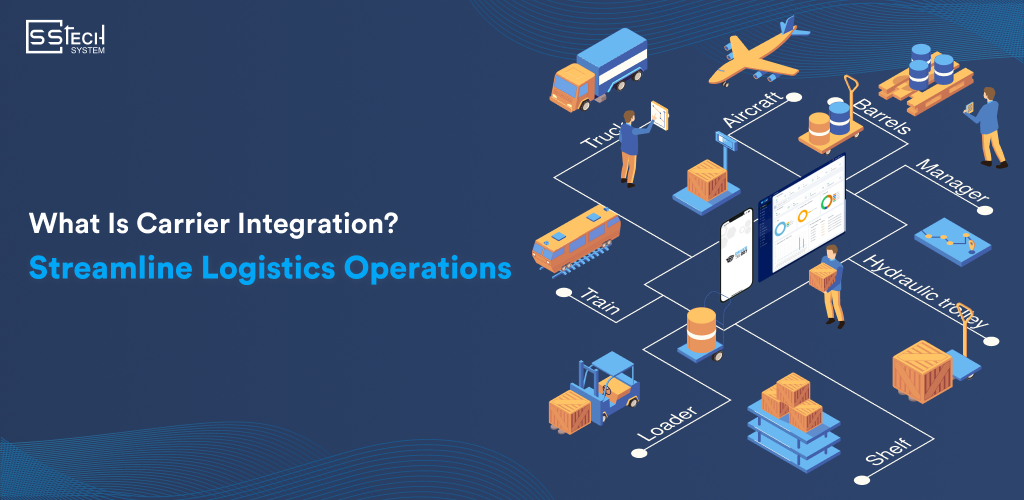
Logistics has become one of the most sophisticated operational functions in contemporary businesses. Previously a simple linear process, dispatch, transport, and delivery are now an extremely connected and multi-stakeholder ecosystem with shippers, carriers, warehouses, fulfillment centers, customers, technology platforms, and regulatory bodies.
Carrier integration solutions have become mission-critical requirements of this ever dynamic environment, and not an option anymore. As one of the backbones of international trade, the global logistics industry was valued at over 9.4 trillion euros in 2023.
Growing Complexity of Logistics and Transportation Networks
Today’s logistics networks operate across:
- Multiple geographies
- Domestic and international carrier networks
- First-mile, middle-mile, and last-mile delivery models
- Courier, freight, air, sea, and road transportation
The teams have to deal with freight carrier management, courier carrier integration, last-mile carrier integration, and cross-border carrier integration. And without automation, it is not easy to remove bottlenecks in logistic operations.
Isolated systems, carrier coordination via manual means, and disinterrupted communication channels result in:
- Operational delays
- Cost overruns
- Data inconsistencies
- Poor customer experience
This is where logistics carrier integration becomes the backbone of efficient logistics execution.
Rising Customer Expectations in the Digital Economy
Customer expectations have changed dramatically. Today’s customers expect:
- Faster order fulfillment
- Same-day or next-day delivery
- Real-time shipment visibility
- Accurate delivery timelines
- Seamless returns and digital proof of delivery
It is almost impossible to meet these expectations without the automation of logistics operations. Manual carrier processes can by no means keep up with the pace of contemporary logistics.
With the help of a logistics AI development company, businesses can achieve the capacity to streamline logistics operations, automate carrier processes, and ensure stable quality of service, despite increasing volumes.
Understanding Carrier Integration in Logistics
What Is Carrier Integration in Logistics?
Carrier integration is the process of integrating logistics platforms and the transportation carriers digitally via technology interfaces, like API, EDI, or file systems.
The global carrier integration software market is projected to reach USD 2.5 billion by 2033, exhibiting a CAGR of 12.7% during the forecast period (2023-2033). These integrations allow the logistics and carriers to communicate and exchange data automatically.
Practically, carrier integration enables companies to:
- Book shipments automatically
- Retrieve real-time tracking updates
- Generate shipping labels
- Calculate freight rates
- Capture proof of delivery
- Manage carrier performance
All carrier-related operations are handled in one centralized platform when deployed under shipping carrier integration solutions.
The Role of Carrier Integration in Scalable Logistics Operations
Integrating carriers is a very important part of logistics scalability. Manual processes become bottlenecks as the volumes of shipment rise. Carrier integration eliminates these bottlenecks through the automation of repetitive work and by standardizing workflows.
Through transportation carrier integration, businesses can:
- Onboard new carriers faster
- Handle seasonal demand spikes
- Expand into new markets
- Support omnichannel logistics models
This scalability is particularly needed when an enterprise is operating multi-carrier logistics integration in different regions.
Read more: The Role of AI in Revolutionizing Logistics App Development
Connecting Shippers, Carriers, and Logistics Systems
Carrier integration serves as a digital bridge between:
- Shippers and warehouses
- Courier and freight carriers
- ERP, WMS, and shipment management software
- Customer-facing delivery platforms
The logistics API integration enables all the systems to share information in real time, thereby maintaining accuracy, consistency, and transparency throughout the logistics lifecycle.

Carrier Integration vs Traditional Carrier Management
The old method of carrier management is very manual and siloed in nature, and involves human intervention. Logistics teams have to work with:
- Carrier emails
- Phone calls
- Multiple carrier portals
- Spreadsheet-based tracking
This approach leads to inefficiencies, delays, and higher operational risk.
Limitations of Traditional Carrier Management
Traditional methods result in:
- Slow booking cycles
- Limited shipment visibility
- High error rates
- Poor scalability
- Reactive issue resolution
The carrier integration software, on the contrary, offers real-time data access, automation, and centralized control.
Carrier Integration: A Modern Alternative
Businesses with carrier integration software use manual coordination with:
- Automated load tendering
- Real-time carrier tracking integration
- Centralized carrier dashboards
- Data-driven decision-making
Carrier integration enables the logistics to be a proactive and intelligence-based operation rather than a reactive operation.
The Role of Carrier Integration in End-to-End Logistics Operations
Connecting Logistics Systems into a Unified Ecosystem
Carrier integration enables seamless connectivity between logistics systems, including:
- Transportation Management System
- Warehouse Management Systems
- Courier Management Software
- Fleet Management Software
- Customer-facing delivery portals
By means of the transportation management system integration, the logistics teams receive one source of truth regarding all carrier operations.
Real-Time Data Exchange Across the Supply Chain
Carrier API integration and shipping API integration makes data flow between systems to continue. This enables:
- Live shipment status updates
- Automated exception alerts
- Dynamic ETA adjustments
Real-time data exchange is the foundation of modern logistics agility.
End-to-End Shipment Visibility
Real-time shipment visibility is one of the most useful results of carrier integration. Shipments can be tracked by the logistics teams and customers across:
- Pickup
- Transit
- Customs clearance
- Last-mile delivery
This visibility improves trust, reduces inquiries, and enhances service quality.
Centralized Carrier Coordination
Through multi-carrier shipping software, logistics teams can manage:
- Courier carrier integration
- Freight carrier integration
- Last-mile carrier integration
- 3PL carrier integration
Automated Logistics Workflows
Carrier integration enables logistics workflow automation, including:
- Automated carrier selection
- Rate comparison
- Label generation API usage
- Webhook-based carrier integration for status updates
Automation ensures consistency, speed, and accuracy.
Types of Carrier Integration Used in Logistics
API Integration
Carrier API integration is the most advanced and flexible integration method.
Real-Time Carrier Connectivity
APIs enable:
- Instant shipment booking
- Live tracking updates
- Rate calculation API access
- Automated documentation exchange
APIs support both domestic and international carrier integration, making them ideal for global logistics operations.
Common Logistics Use Cases
API integration is widely used for:
- E-commerce carrier integration
- On-demand delivery app solution
- High-volume shipping automation
- Enterprise carrier integration solutions
EDI Integration
EDI in Freight and Transportation
Electronic Data Interchange (EDI) has been in use in freight and enterprise logistics. It allows standard data sharing between big organizations.
When Logistics Teams Use EDI
EDI is commonly used for:
- Large 3PL carrier integration
- Freight carrier management
- Legacy carrier networks
While reliable, EDI lacks the real-time capabilities of APIs.
File-Based Integration
CSV and FTP Connections
File-based integration uses scheduled file transfers to exchange shipment data.
Limits of File-Based Methods
File-based methods:
- Lack real-time updates
- Require manual reconciliation
- Are difficult to scale
Read more: Why Your Business Needs a Smart Logistics Database Solution?
Key Logistics Operations Streamlined by Carrier Integration
Carrier Rate Management and Freight Cost Optimization
Carrier integration enables automated rate retrieval and comparison across carriers. This supports:
- Logistics cost optimization
- Better carrier selection
- Reduced freight spend
Businesses can reduce logistics costs while maintaining service quality.
Freight Booking and Load Tendering
With automated carrier operations, load tendering becomes instant and error-free. Capacity is secured faster, reducing delays.
Shipment Tracking and Delivery Visibility
Real-time carrier tracking integration provides continuous shipment updates, improving planning and customer communication. The India logistics market generated a revenue of USD 228.4 billion in 2024 and is expected to reach USD 357.3 billion by 2030.
Proof of Delivery and Freight Documentation
Carrier integration automates:
- Digital proof of delivery
- Billing documentation
- Compliance records
Business Benefits of Carrier Integration for Logistics Teams
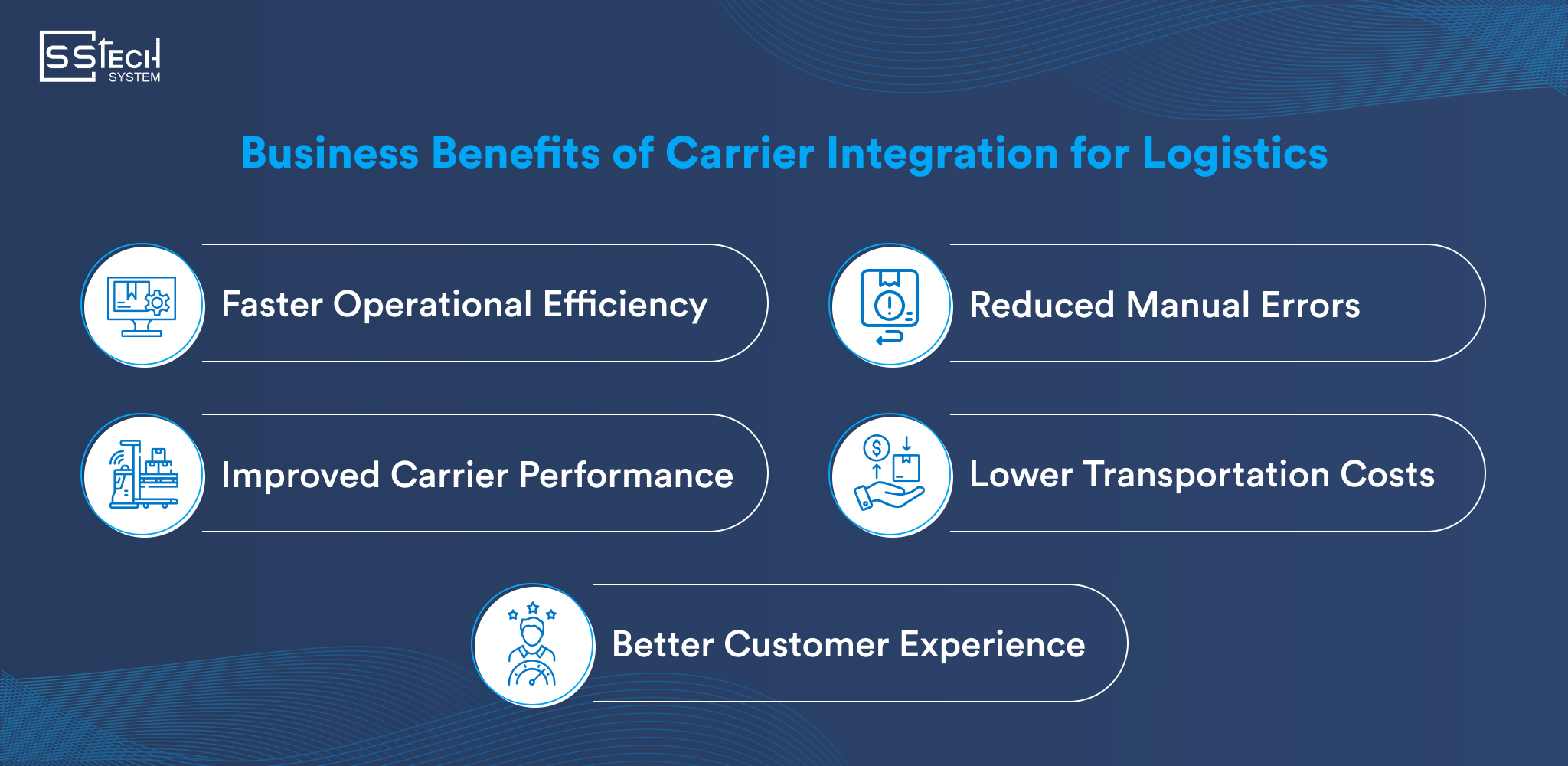
Implementing carrier integration software delivers measurable operational, financial, and customer-experience benefits for logistics teams. By replacing manual carrier coordination with automated, system-driven workflows, businesses gain efficiency, accuracy, and scalability across their logistics operations. So, always choose a logistics app development company to get the best carrier integration services.
Faster Operational Efficiency
One of the most immediate benefits of logistics carrier integration is improved operational speed. Automation removes time-consuming manual steps such as emailing carriers, logging into multiple carrier portals, and updating shipment details manually.
With logistics operations automation and transportation management system integration, tasks like carrier selection, booking, label generation, and tracking updates happen instantly.
Reduced Manual Errors
Manual data entry across disconnected systems often leads to incorrect addresses, wrong service selections, billing discrepancies, and shipment delays. Carrier integration software eliminates these risks by enabling direct, system-to-carrier data exchange.
Using shipping API integration and logistics API integration, shipment data flows automatically between internal systems and carriers. Improved data accuracy strengthens the reliability of shipment management software and enhances overall system trust.
Improved Carrier Performance
Carrier integration provides logistics teams with real-time visibility into carrier performance metrics such as:
- On-time pickup and delivery rates
- Transit delays
- Exception handling efficiency
Through centralized dashboards and analytics enabled by carrier management system tools, businesses can identify underperforming carriers, improve accountability, and make data-driven decisions. Over time, this leads to stronger carrier partnerships and better service quality across freight carrier management and courier operations.
Lower Transportation Costs
Carrier integration directly supports logistics cost optimization. Automated rate comparison and smart carrier selection ensure that shipments are assigned to the most cost-effective carrier based on service level, delivery speed, and destination.
With multi-carrier shipping software and carrier API integration, businesses can:
- Avoid overpaying for premium services
- Reduce manual negotiation overhead
- Minimize costly delivery errors and re-shipments
These capabilities help businesses consistently reduce logistics costs while maintaining delivery performance.
Better Customer Experience
Modern customers expect transparency and speed. Real-time shipment visibility, enabled through real-time carrier tracking integration, allows customers to track orders accurately and receive proactive updates.
When logistics operations are reliable and predictable, businesses naturally improve delivery efficiency and build long-term customer trust.

Carrier Integration for Different Logistics Models
The operational requirements in different logistics models are different. Carrier integration solutions will allow the flexibility to serve a variety of business models without complexity in operations.
3PL Operations
Managing Multiple Carriers
Third party logistics (3PL) firms handle the shipping of various clients with varying carrier preferences and service-level agreements. Integration of multi-carrier logistics integration helps 3PLs to interface with many carriers on a common platform.
With the enterprise carrier integration solutions, 3PLs are able to:
- Manage domestic and international carrier integration
- Balance capacity across courier and freight carriers
- Scale client operations without system fragmentation
Client-Specific Workflows
Each client possesses its own logistics processes, payment regulations and documents. Carrier integration provides 3PLs with the ability to build customer-specific flows using the same system.
Through integrating carrier solutions with logistics workflow automation, 3PLs are able to provide custom services to clients without creating a distinct system to the client, enhancing their efficiency and profitability.
E-commerce Logistics
High-Volume Shipping
The amount of transactions in e-commerce businesses is extremely variable particularly when there are sales events or high seasons. The e-commerce carrier integration allows the logistics staff to do thousands of shipments every day without any human involvement.
Automate carrier operations allow the businesses to handle large volumes of information with minimal time and error, which is vital in online retailing.
Last-Mile Carriers
The last mile is the most customer-facing and failure-prone stage of delivery. Last-mile carrier integration ensures smooth handoffs to local couriers and delivery partners.
With real-time tracking and automated updates, businesses can ensure faster, more reliable final deliveries while reducing customer inquiries and delivery failures.
Global Logistics
Cross-Border Carriers
Global logistics entails a number of international carriers, customs operations as well as regional regulations. Cross-border carrier integration eases these complexities by automated carrier communication and documentation flows.
Businesses have improved visibility and control of shipments everywhere, through domestic and international carrier integration.
Compliance Handling
Carrier integration automats the creation and exchange of customs documentation, invoices, and regulatory documentation. This avoids delays on clearance and penalties and promotes easy cross border operations.
Challenges in Logistics Carrier Integration
Though the advantages are so high, logistics carrier integration is not implemented without its challenges that should be met in a strategic way.
Carrier Technology Gaps
Not all carriers offer modern APIs or standardized data formats. Smaller or regional carriers may rely on legacy systems, making carrier API integration more complex.
To overcome this, businesses often use hybrid approaches that combine APIs, EDI, and file-based integrations.
Integration Complexity and Maintenance
The integrations of various carriers have to be kept under continuous monitoring, updating and troubleshooting. The carrier systems are undergoing changes and as they change, the integrations have to be kept to allow reliability and performance. This is further complicated with increase in carrier networks by businesses.
Data Accuracy and System Reliability
Data consistency is very important to carrier integration. Lack of appropriate standardization and validation can spread incorrect data to systems, which might impact on shipment tracking, billing and reporting.
Best Practices for Successful Carrier Integration in Logistics
To maximize the value of carrier integration, fleet management software development teams should follow software development best practices to get client-specific workflows in your software.
Prioritize High-Volume Carriers
Initiate integration with carriers that carry most of the volume of shipments. This provides quicker ROI and instant operational enhancements.
Choose Scalable Carrier Integration Software
Choose carrier integration software which allows expansion, multi integration options and expansion to new markets or models of delivery.
Standardize Data Formats
Consistent data formats ensure smooth communication across systems and carriers. Standardization is essential for reliable transportation management system integration.
Enforce Security and Compliance
Carrier integrations contain delicate shipment and customer information. There are robust security practices and standards of compliance that ensure trust.
Monitor Integration Performance Continuously
Monitor uptime, the accuracy of the data, and reaction durations to verify that integrations are working as desired and they can sustain business-related business processes.
How Carrier Integration Drives Logistics Scalability and Growth
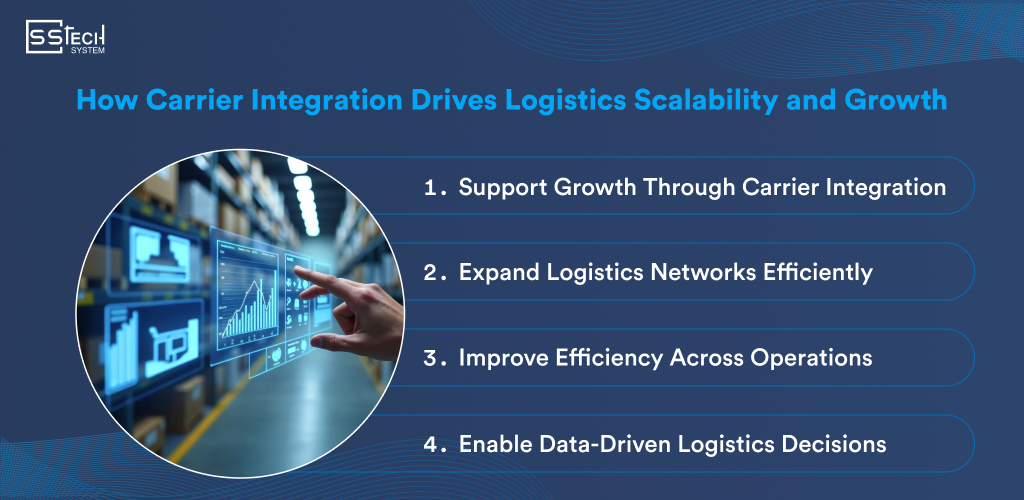
Scalability is one of the biggest challenges in logistics. As shipment volumes increase, carrier networks expand, and customer expectations rise, operational complexity grows rapidly. Carrier Integration Solutions act as a growth enabler by ensuring that logistics operations can scale efficiently without sacrificing speed, accuracy, or cost control.
Support Growth Through Carrier Integration
Traditional logistics models struggle to scale because growth often requires additional manpower, manual coordination, and fragmented systems. Logistics carrier integration changes this dynamic by enabling businesses to grow shipment volumes and carrier networks without proportional increases in operational costs.
Expand Logistics Networks Efficiently
As the business expands, it has to recruit new airlines to serve the region coverage, service level, and capacity requirements. Onboarding new carriers without integration is resource-intensive and time-consuming and prone to errors.
This scale of carrier networks is essential in businesses that work in the competitive and swift markets like e-commerce, 3PL services and international freight logistics.
Improve Efficiency Across Operations
Efficiency improvements are one of the most tangible outcomes of carrier integration. By eliminating manual coordination and disconnected systems, carrier integration software streamlines logistics operations end to end.
With transportation management system integration and shipment management software, logistics teams gain centralized control and visibility, allowing them to operate faster while maintaining consistency and compliance.
Enable Data-Driven Logistics Decisions
Carrier integration creates enormous sums of real-time operational data. This data can be used as a potent tool of decision-making when it is added to analytics and intelligence layers.
Future Trends in Logistics Carrier Integration
The future of logistics is highly digital, automated and intelligence-focused. The integration of carriers would keep on changing as the world supply chains redefine due to emerging technologies and business models.
Real-Time Carrier Connectivity
Always-on, real-time integrations will become the standard across logistics ecosystems. Businesses will increasingly rely on real-time carrier tracking integration to monitor shipments continuously rather than through periodic status updates.
API-First Logistics Platforms
API-first architecture is becoming the foundation of modern logistics platforms. Carrier API integration and shipping API integration will dominate carrier connectivity strategies due to their flexibility and scalability.
Predictive Shipment Visibility
Predictive visibility will go beyond tracking current shipment status. By combining historical data, real-time signals, and AI models, logistics systems will anticipate delays before they occur.
AI-Driven Carrier Insights
Machine learning will play a growing role in optimizing carrier performance. AI-driven systems will analyze patterns across carriers, routes, and service levels to recommend optimal shipping strategies.
Digital Freight Ecosystems
The logistics industry is moving toward fully connected digital freight ecosystems where shippers, carriers, platforms, and partners operate within shared digital environments.
Read more: How AI, Automation & IoT Are Redefining Logistics in 2026
Conclusion
The concept of carrier integration ceases to be a mere technical improvement, it is the keystone of modern logistics excellence. Companies which invest in logistics and transportation software development services will achieve automation, real-time visibility, scale and competitive advantage in the long term.
Carrier integration can start with e-commerce carrier integration and then last-mile carrier integration, then move on to 3PL carrier integration and international freight operations. Carrier integration enables logistics teams to work smarter, faster, and more efficiently.
Through the logistics carrier integration, transportation management system integration, and advanced analytics, companies will be able to transform the logistics process and address the needs of an increasingly interconnected world in the future.
Frequently Asked Questions
Carrier integration is a digital digitization method of linking the logistics systems to the carrier to automate the shipping business to include making a reservation, tracking, documentation, and rate change. It is the foundation of the contemporary automated logistics processes.
Carrier integration with route optimization software for logistics business enhances logistics with automation, visibility of shipment in real-time, cost optimization in logistics and scalable expansion. It minimizes the manual labor and enhances the reliability in operations.
The predominant approaches are API integration, EDI integration and file-based integration. The most scalable and flexible way of applying to the current logistics setup is API integration.
Carrier integration lowers the shipping costs through automation of rate-comparisons, carrier selection optimization, reduction of errors, and maximization of the efficiency of delivery in the logistics operations.
Contracting software development services specialists in the area of courier management software, fleet management software and transportation management system integration is the necessary solution since safe, scalable and future-proof carrier integrations, implementation risk and time-to-market is minimized.
Related Article