


Mobile technology has advanced rapidly, and mobile applications have ceased to be mere digital tools and are now becoming business enablers. Mobile apps are no longer optional touchpoints; they have become mission-critical platforms that dictate customer experience, efficiency of operations, and growth of revenues in industries in 2026.
Applications have become much more intuitive, adaptive, and intelligent with the development trends of new technologies that have been witnessed in mobile application development during the last several years.
Enterprises are spending more on the creation of bespoke mobile apps in order to provide a hyper-personalised experience, real-time interactions, and smooth online experiences. Due to the 5G network implementation being a momentum in the world, mobile applications will offer quicker performance, a visually realistic appeal, and interaction with no latency, as has never been experienced previously.
Mobile app development ideas for start-ups are transforming the nature and scale of business operations and performance, whether it be healthcare platforms that enhance patient outcomes, logistics apps that streamline last-mile delivery, or eCommerce apps that attract more conversions. The perception of these trends is no longer about keeping up with the times it is about remaining relevant.
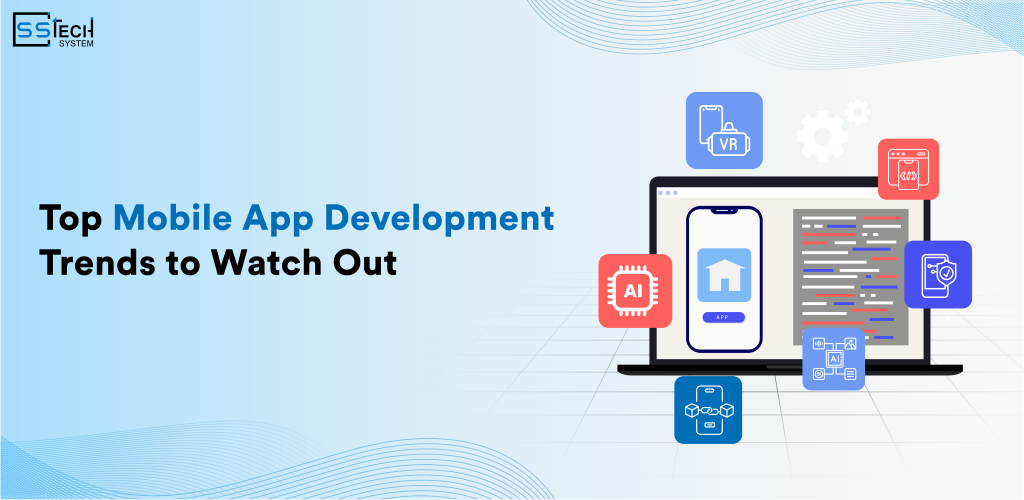
Top Mobile App Development Trends
The first point to make before discussing the best trends in mobile app development in 2026 is that app innovation is no longer technology-centric, as trends are now driven by industry-related issues and changing customer behaviour. The mobile applications that will be developed in the year 2026 will be vertically oriented and no longer based on a one-size-fits-all approach.
Keeping this in mind, it is time to discuss the top 10 smartphone app development trends that will influence the business in 2026.
Artificial Intelligence & Machine Learning in Mobile Apps
The current trend of utilizing AI and Machine Learning (ML) primarily transforms the healthcare mobile app by supporting the implementation of anticipatory, personalised, and preventive care models.
As opposed to conventional healthcare applications, which merely capture information, AI-powered healthcare applications actively respond to patient behaviour, medical history, and real-time health measurements to aid speedy clinical decision-making.
Statista reports that the global AI in healthcare market is expected to cross USD 180 billion by 2030. Healthcare apps have been turning toward on-device machine learning models in 2026, enabling sensitive patient information, including heart rate, glucose levels, sleep patterns etc, to be computed on-device rather than continually relying on the cloud.
Key AI Use Cases in Healthcare Apps
- Predictive analytics for early disease detection
- AI-driven symptom checkers and virtual triage
- Smart medication reminders based on patient behaviour
- Personalised care plans using historical health data
Generative AI Integration in Mobile Apps
The most recent advancement of eCommerce through mobile apps is the rapid adoption of generative AI to go beyond chatbots to fully automated customer and content-generating engines.
The global artificial intelligence in retail market size was estimated at USD 11.61 billion in 2024 and is projected to reach USD 40.74 billion by 2030. eCommerce apps in 2026 are already employing Generative AI to dynamically generate product write-ups, marketing copy, personalised deals, and even images, according to user preferences and browsing habits.
Generative AI models, unlike traditional rule-based systems, can learn from a large dataset of customer interactions and thus comprehend intent, context, and emotional signals in their apps. This enables the custom software development company to provide hyper-personalised shopping experiences that are dynamically adjusted and boost conversion rates and customer satisfaction.
Key Generative AI Use Cases in E-Commerce Apps
- AI-powered chatbots handling pre-sales and post-sales queries
- Automated generation of product titles, descriptions, and FAQs
- AI-driven personalised shopping assistants
- Smart upselling and cross-selling recommendations

Augmented Reality (AR) & Mixed Reality (MR)
Augmented Reality (AR) and Mixed Reality (MR) are transforming retail-focused mobile apps into immersive digital showrooms. According to a NielsenIQ survey, 56% of consumers reported that AR technology increases their confidence in a product’s quality.
As the survey reveals, AR technology is already a proven conversion booster in the retail apparel, furniture, beauty, and electronics sectors in 2026. Retail apps have become available to help people virtually wear clothes, accessories or make-up or see how furniture will fit into their real-life space.
Mixed Reality also supports collaboration, but through integration of digital objects and physical space to provide interactive product demonstrations and guided shopping.
Key AR/MR Applications in Retail Apps
- Virtual try-on for apparel, footwear, and cosmetics
- AR-based product placement for home décor
- Interactive product tutorials and demos
- MR-powered collaborative shopping experiences
5G-Enabled Mobile App Experiences
The international implementation of 5G networks is opening up a new era of mobile applications for logistics and last-mile delivery. Ultra-low latency and high data throughput of 5G provide the capability of real-time tracking, route optimisation, and real-time communication between drivers, the warehouse management system, and customers.
The 5G services market is estimated at USD 205.52 billion in 2023 and is projected to reach USD 497.24 billion by 2028. Milliseconds count in logistics AI app development. Latency in data synchronisation may lead to missed deliveries, ineffective routing, and negative customer experiences. 5G removes these constraints, so that real-time information can flow across the supply chain smoothly.
Key 5G Use Cases in Logistics Apps
- Live vehicle tracking with real-time updates
- AI-driven route optimisation
- High-quality video proof of delivery
- Real-time inventory synchronisation
Progressive Web Apps (PWAs) & Instant Apps
PWAs are beginning to sweep through local service providers and courier businesses, gaining immense popularity due to low development costs and instant access. PWAs provide app-like features in browsers, without the need for a full app installation.
Speed and accessibility are vital for hyperlocal and courier services. PWAs are loaded automatically, can work without connectivity, and use less storage, making them ideal for users in low-connectivity locations.
Key PWA Benefits for Service Apps
- Faster loading times
- Offline access for booking and tracking
- Reduced development and maintenance cost
- Cross-platform compatibility
Mobile Commerce Enhancements
The key improvements in mobile commerce will be at the center of the revenue gains that eCommerce businesses will make in 2026, helping increase revenue and enhance customer retention. As smartphones have become the main shopping tool in the world, eCommerce apps are being transformed into conversion-oriented, intelligent ecologies and not transactional platforms.
The current eCommerce mobile applications are now placed with frictionless checkouts and incorporate one-tap payments, digital wallets, buy-now-pay-later, and biometric authentication to decrease cart abandonment. According to Statista’s Market Insights, mobile e-commerce sales reached $2.2 trillion in 2023 and now make up 60 percent of all e-commerce sales around the world.
In addition to payments, applications are leveraging AI to customize home screens, product listings, and offers on demand based on the history and location of browsing, as well as intent to make purchases.
The other significant change is the implementation of AR-based product visualisation in eCommerce applications. They are able to test products, i.e, furniture, fashion, and accessories in the real world settings where customers can confidently purchase products and consequently reduce the rate of returns.
Key Mobile Commerce Enhancements in eCommerce Apps
- One-tap checkout with digital wallets
- AI-driven personalised product recommendations
- AR-based product previews and virtual try-ons
- Voice-enabled search and ordering
- Smart loyalty programs inside mobile apps

IoT & Connected Mobile Apps
Mobile applications that use IoT are radically transforming the field of healthcare, especially remote patient monitoring and chronic disease management. By 2026, healthcare apps will be more linked to smart medical devices, sensors, and monitoring equipment to provide real-time and uninterrupted health data with the help of trusted app developers.
The apps gather data on heart rate, blood pressure, glucose, oxygen saturation, and sleep patterns of devices linked to the applications. The global internet of things in healthcare market size was estimated at USD 44.21 billion in 2023 and is projected to reach USD 169.99 billion by 2030. The apps identify anomalies, forecast potential health risks, and notify patients and healthcare providers using AI-based analytics. This will enable timely intervention and avoid unnecessary hospital visits.
Medical apps that run on the logistics IoT solution are particularly useful in the treatment of chronic illnesses and post-surgical care. The patients will be able to heal at home and doctors will be able to monitor their progress remotely using mobile dashboards. The model enhances comfort for the patient and decreases the load on the healthcare software and app development infrastructure.
Key IoT Use Cases in Healthcare Apps
- Remote patient monitoring
- Real-time vital sign tracking
- Automated alerts for abnormal readings
- Integration with hospital systems and EHRs
Read more: How IoT Application Development is Transforming Smart Cities and Homes?
Enhanced Mobile App Security
Healthcare mobile apps are uncompromising in terms of security since confidential patient information has to be secured against theft and unauthorized access. By 2026, healthcare apps will implement security-by-design models that meet stringent data protection rules and ensure they retain patient confidence.
Modern healthcare apps incorporate biometric authentication, encrypted storage, secure APIs, and role-based access controls to safeguard patient data. These features ensure only authorized users access sensitive medical information. Simultaneously, AI-driven threat detection systems track suspicious patterns and prevent data leaks in real time.
Mobile apps are becoming the channel for accessing patient data with the advent of telemedicine and digital health records. Subsequently, designing apps with privacy priorities and adhering to multiple global healthcare regulations are key to developing a modern healthcare app.
Key Security Features in Healthcare Apps
- Biometric login (face and fingerprint recognition)
- End-to-end encryption of patient data
- Secure APIs for system integrations
- Compliance-focused data storage and access
Blockchain & Web3 Integration
The use of blockchain technology in logistics and the courier service’s mobile app is gaining traction in this field because they can increase transparency, trackability, and trust in complex supply chains. Later this year, in 2026, the logistics app development will incorporate blockchain to develop immutable delivery records and safeguard information exchange among stakeholders.
Blockchain logistics applications decentralize shipping by logging pickup, transit, and delivery data on a secure registry. This provides total transparency and eliminates data manipulation. By using smart contracts, the system automatically triggers payments and settles agreements upon delivery, effectively reducing overhead and conflict.
In the case of last-mile delivery solution delivery processes, blockchain enhances responsibility in that it allows a secure delivery record with undeniable proofs on time and location. This is particularly useful on high-value or sensitive shipments.
Key Blockchain Use Cases in Logistics Apps Features
- Transparent shipment tracking
- Smart contract-based delivery agreements
- Secure proof-of-delivery records
- Fraud prevention in courier operations
On-Device Computing & Edge AI
On-device computing and edge AI empower last-mile delivery and courier apps to make real-time decisions, even in low-connectivity areas. These apps store critical data directly on delivery devices instead of relying solely on cloud servers.
Edge AI enables features such as an offline route optimization solution, package scanning, delivery confirmation, and driver performance analysis without network delays. Edge computing reduces latency by up to 60% compared to cloud-only processing. Once connectivity is restored, data is synchronised with central logistics systems automatically.
It is a better method for enhancing reliability for delivery agents working in remote locations, highly populated urban areas, or high-mobility locations. It also improves the privacy of data as it does not transmit data continuously but stores sensitive data of operation in the device.
Key Edge AI Benefits for Logistics Apps
- Faster decision-making with low latency
- Reliable offline functionality
- Reduced network dependency
- Improved data security
Why Businesses Must Adopt These App Trends
New trends in end-to-end mobile app development services adoption are critical to the business. Mobile applications have evolved beyond simple digital touchpoints; they now serve as the foundation of business platforms that drive revenue, boost efficiency, and build customer trust.
Enhance Customer Engagement and Satisfaction:
The AI-based personalisation, AR, and real-time updates assist businesses in providing user journeys that are easier and more automated.
Improve Operational Efficiency and Productivity:
Automation, IoT, and Edge AI minimizes human-processing and error. It helps optimize routes and deliveries, monitor the patient, and manage inventory and orders.
Stay Competitive in the Market:
Companies that embrace new application technologies have a definite competitive edge. Quick performance, more intelligent features, and improved user experience are some ways brands can stand out in a saturated digital market.
Enable Data-Driven Decision Making:
The contemporary mobile apps gather and process real-time user and operational information. This allows the businesses to make sound decisions, enhance services, and forecast future demand more precisely.
Reduce Costs Through Automation:
The use of AI chatbots, automated workflow, and smart analytics helps to decrease the costs of operation by reducing the number of people involved and enhancing speed and precision.
Drive Innovation and Business Growth:
Future-ready apps open the door to new business models, services, and revenue streams, and ensure sustainable scaling of businesses.
Conclusion
As mobile technology evolves, companies must shift their perspective. Rather than treating mobile applications as temporary digital solutions, they should be regarded as long-term strategic resources. Ultimately, mobile apps represent the future of business operations, scale, and value in 2026.
Artificial intelligence, 5G connectivity, automation, blockchain, and edge computing are the trends that are transforming mobile experiences to be quicker, smarter, and safer. The businesses that embrace these mobile AI app development trends proactively are in a better position to meet customer expectations, regulatory requirements, and market competition.
Emerging mobile applications allow real-time interaction, operational visibility, and data-driven innovation, all of which are fundamental in sustainable growth. To pull up the full potential of these app trends you should find an app development partner for your start-up.
Modern mobile strategies foster digital ecosystems. As a result, businesses establish scalable foundations that ultimately deliver long-term success.

Frequently Asked Questions
AI-powered personalisation, 5G-enabled real-time experiences, AR-driven interfaces, automation, integration of blockchain, and data-driven apps intelligence are the top mobile app trends in the year 2026.
AI enhances mobile applications by making them intelligent through personalisation, predictive analytics, automatic customer care, and real-time decision-making.
The significance of 5G is that it provides ultra-low latency, a greater bandwidth, and a more secure connection. This enables mobile applications to facilitate real-time tracking, video streaming of high quality, AR experience, and real-time data synchronisation- particularly in logistics and healthcare applications.
Progressive Web Apps have rapid loading, offline support, and are cross-platform. They lower the cost of development and provide app-like experiences, being particularly handy in eCommerce platforms and logistics services that address large populations.
Blockchain will strengthen the security of mobile apps and ensure the establishment of tamper-proof records, decentralised data storage, and transparency of transaction tracking.
Mobile applications that are future-ready have AI-powered intelligence, robust security systems, scalability, offline, integration, and analytics. These characteristics make sure that apps are flexible, secure, and topical as technologies and demands of users change.
Related Article