


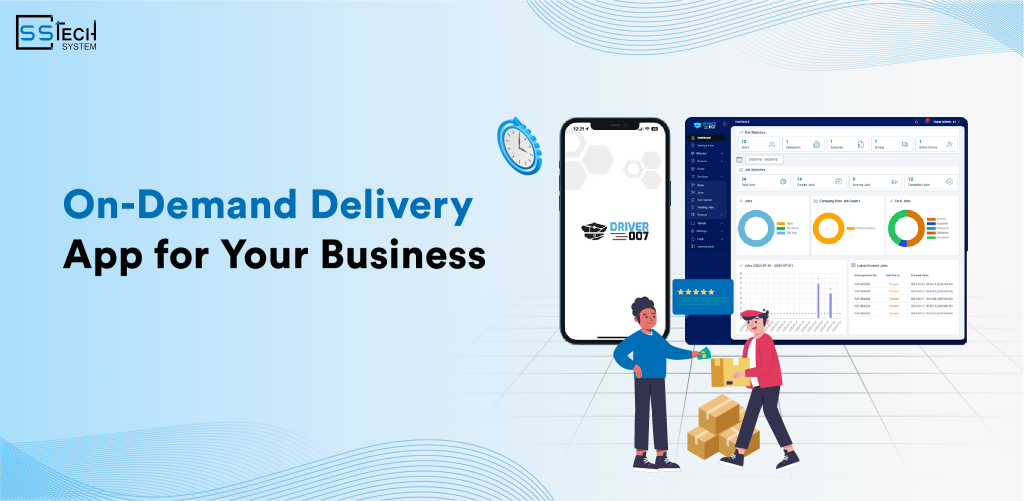
The on-demand economy has been gaining more popularity in the past few days. Of course, people use online shopping and order many things via smartphone. However, technology is growing, and everything will come at the fingertip. Today, consumers use the On-demand delivery app to get anything in a short time.
The main reason is the widespread Coronavirus worldwide. So, there is a sudden increase in on-demand apps. Likewise, business owners are keen on designing an On-demand delivery app for their successful business. In this blog, you will learn how to create an on-demand delivery app without trouble.
What is an on-demand delivery app?
The on-demand delivery apps allow customers to order products whenever, anytime. In a single app, customers shop for the goods they want to purchase. Of course, it is the most convenient and flexible online shopping option. You can explore more products to order with a single click with a single app.
Parts of on-demand delivery apps
If you are willing to design an on-demand delivery app for your business, you should develop an entire ecosystem. To make the platform work well, it includes parties and discovers an on-demand app for a successful business. The design of an on-demand app consists of 4 phases.
When you create an on-demand app, you must know about what are on-demand delivery apps to know:
- Customer app
- Restaurant app
- Courier app
- Admin panel
Of course, on-demand app designing includes various features. You must know the features first and design the app for your business.
Features of Apps that are On-Demand
With an On-demand delivery app, you have built-in speed/convenience and will always be able to see what is happening at each step of the way. Your delivery system design is supposed to come across instant, intuitive and a hallmark of perfect mobile ecosystem.
- Users receive immediate access to products and services
- Time-bound monitoring included in the delivery app experience
- The mobile-first interfaces that will streamline your on demand delivery app development process
- User paths flowing like a river built on solid delivery system design principles
- Personalisation according to user preference and consumption pattern
Market Size & Growth Trends Global & India
When you look to know how to make on-demand delivery app solutions, you will see the market is growing rapidly from huge global level and Indian region as well. This includes how most businesses, even Baas delivery services invested heavily in the latest tech and best-practice delivery system designs, driven by the transition to a demand for faster deliveries.
According to a 2023-2032 forecast, the global On-demand delivery market was valued at USD 15.19 billion in 2023 and is projected to reach USD 83.82 billion by 2032, growing at a CAGR of around 20.9%.
Another recent estimate values the global on-demand delivery market at USD 183.2 billion in 2024, with growth to USD 899.4 billion by 2033.
In India, hyperlocal delivery and quick-commerce are booming, one report finds the hyperlocal delivery market has been growing at an estimated CAGR of 51.84% between FY2021 and FY2025E.
On-Demand Delivery App vs E-commerce/Marketplace- What Are the Differences?
Once you put an On-demand delivery app in comparison with normal e-commerce, you understand the levels of expectations and outcomes are totally separated. Users expect fastness, live updates and instant fulfilment from their marketplaces and regular marketplaces just cannot achieve it.
- While the on-demand delivery app provides instantaneous deliveries, the e-commerce takes the scheduled or delayed shipping route.
- Unlike marketplaces, real-time driver tracking is at the heart of on demand delivery app development.
- Hyperlocal ordering with quick fulfilment vs e-commerce with broad product catalogues
- Routing, batching, assignment and optimisation needs advanced delivery system design
Continuous engagement and retention strategies more critical in how to build on demand delivery app solutions
Steps to design an on-demand delivery app (current Content)
Let us move on to the steps to successfully design an on-demand delivery app for your business:
Conduct market research
In the initial execution flow of an on-demand app, you must analyze and conduct market research. You have to understand the market and what customers need deeply. Apart from this, you must study your competitors carefully.
Creating a food delivery service must gather information about customer needs and trends. It would help to analyze the strong and weak sides while designing the on-demand delivery app for your business.
- Goals and mission of the company
- Target audience on service
- Fulfill the user needs and understand the importance
- How to monetize using the platform
Identify the target audience
When you create on-demand delivery apps for Android for your business, you must also know your targeted audience. Of course, the audience is significant for every business. To keep them in mind, you can create more personalized solutions and gain more users. An employee can connect with an account and pays for the ride for the delivery charge.
Each group has specific needs, and you must understand them in mind. While designing an on-demand delivery app for business, it has to examine the customers deeply. They usually order products with home delivery. So, your design must fulfill the delivery platform.
Apart from this, preparing a schematic portrait for your customers is exemplary. While designing an on-demand delivery app, entering a location, food preferences, orders, and more are essential.
Create a customer journey map
Customers are assured to check the delivery partner route and how they reach the doorstep. Hence, it includes lots of steps to connect with customers. Before designing an on-demand delivery app, you must develop a customer journey map.
It stands for the journey via the app from a user’s point of view. You must enter the delivery address and note it on the map and menu list. You must understand the app’s logic and design to use the maps conveniently.
The format of an on-demand delivery app includes the following points:
- Informing
- Ordering
- Delivery
- Receive
- Feedback
These are the basic ones to consider in mind about on-demand app design. It applies to all sectors, and the platform is the same for all with little changes.
Design and test prototypes
When you create an on-demand delivery app for business, you must understand the types of on-demand applications well. If you create a prototype of the service, the design must follow the prototype of the business need. It considers an interactive model which shows particular results as per the actions.
A prototype allows showing the products and concludes app designing. It will represent the app interface and functionalities while giving priority to users.
Develop an MVP version
The minimum viable product includes significant features and needs to take users with an essential fulfillment. Of course, MVP allows users’ feedback and updates by focusing on product expectations. Building an MVP on-demand food delivery app takes entering the market with a comprehensive solution.
You must prefer the best technology, and it must also be promising. For designing most on-demand delivery apps, web developers use flutters app development. With a single codebase, you can create cross-platform apps.
Selecting the right platform (Native or Cross Platform)
In case you are starting to build an On-demand delivery app, whether you choose a native or cross-platform development impacts the performance, cost, and scalability in the long run. Native apps afford you more device access as well as a more seamless experience but typically come with higher budgets and longer timelines to build out.
Cross-platform frameworks such as Flutter or React Native enable a unified codebase that helps you get up and running faster. Easier updating, reduced cost, and uniform UI, all perfect for when your delivery system design is aimed at both Android and iOS at once.
Core Features Chat List
The effectiveness of your on-demand delivery app development is determined by integrating superior features across customer, courier, and admin dashboards. Ordering should be speedy, instant tracking and payment need to be convenient, customers want it all; and couriers prefer easy routing, earnings tracking, and delivery assignment.
On the back end, your admin panel should have you covered with analytics, automated workflows, and complete control over orders, users, pricing, and delivery zones. Having this complete feature ecosystem gives strength to the entire skeleton of your delivery app.
UX/UI Best Practices For On-Demand Applications
Good UX/UI decides how seamlessly your users navigate through your On-demand delivery app. Mobile-first layout: Buttons, flows and interactions that make sense and are fast, especially if the user has to re-order from time to time or track their delivery in live time.
The inclusion of maps, visual statuses on the order status and live tracking of the driver boost trust and transparency. A design that combines simplicity with speed provides a way to sail over the friction with the end-user which in turn raises the bar for user satisfaction to a whole new level.
Testing & Launch Strategy
Test your delivery app with actual users in different devices and areas before releasing it. Beta testers reveal performance problems, edge-case bugs, and usability issues that internal teams will never encounter.
With a staged rollout (starting with a few regions), you can collect feedback, fine-tune your workflows, and reinforce your on-demand delivery app development. This iterative style mitigates risk and increases long-term retention.
Growth & Iteration After Launch
After your app goes live, growth becomes a function of your ability to track user behaviour and optimise experiences. With analytics you can see what features convert, where users drop off, and how your delivery system design will perform under spike loads.
This A/B testing of flows, screens and offers allows you to optimise for conversions over time. Regularly updating your feature roadmap/set of features keeps your On-demand delivery app updated, contemporary, and user-centric.
Main benefits of on-demand delivery apps:
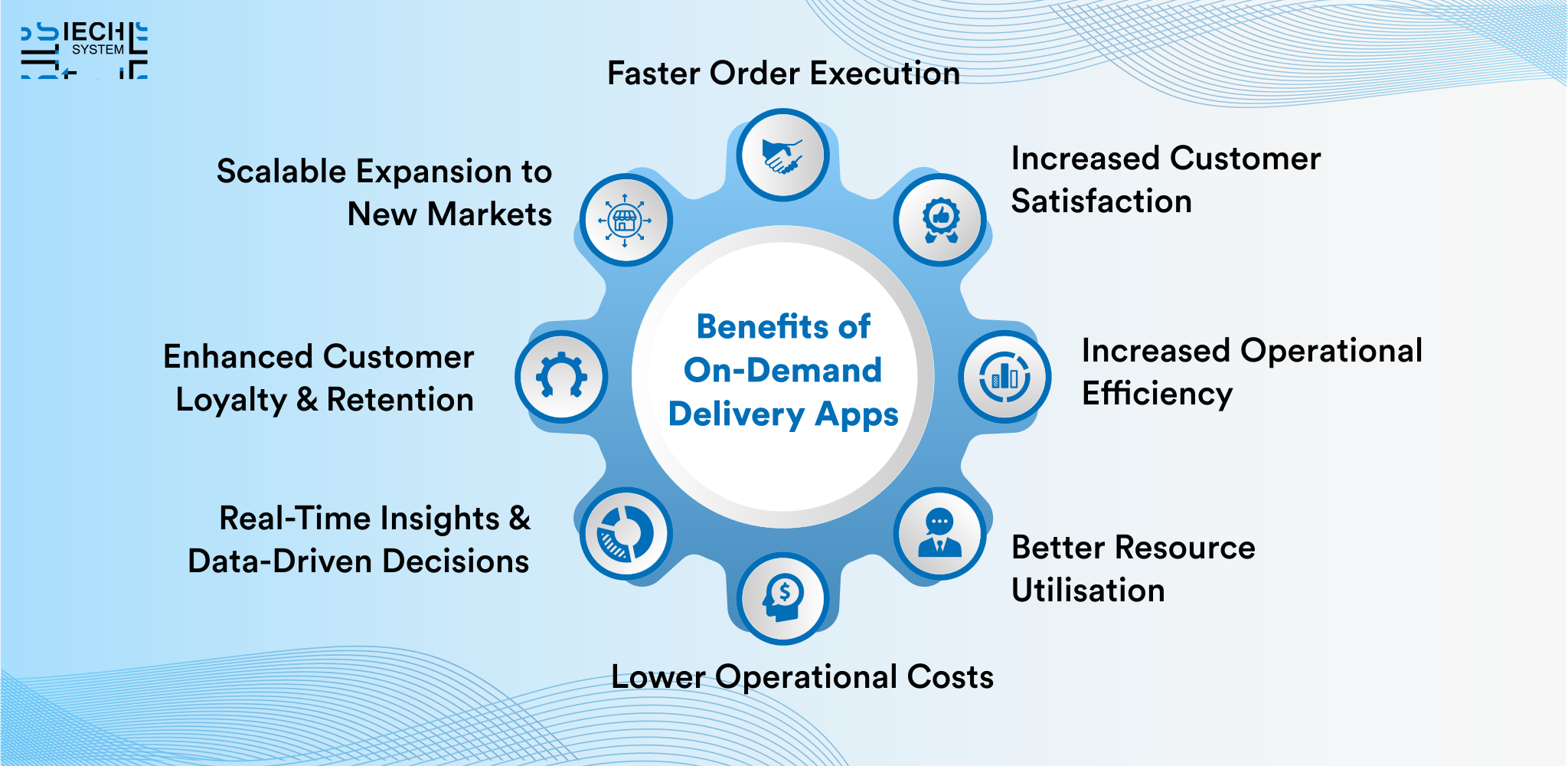
When you build an On-demand delivery app, you unlock a level of speed, convenience, and automation that traditional delivery workflows can’t match. Your customers expect real-time experiences today, and an app helps you meet those expectations instantly. From faster order fulfilment to improved operational visibility, here are many more benefits from delivery system design:
Faster Order Execution and Increased Customer Satisfaction
With the help of an On-demand delivery app, you streamline fulfilment and help your customers to minimise their waiting time. Faster deliveries with improved brand reputation and repeat purchases are made possible with features like real-time tracking, live updates, and automated routing.
Increased Operational Efficiency
Automation ends manual coordination and reliance on human decision making. With the ability to manage orders, drivers, payments and inventory in one dashboard, it makes your operations leaner, scalable and more manageable across multiple locations.
Better Resource Utilisation
By nice delivery system design, delivery routes, driver as well as vehicle can be optimally planned. This allows you to minimise the amount of fuel wasted, idle time and ensure that every single delivery run provides maximum value for your business.
Importance of Real-Time Insights & Data-Driven Decisions
In-built analytics in your delivery app provides you visibility into trends in order, peak timings, customer behaviour, and the efficiency of delivery. This data helps you in optimizing price, promotions, staffing, and service areas to strengthen your growth.
Lower Operational Costs
Operational costs are reduced, as you automate most of the workflows, eliminating the need for most call-centre coordination. The fuel, human, and delivery delay savings are realised in the long run, all from the real time route optimisation and automated dispatching.
Enhanced Customer Loyalty & Retention
By keeping its users engaged with personalised recommendations, loyalty programs, and consistent delivery experiences. By providing convenience and reliability, you ensure that clients are drawn to your service not just because of low prices but most importantly because uptime is what matters and there are no salesmen going around with pen-and-paper systems to offer services.)
Scalable Expansion to New Markets
Your on-demand delivery app development is scalable. Want to reach new delivery areas, onboard even more drivers or sell new products? The platform is flexible and can be adapted to the new situation without affecting previously adjusted operations.
How to monetize an on-demand delivery app?
After creating the best on-demand app, you must start earning income from the app. Using the appropriate monetization model includes plenty of strategies to choose from and ranges from general to specific keywords. Let us see in brief.
Delivery charge
This is the most common strategy to earn income for on-demand apps. When the customer orders the products, you must set a delivery charge. So, it gives a steady income on delivery charge income.
Fast delivery or express delivery charge
When customers hurry to get their products, you must set a price for the express delivery option. So, the services will reach customers faster as possible. During busy hours, you can unlock the offers for additional payment.
Ads and commissions from merchants
If you start a grocery delivery app, you must post some ads about the business. On the other hand, you must get a commission from the merchants who joined their company into your app.
App Security, Compliance & Data Privacy: What You Must Know
Encryption, encrypted APIs, Payments safe.
Every transaction within your On-demand delivery app itself should be backed by industry-leading encryption, tokenization and secure APIs. PCI-DSS compliant payment gateways safeguard your users with secure digital payments while your backend prevents breaches, fraud attempts, and unauthorised access to your entire delivery system design.
Privacy Policy, Obtaining user consent, GDPR/ India personal data laws
Having a clear privacy policy ensures that people know how their data is being collected, stored, and used. It is advisable that you add explicit user consent screens in your app, and develop your on-demand delivery app in compliance with GDPR, India Digital Personal Data Protection Act (DPDP) and global compliance standards to mitigate any legal liabilities and ensure long-term trust.
Know your customer (KYC) for drivers and merchants, including background checks
Verification of all delivery drivers and merchants through KYC checks to ensure safety on the platform. Background checks build trust, eliminate fraud incidents, and keep the ecosystem safe, which is an undeniable feature when your consumers rely on your delivery app for safe pickups and doorstep arrangements.
Dealing With Consumer Complaints, Getting in Apple and Play Stores
This one shall work towards the second half of the journey as well – implementing a structured complaint-resolution system shows users that you care about their experience. Satisfying the compliance guidelines of enterprise app stores is at the core of the app publishing processes, especially for Google Play Store and Apple App Store, where security, functionality, and permission aspects are strictly checked and privacy and permission disclosures are mandatory for the approval of the apps and to minimize the risk of suspension.
Trust (ratings, reviews, transparent traceability)
When doing business with an On-demand delivery app, trust becomes the most successful factor. Providing clear tracking, real-time updates and a tendencies-evaluating and authentic ratings-and-reviewing ecosystem makes users comfortable. If the customers can track the drivers, view the quality of service and give feedback, naturally your brand credibility and retaining customers will all increase.
How to Develop An On-Demand Delivery App?
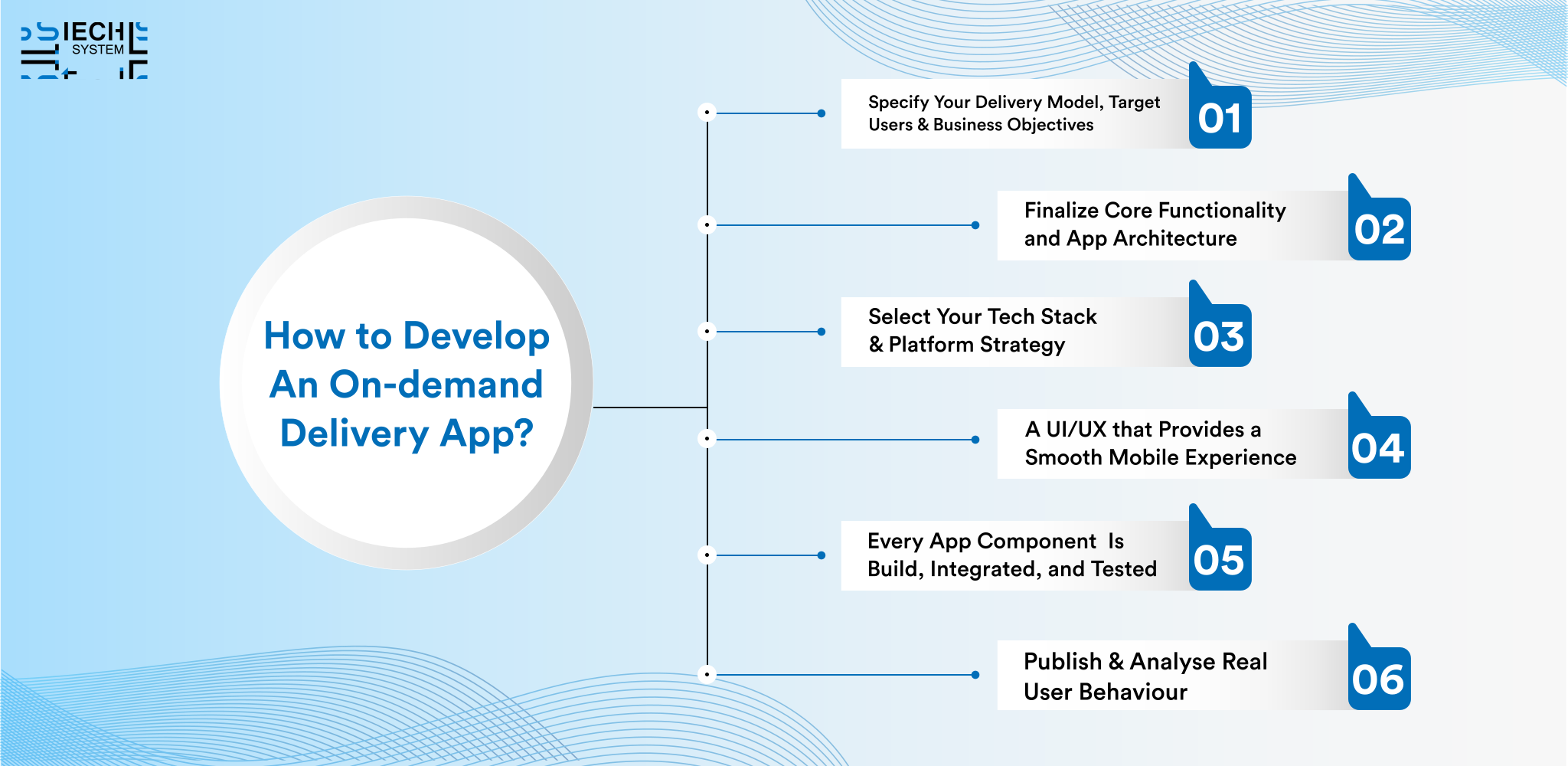
Designing a delivery system, confirming your supply of delivery personnel and ensuring UX and strategy helps to get an app for delivery that gets you conversion and growth at the same time. Follow this step-by-step process to build yours.
Specify Your Delivery Model, Target Users & Business Objectives
The first stop on how to make on demand delivery app is to identify whether you want to prepare food delivery, grocery, courier, pharmacy, or multi-category. Features and workflows are set by clear positioning.
First, identify your main user personas: customers, drivers, merchants and admins. Knowing their journeys, you carve a custom delivery app experience that not only meets the expectations but continues to bridge long-term retention.
Finalize Core Functionality and App Architecture
Having features like ordering, tracking, payments and notifications, is just one side of the coin when it comes to on demand delivery app development, the other side being sheer backend architecture. It forms the foundation of your app in terms of speed and reliability.
Map out modules for customers, drivers, vendors, and admins. Add features such as real-time tracking, route optimisation, automated dispatching, and secure payment flows. If your delivery system is well designed, it makes sure that your operation can run smoothly from day one.
Select Your Tech Stack & Platform Strategy
Choosing your native, or cross-platform tech stack makes or breaks your performance in the long term. Native apps are fast while cross-platform apps save money and reduce the development time considerably.
Use cloud-based architecture, secure APIs, and GPS-enabled services for scalability. Your on-demand delivery app tech stack should handle millions orders, high concurrency, and live tracking along with processing of fast data.
A UI/UX that Provides a Smooth Mobile Experience
By adopting a mobile-first interface, your users are also able to browse, order, track, and communicate without hassles. When navigation is simple and fewer steps the completion percentages up and friction reduces.
Your delivery app becomes a lot more dependable with smooth deliveries from the driver end with simple task screens and map visibility and status updates which keep all the stakeholders in the loop and make sure there are no delays in the process.
Every App Component Is Build, Integrated, and Tested
Development starts with coding your frontend, backend, APIs, and admin portal. Integrate secure payment gateways, maps, geolocation tools, notification engines, etc.
It is tested over many devices and it works smoothly on all devices. Everything from edge-case tracking to payment failures is handled by rigorous testing to make your on-demand delivery app development stable and launch-ready for the public.
Publish & Analyse Real User Behaviour
Deploy an MVP to a limited audience, and then scale from there depending on reviews. This allows the identification of user challenges and operational gaps through real-time analytics.
Identify delivery system design improvements based on customer reviews, driver feedback, and performance metrics. Continuous improvement can help you to scale fast and compete effectively.
Comparing Different Hiring Models: Freelancer vs In-House vs Outsourcing Development
Here’s a detailed comparison between the different hiring models that can help you make an informed decision:
| Hiring Model | Advantages | Disadvantages | Cost Range | Best For | Other Key Features |
|---|---|---|---|---|---|
| Freelancer Developers | Low-cost hiring, flexible engagement, ideal for small tasks and quick prototypes. | Limited accountability, inconsistent quality, no long-term availability, not suitable for complex On-demand delivery app systems. | ₹30,000 – ₹1,50,000 per module depending on expertise. | Small businesses, simple features, temporary tasks. | Great for UI tweaks, bug fixes, or small upgrades but risky for full delivery system design. |
| In-House Development Team | Full control over development, easy communication, strong alignment with company goals, fast iteration cycles. | High salaries, infrastructure costs, hiring delays, and skill limitations when building advanced delivery app features. | ₹20–50 lakhs yearly for a small team of 3–5 developers. | Large companies, brands building long-term tech IP. | Best for continuous product development, but expensive for early-stage on demand delivery app development. |
| Outsourcing Development (Agencies/Tech Partners) | Access to full teams (UI/UX, backend, QA), predictable cost, faster delivery, scalable resources, expertise in how to build on demand delivery app. | Dependency on vendor quality; requires proper communication and milestone management. | ₹5–25 lakhs for MVP; ₹25–60 lakhs for enterprise-grade apps. | Startups, SMEs, enterprises needing fast, reliable build. | Offers complete delivery system design, long-term support, cloud setup, real-time tracking systems, and scalable architecture. |
If you’re building a sophisticated On-demand delivery app with real-time tracking, automated dispatch, and multi-role dashboards, outsourcing to an experienced tech partner is usually the most cost-effective and fastest route. Freelancers are good for minor tasks, and in-house works best once your app is mature and needs continuous iteration.
Cost Breakdown & Timeline- How Much Time and Budget Does It Require?
Cost elements
Your final investment in UI/UX design, frontend development, backend architecture, API integrations, QA testing, and deploying the app. Not only does each stage affect the performance, scalability, and user experience but you also need to ensure that you create the On-demand delivery app at the right price possible with the best quality.
For India, mid-market vs enterprise; example budget ranges
MVPs may start at ₹3–6 lakhs in India, mid-market apps will cost ₹8–25 lakhs and enterprise-level solutions, often going beyond ₹40 lakhs. Custom routing engines, others may require real-time tracking, extensive automation, or advanced delivery system designs, which elevate the costs.
Phases on the timeline
Click-through prototype → 1–2 weeks MVP → 6–10 weeks depending on features. The full launch and scaling could take up to 3–6 month to get the workflows in shape, add modules, increase stability, and optimise your delivery app.
There are hidden costs
However, do not forget that there are recurring costs to support your application too: server hosting, bug fixing, feature updates, app store fees, compliance changes. On-demand delivery app development, especially during the early stages of traction, often leads to high costs overshadowed by slower bursts of marketing, more user acquisition, and the subsequent driver onboarding issues.
Cost-Control
We can Help you in bringing down the cost drastically by choosing open sources libraries, cross-platform framework and modular architecture. A phased rollout– an initial MVP followed up by advanced features– lets you optimise investment and scale your app without blowing your budget.
Case Studies & Success Stories – Real-World On-Demand Delivery Apps
DoorDash
As of now, DoorDash has a little over 68% of U.S. food delivery market share.
According to the report, DoorDash processed billions of orders on its platform over 2024 while continuing both food and non-food delivery expansion globally.
With this scale, you can see what a great design with an on-demand delivery app can do in an otherwise crowded market.
Uber Eats
Too, Uber Eats still ranks as one of the largest single-app global delivery services, if you exclude China.
By the year 2024 Uber Eats had approximately 1,000,000 restaurants available worldwide (in complete growth from 80.000 in 2017).
If as an entrepreneur you wish to learn how to build on demand delivery app, Uber Eats showcases the potential of leveraging existing infrastructure(ride-share + delivery) and scaling it across geographies in no time.
Grubhub
In a 2024 dataset, Grubhub still had a sizeable footprint in the U.S., though they were behind DoorDash and Uber Eats; by some estimates, they had between ~8%–16% of the market48.
The fact that it has lasted so long and is in so many cities in the US shows that even lower-order apps can sustain themselves if they have a niche market, a substantial number of local users, or can provide a consistent service, so a nugget of wisdom for any delivery app that is more niche or region-specific.
Trends in the Global Delivery Market (multi-platform)
However, the 2025 global industry report indicates that food delivery and on-demand aggregator-type platforms (such as DoorDash, Uber Eats, etc.) represent the bulk of the worldwide on-demand delivery landscape. (Mordor Intelligence)
Mobile-app-first ordering trends continue to dominate: mobile apps made up the lion share of global delivery revenue vs desktop interfaces. (Mordor Intelligence)
This makes all your emphasis around robust delivery system design, mobile-first UI/UX, and scalable architecture so much more important, even if you’re building something niche or for a new market.
What these case studies can teach you
The presence of pillars such as DoorDash and Uber Eats highlights that strong tech and operational scale combined together to win, which means your very own app must achieve optimal delivery system design, UX, backend, and operational scale.
Add multi-restaurant / multi-merchant support, like that of Uber Eats, and it intensifies the need for flexible integrations and a robust backend + API architecture – even at this stage in your on-demand delivery app development journey.
Grubhub and other small players show that the sector delivers in a targeted way, by locality, in a narrower offering, dense in a broader choice of services, so you can consider it if you plan a thin or local delivery app.
This global data (moving heavily toward mobile-first, success of aggregators) backs up the new reality that delivery is still a growing category all over the world: if you build right, there is a huge opportunity out there.
Conclusion
Creating an On-demand delivery app is not just a tech decision anymore, it is more of a strategic move that determines how you serve your customers, scale your operation, and compete in an ever-evolving digital marketplace. By getting the right architecture, user experience, automation, and security integrated, you set your business up to grow faster, work smarter, and execute with precision, every time. A smartly designed delivery system will provide simplicity, visibility, and control that no traditional model can deliver.
But you don’t have to build everything alone. This is where the right technology partner becomes your biggest advantage. SSTech System brings deep expertise in on-demand delivery app development, backend engineering, cloud infrastructure, real-time tracking systems, logistics automation, and product scaling.
You get an entire team that already knows the ins and outs of routing, driver workflows, marketplace logic, payments, security and customer experience whether you’re launching an MVP or replacing your existing delivery platform.
If you feel that you are truly ready to work on your business for a change, and are planning on an On-demand delivery app developed, you then should not delay any longer.
Schedule your free consultation with SSTech System now to help you build a high-performing delivery platform based on your idea.
Frequently Asked Questions
On-demand delivery app enables users to order and receive products or services in as less time as possible via a mobile platform. This enhances convenience, increases operational efficiency, automates delivery workflows, and allows you to grow without the added burden of hardware infrastructure. You achieve enhanced visibility, accelerated turnaround, and improved customer loyalty.
For instance, it usually takes 8–12 weeks to build the MVP of an on demand delivery app and 3–6 months to build a full-scale product. Depending on the features, integrations, backend architecture and if you are going for native or cross-platform development the timelines will differ. This lets you launch much quicker thanks to solid planning and phased rollouts.
Features you should use for delivery system design for customer real time tracking Route optimisation Secure payments User authentication Notifications Map integration Driver dashboards Admin panel You can also supplement it with multi-vendor modules, subscription plans, order batching, AI-based recommendations, depending on the type of your business.
Dimensions like design, features, app complexity, and geographical region influence the development costs. An MVP can cost ₹3–6 lakhs in India, mid-market apps are ₹8–25 lakhs and enterprise platforms ₹40 lakhs+. This cost may rise with premium features, including advanced tracking, automation, and analytics.
Yes. SSTech System specialises in building scalable, secure, and high-performance delivery platforms. The team makes sure that your On-demand delivery app is up to the industry standards and well-aligned with your business goals right from UX design to backend development, API integrations, real-time tracking, to post-launch support.
Related Article