


In 2026, selecting the right cross-platform framework is not merely a tech decision, it can determine the success, scale and longevity of your mobile app. If you are a business owner, a tech founder, or a product strategist, you are required to make decisions to accelerate the development but also that retain the future-ready stance of your app. Which is why your choice between Flutter vs React Native matters now more than ever.
In an era when mobile usage is at an all-time high and businesses want faster development cycles, the need for cross-platform solutions continues to increase. By 2026, Flutter and React Native are still the talk of the tech town, running millions of apps around the world. Both promise faster builds, codebases that are shared across iOS and Android, lower costs, and experiences that feel like native, they also come with strengths and trade-offs that you need to understand very well.
This guide is designed to help you make the most intelligent technical and strategic decision. Updated insights from previous comparison analyses, new ecosystem changes, and 2026-specific considerations that can affect your timelines, costs and product health in the long run will be covered in the report. At the end of this article, you will know exactly which framework suits your vision for your app best; which will be what guides you into your final framework to use.
What is Flutter vs React Native?
Flutter is a mobile app SDK built by Google that allows us to create, high performance, high fidelity, and extremely fast applications that can run on multiple platforms like Android and iOS. Flutter is powerful as it has a thin layer of C/C++ code but most of its systems are implemented in Dart (A general-purpose programming language originally developed by Google). The developers can easily approach read, replace or remove. This gives developers tremendous control over the system.
React Native an open-source framework backed by Facebook, released on GitHub that involves the way for combining both iOS and Android platform’s native APIs. It is written in JavaScript.
What is Flutter?
Google developed the mobile app development framework Flutter. It was introduced in 2017 and offers a complete toolkit for creating aesthetically pleasing and efficient applications using the Dart programming language.
What is React Native?
Facebook created the mobile app framework React Native. With it, developers may create natively displaying mobile applications with React and JavaScript. The effectiveness and simplicity of usage of React Native have made it very popular since its 2015 debut.
Read more: Best Mobile App Development Frameworks
Why the “Flutter vs React Native” debate still matters
Even in 2026, the debate hasn’t faded, it has evolved. You still need to compare these frameworks because the pressures around modern app development have become more intense.

Market Forces: Speed, budget and skills
Your business is expected to move fast. Whether you’re building an MVP or scaling a full-fledged product, your framework choice can impact:
- Speed to market: Flutter wins with faster UI builds, while react-native gains from gigantic pool of talents.
- Budget control: A shared codebase translates to reduced developing costs however, the maturity and complexity of the plugin varies.
- Team Effect: You want developers who are going to maintain your app, not just build it. Pick a framework that will be well-supported by your team.
Emerging Platform Demands
No longer you really know what Hot apps mean, Android & iOS Your app may eventually have to run on:
- Web
- Desktop
- Embedded devices
Smart appliances & wearables
Flutter has aggressively expanded in these categories, while React Native remains dominant in mobile but is closing the gap with React Native for Web and community-based projects.
Thinking Beyond Hype
Today, most engineering leaders assess Flutter vs React Native strategically, rather than emotionally. Picking a framework simply because it is trendy is a big mistake, you need to assess:
- Your app’s long-term roadmap
- Dart vs JavaScript Familiarity with Your Team
- The ecosystem and plugin health
- Native integration needs
This debate matters because the framework you choose will impact your app for years, not months.
Head-to-Head Comparison: Key Parameters
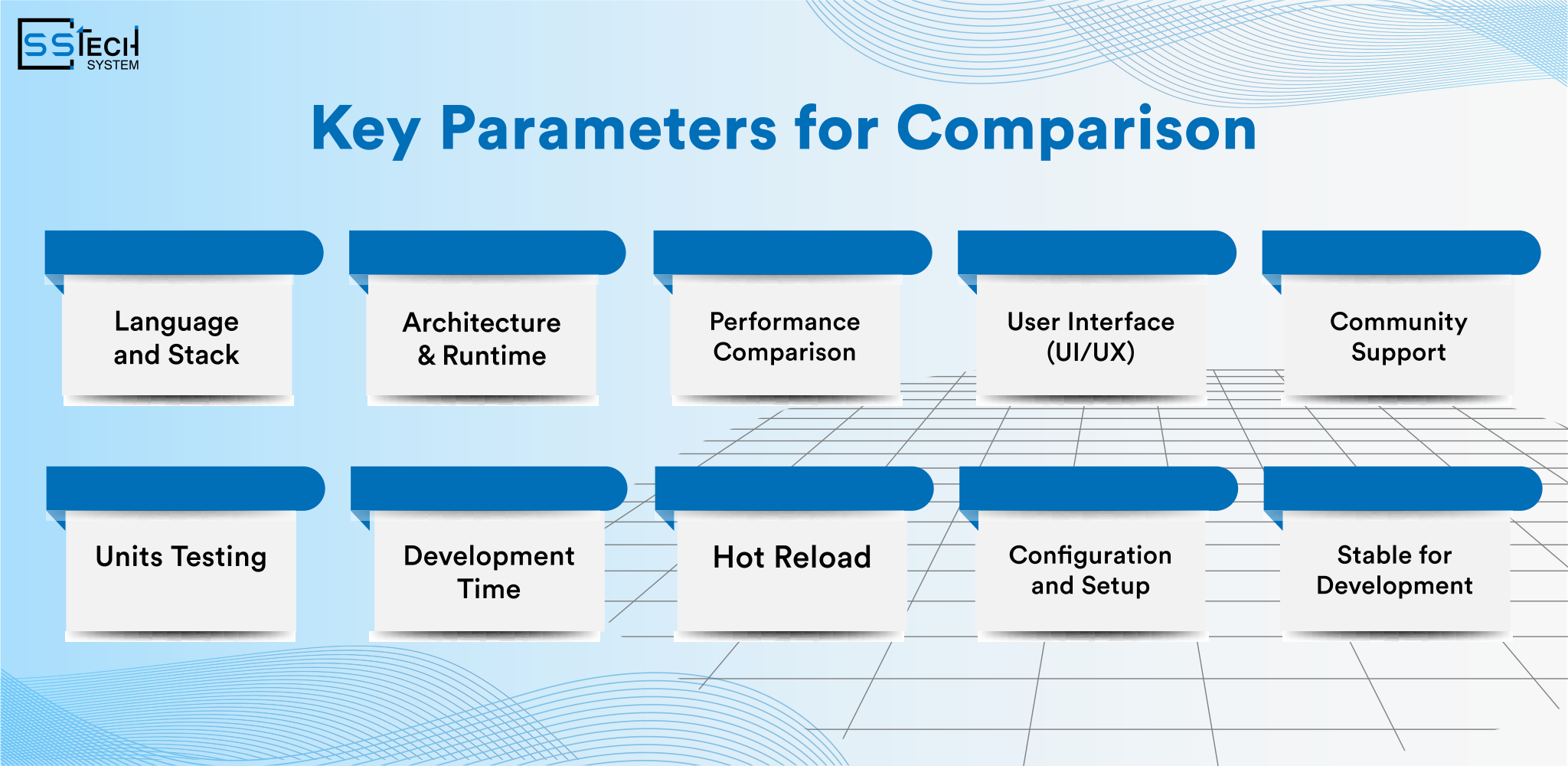
Here are some of the most important key parameters that can help you to compare these two technologies.
Language & Stack
Flutter is an open-source mobile application framework that works on a completely different programming language called Dart. Developers use Dart to create high-quality, mission-critical apps for iOS, Android, and the web. It is a great fit for both mobile and web apps for client-side development. Dart is based on c/c++, java and supports things like abstraction, encapsulation, inheritance, and polymorphism. With Dart Bridge, the bigger size application works much faster. Unlike React Native with JavaScript bridge. Whereas React Native lets you build mobile apps using only JavaScript. It assembles dynamic JavaScript code to native view at runtime. The rest of the code runs in the additional virtual machine that is packaged inside the app itself. Flutter vs react native usage of the JavaScript bridge to communicate with native modules
Architecture & Runtime
React Native vs native app architecture is known as Flux. Facebook uses flux to develop client-side web applications. Each framework mostly follows the MVC framework. The unidirectional data flow is the main concept of Flux. Flux takes care of the Model in the MVC and reacts takes care of the view part.
Flutter
A Dart app architecture library with uni-directional data flow inclined by RefluxJS and Facebook’s Flux. Flutter-flux implements a uni-directional data flow pattern comprised of actions, stores, and store watchers. It is based on flux but modified to use flutter instead of React. Flutter Flux implements a unidirectional data flow pattern that consists of Actions, stores, and store watchers.
Performance Comparison
React Native script you need a bridge to call Swift, Android, or Windows & Mac APIs with Flutter its dart so you don’t need that everything would potentially be native. This also solves the problem with the JS Ecosystem split between many different versions like Common JS, AMD. React Native developers face problems developing hybrid apps, but for native apps, you won’t face any performance-related issues. It offers seamless performance in all standard cases and it is highly reliable. Flutter vs react native app size doesn’t really matter as the memory issue is being solved while developing extensive apps an MB or 2 doesn’t make much because the libraries are heavy.
Flutter takes the crown over react native, when comparing both Facebook’s Flutter vs react native performance. It has the advantage of Dart and there is no JavaScript bridge for initiating interactions with the device native components, the speed of development and running time gets accelerate drastically. Flutter has set the animation standard at 60fps is evidence of its high performance. Lastly, as Flutter is compiled into the native ARM code for both Android and iOS, performance is the one issue that it would never face.
User Interface (UI/UX)
React Native app development requires to use of third-party libraries since React Native does not have a UI components library of its own. We used native base components, which is an open-source UI components library. React Native Elements, Shoutem, and react native Material Design are other similar UI libraries that are available to the user. When comparing user Interfaces between React Native vs Flutter, React Native is similar to using HTML without any CSS framework. It is based more on the native components both for Android and iOS also better User Experience when a user taps into the operating system.
Flutter’s Flat App does not have a UI components library of its own like React Native, it uses third-party libraries and components like Native Base, which is an open-source library that develops a layer on top of React Native that provides you with the basic set of UI components. There are three main UI libraries, Shoutem UI Components, React Native Elements, Native Base components.
Flutter layout widgets are currently part of the application, new widgets can be included and existing ones can be modified to give them an alternate feel and look, the trend has now changed, the UIs have become more user-friendly, easy to use, increase user engagement, and win grants. Flutter accompanies built-in beautiful material design and Cupertino like iOS-flavour widgets, rich motion APIs, smooth natural scrolling, and platform awareness. Flutter has its own UI components, material design; adaptable widget sets along with an engine to render them on Android as well as an iOS platform. Few examples of Flutter Widgets are drawer, Inkwell, Gesture detector, default tab controller.
Community Support
React Native is the most popular open-source framework on Stack Overflow it is backed by a huge community with 68K stars on GitHub, 14.5k user subreddit-9000 user discord chat, and strong support on Stack Overflow that is why it has more third-party libraries/plugins than Flutter.
Flutter
The Flutter team can be found for support in a 4.5k user subreddit-30k stars on Github-740 users on Google Group and on Stack Overflow. When comparing the flutter vs react native benchmark, the flutter’s community is not as strong as the one for React Native. Support provided by the Flutter Team at Google is good. Their documentation is thorough enough to help you and they address the questions posted within a reasonable timeframe which helps to get started with flutter with app development.
Units Testing
React native developers have all JavaScript frameworks for testing at a unit level. And when it comes to UI and automation testing, the situation is not as bright. A number of third-party libraries are available
Flutter is a new framework when it comes to testing a new framework it’s somehow difficult, but flutter uses Dart which provides an excellent unit testing framework, it offers you a great option for testing the widgets on a headless runtime, at unit test speeds.
Development Time
The web app development company works on a very strict deadline and if the frameworks deliver short development time then there are major possibilities that companies would opt for that framework. React native has many different third-party libraries, such as Calendar, Modal also has ready-to-use components, which improves flutter vs react native development speed for the app. In Flutter, we need to add separate files for both iOS and Android platforms. In each of these files, you need to add code that corresponds to the rules of the platform.
Hot Reload
Both Flutter and react-native support hot reloading which is blazing fast compared to how true native apps recompile in Android Studio and Xcode. If your app encounters an error, you can fix the error and then continue on as if the error never happened. Changes can be made to a Flutter app while it is running and it will reload the app’s code that has changed and let it continue from where you left off.
Configuration & Setup
Flutter’s setup process is much more straightforward than React Native. Flutter comes with the provision of automated check-ups of system problems, something which react-native communications miss to a great extent.
Stable for Development
Stability becomes an important factor to develop a cross-platform app. As Flutter is considerably new in the cross-platform industry, the numbers of businesses that have adopted the SDK for developing their cross-platform apps are very less. The Flutter Beta 3, offers improved developer tools and asset systems.
React Native display page of apps that have been developed using the framework is much higher. It was quite stable from earlier and it also enjoys the support of a large community of contributors.
React Native vs Flutter both have their own set of gains and losses, Flutter app development is still new in the market of the app development industry, and React Native made its formation way before to gain a good audience ground. Some industry experts realize the untapped potential with Flutter and predicted the future of mobile app development. So it is clear that Flutter has entered the cross-platform mobile development race very strongly.
Use-Cases & Real-World Suitability
Mobile app development is a fast-changing sector where corporations and developers seek the finest and most effective ways to create great applications. As part of this effort, cross-platform mobile app development lets developers construct iOS and Android apps with a single codebase. Two of the most popular mobile app frameworks are React Native and Flutter.
Facebook’s React Native lets developers build native mobile applications using React and JavaScript. Since its 2015 inception, its ease of use, substantial community support, and ability to connect with native components have earned it a loyal following.
In contrast, Google launched Flutter in 2017 as a comprehensive toolset for developing fast, beautiful apps using Dart. Its widget-based architecture allows platform uniformity and customization.
React Native vs Flutter is compared in performance, UI, development speed, cost, and developer availability. This article compares these characteristics to help you pick the best framework for your next mobile app project. Knowing the pros and cons can help you pick intelligently and according to your initiative’s goals.
When to Choose React Native
- If React and JavaScript are already second nature to your team.
- When having access to several libraries and modules and needing a fast start.
- For projects where you can use native modules, speed is necessary but not essential.
When to Choose Flutter
- This is for applications that need smooth animations and great performance.
- When you want a consistent user interface on all platforms.
- This is for projects that depend on speed enhancements and the newest technologies.
Which Framework Fits Which Project Type?
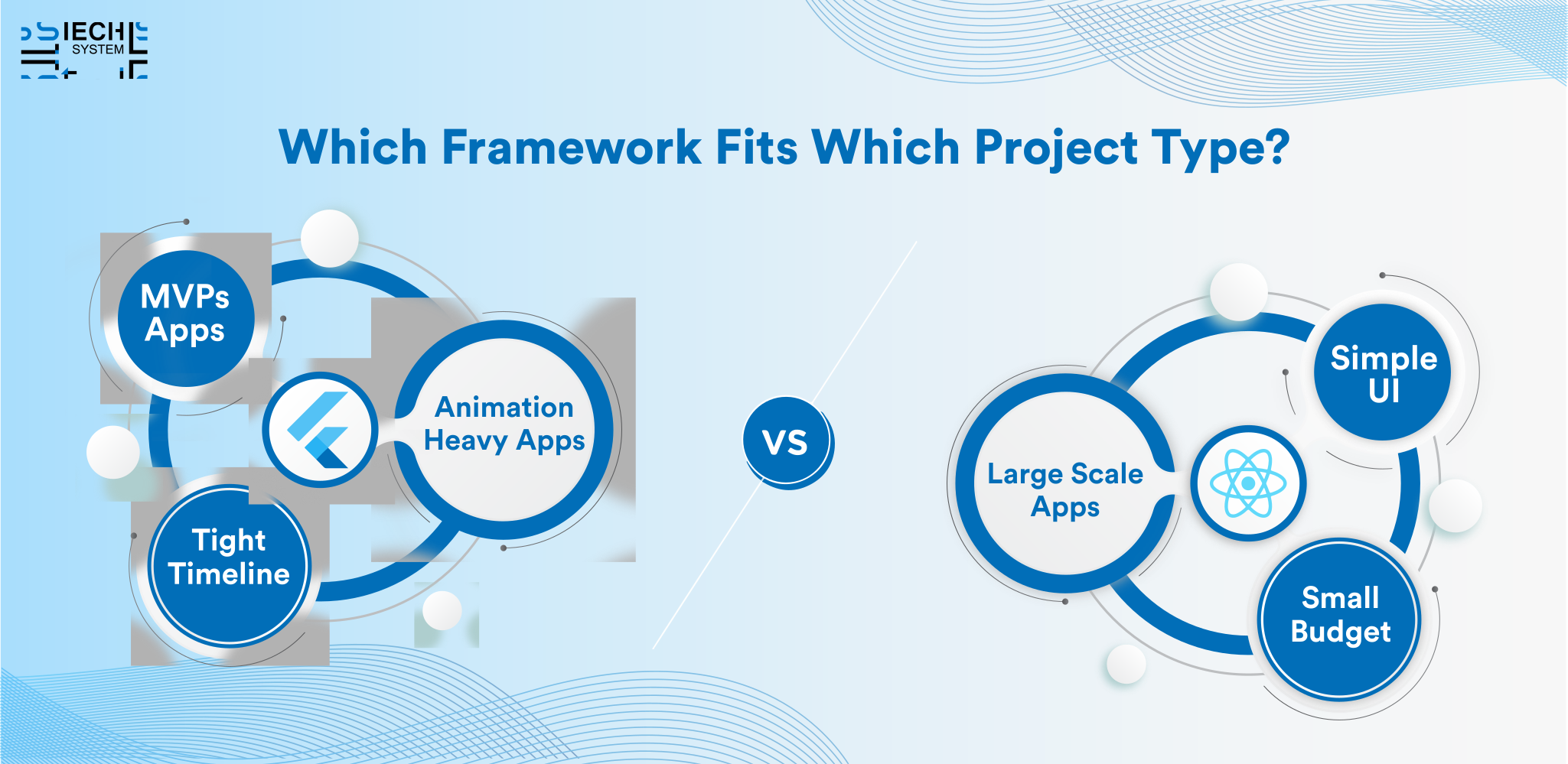
Mapping it to project goals can help in choosing the right framework. Here is how you can choose based on your use case,
MVPs vs. Large-Scale Apps
- Flutter is ideal for MVPs when you want pixel-perfect UI fast.
- The wide ecosystem makes React Native really shine in the case of a large-scale app with complex integrations.
Animation-Heavy Apps vs. Simple UI
- Unmatched for animated, visual creativity apps (Flutter).
- React Native suits applications with simple UI components and extensive backend overhauling.
Small Budget / Tight Timeline
If you want stuff built pretty fast without heavy dependence on native modules:
- Widgets are ready to use, so you can speed up your process with Flutter.
For leveraging JavaScript talent (more easily available and hiring-friendly):
- React Native is more cost-effective long-term.
Case Studies / Company Adoption
Companies Using Flutter
- Google (Google Ads, Google Pay revamps)
- BMW (My BMW App)
- Nubank
- Alibaba
Takeaway: These companies chose Flutter for speed, modern UI, and consistency across platforms.
Companies Using React Native
- Meta (Facebook, Instagram components)
- Shopify
- Discord (partial usage)
- Microsoft (Teams mobile)
Takeaway: Tech giants choose React Native for its developer availability, JavaScript ecosystem, and scalability at enterprise level.
For you, the lesson is simple: each framework wins when paired with the right project vision.
Decision Framework: How to Make the Choice
If you have to think a lot about whether to choose flutter or react-native then its not the way, the choice shouldn’t be the guess work. Each framework can be matched to your business context by assessing your product vision, your team capability and your long-term objectives. This decision framework aids you in seeing through the noise and selecting the appropriate technology with certainty.
Key Questions for Business Leaders
Asking yourself these questions allows you to choose a framework that fits your reality as a business and not just a passing market trend.
What is your distribution of platforms you are targeting?
- Is your app operating mobile only, or would you expand to web, desktop, or any embedded screens?
- If you have a codebase that you want to share across all devices, Flutter wins that one.
- If your focus hasn’t deviated far beyond mobile + web via existing React stacks, React Native can feel like a natural fit.
What skills does your team have currently?
- Your developer ecosystem matters.
- React Native decreases onboarding friction if your team is already writing JavaScript or TypeScript.
- If you are looking for persistent UI and have the fondness for component-based development along with a mighty rendering engine, dart + flutter might just be the answer to turbocharge your team.
And what is the fidelity and performance of my UI/UX?
Flutter has a widget-driven engine, offering pixel-perfect design, smooth animation, and stunning UI, so if your app depends heavily on these features, nothing else but Flutter would work better.
React Native works beautifully when integrated with heavy applications with complex business logic and dependent on native modules.
How much are you willing to commit and how long are you able to wait?
One of the major reasons Flutter is better than native applications is that it speeds up UI development and thus lowers the hourly rate in the early phases.
Hiring React Native developers may be more cost-effective in the long run because of the large pool of available talent.
How do you plan to maintain and scale it in the long term?
You need to evaluate:
- Future OS upgrades
- Ecosystem stability
- Plugin maturity
- Community support
- Company backing
Pick a framework that will support your product for the next 5–10 years, not just the MVP that you are launching.
Decision Matrix
Below is a quick reference comparison to help you evaluate which framework aligns with your needs.
| Criteria | Flutter (2026) | React Native (2026) |
|---|---|---|
| Language | Dart | JavaScript / TypeScript |
| UI/UX Quality | Exceptional (custom rendering engine) | Strong (native components) |
| Performance | High & consistent | High but depends on native bridges |
| Plugin Maturity | Improved but uneven in niche areas | Very mature & community-rich |
| Talent Availability | Moderate | Very high |
| Web Support | Strong via Flutter Web | Strong via React Native Web |
| Desktop Support | Strong (Windows/Mac/Linux) | Improving (Windows/Mac by Microsoft) |
| Best For | High-fidelity UI, multi-platform expansion | Large-scale apps, JS-heavy ecosystems |
| Community Ecosystem | Growing fast | Established & widely adopted |
| Migration Difficulty | Medium | Medium |
Use this matrix as a guide when mapping your app requirements with technical capabilities.
Common Pitfalls & How to Avoid Them
Framework decisions and inappropriate reasons to choose a framework. And here are the mistakes you should be actively working to avoid:
Hiring only for “hot skills.”
To make it explicit, its scope is not by engaging the buzz many developers are still busy talking about, few even working with; but rather to make you see a way to stay on top of the framework`s latest. Pick whatever your future team is able to long-term maintain.
Choosing based solely on hype
The trends in Flutter and React Native change over the years. It needed to be sound decision making,not a popularity contest.
Ignoring plugin/community maturity
If your business logic depends on some plugin that is outdated or worse, missing, it can take weeks to get your project back on track. Lock in your choice only after checking community support.
Underestimating platform-specific customisation
Cross-platform doesn’t mean customisation-free. You will still need:
- Platform-specific APIs
- Native integrations
- Conditional UI
Take this into account when calculating your expenses and planning the deadline.
Failure to plan for future platform growth
Choose a framework that can grow with you if you are looking to expand to web, desktop, or embedded systems in the future,not a framework that will box you in.
Future Outlook: What to Expect in 2026 and Beyond
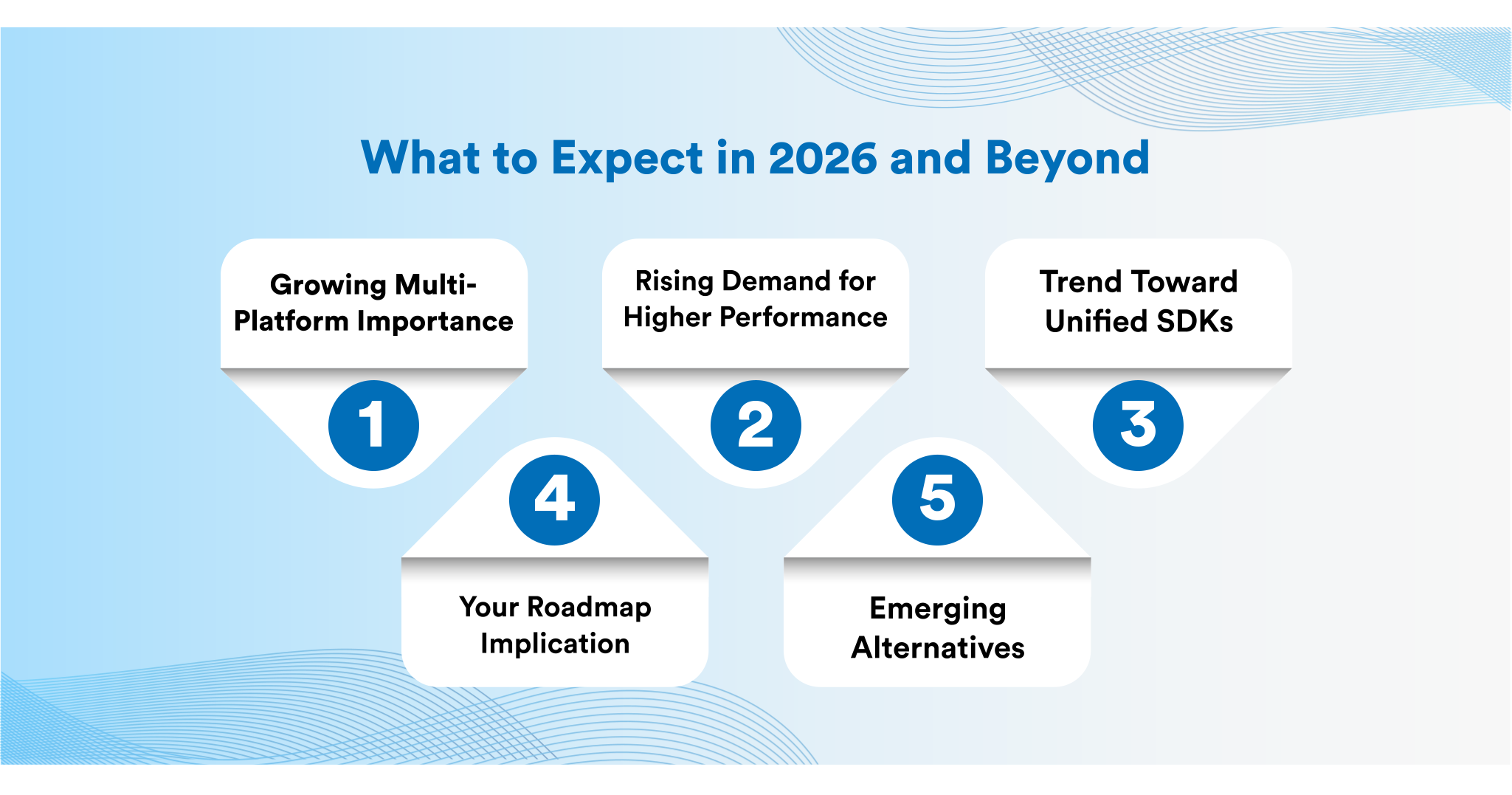
The world of mobile development is changing. When it comes time to adopt, it must be based on the future of the ecosystem, not its past;
Increasing Importance of Multi-Platform Support
With businesses expecting apps to span virtually every surface, mobile, web, desktop, in-car screens, kiosks, IoT displays, etc.
Flutter is at the forefront of this cross-platform revolution.
Microsoft and React Ecosystem making web and desktop support with React Native better.
Rising Demand for Higher Performance
Users demand very smooth animation at 120 FPS, instant loading, low memory consuming and navigation experience.
Flutter’s rendering engine has a continuous evolution to face these challenges.
Using React Native’s new architecture (Fabric & TurboModules) improves performance as well as decreases bridge overhead.
Trend Toward Unified SDKs
Since LTDM in enterprises is one design system with one codebase at the end of the day. Flutter is the closest thing we have to this vision presently.
Ecosystem Enhancements
Flutter: Better 3D and Animation support, Embedded systems, enterprise-level plugins
React Native – tighter integration with React, stable native modules, simplified architecture
Emerging Alternatives
Flutter and React Native rule, but there are tons of new players, such as Kotlin Multiplatform or the combination of SwiftUI + Jetpack Compose or even Web Assembly-based ones. A road map that lets you escape the lock-in of legacies of technology.
Your Roadmap Implication
Choose a framework that gives you flexibility, not constraints. Consider where your app will be in 3–5 years, not just launch day.
Migration Considerations: What If You Want to Switch Between Flutter vs React Native?
Sometimes your early framework choice doesn’t remain viable. You might consider migrating to Flutter or React Native due to performance issues, team restructuring, plugin limitations, or platform expansion.
But switching frameworks isn’t simple, here’s what you must know.
The Challenge of Migrating an Existing App?
Additionally, Flutter and React Native are different frameworks so migrating between them means a lot of rework, as they use different:
- Programming languages (Dart vs JavaScript)
- Rendering engines
- UI structures
- Build pipelines
- Plugin ecosystems
You are basically rewriting key functional components of your application component.
What Needs Re-Engineering?
You have to remold when migrating:
- UI components, not cross-framework reusable
- Navigation structure
- State management
- API integration layers
- Custom modules & native code
- Animations & theming
- Build and deployment pipelines
Massive reuse of backend apis, business logic models, architecture planning, but most of the client-side component needs to be rebuilt.
Cost, Time & Risk Factors
Expect the migration to take 40%–80% of the time it took to build your app originally, depending on:
- App size
- Plugin dependencies
- Native integrations
- Architecture complexity
Risks include:
- UI inconsistencies
- New bugs during migration
- Temporary performance drops
- Need for retraining your team
Migration is a huge investment look at it critically.
When Is Migration Worth It?
Migration makes sense when:
- Your current framework cannot support your future platforms
- You face serious plugin limitations
- Performance bottlenecks persist despite optimization
- You want a single base of code for every platform, mobile, web and desktop.
- The workforce that we now have going forward can no longer sustain that old stack
If your troubles are minor and repairable, it may be wiser to stick with the status quo.
Migration Best Practices
The structured migration approach is to move forward if you decide.
- Phased Rollout: Re-create and migrate functionality by functionality.
- Dual-Framework Testing: Run both apps simultaneously until your new version is rock solid.
- Performance Benchmarking: Measure before and after to ensure that things really are better.
- Gradual API Reuse: Save work as much as possible by using existing logic and API connections.
Make the Correct Decision
In 2026, you should choose between Flutter and React Native guided by what your app looks like in the future, the strengths of your team, and what you want to accomplish in the long run, not hype or whatever is popular. With Flutter, you have full UI control and multiplatform reach. React Native provides a huge ecosystem, a known JavaScript environment, and stability for the enterprise.
If your goal is:
- Fast, stunning UI: Choose Flutter
- Choose React Native for scalable, integration-heavy, enterprise apps
- Blueprint + Unity: React Native for Web + Mobile
- Web + mobile + desktop + embedded: Flutter
The better you assess your timeline, budget, and technical aspirations, the better decision you can make for your app in 2026. With the right framework, you can build faster, scale with confidence, and deliver an engaging mobile experience for your users.

Frequently Asked Questions
Flutter is faster because it uses its own high-performance rendering engine and native ARM code. * Flutter provides smooth animations and frame rates highly consistent at 60fps. React Native is also fast (new architecture out: Fabric and TurboModules), but it still needs a JavaScript bridge at times. Flutter will typically give out better performance for UI-heavy or animation-rich apps. They both perform similarly for business apps that are heavy on API-driven logic.
And, of course, the React Native has still a bigger community (for now), just because of the JavaScript ecosystem and being in the market longer. There are additional libraries, external plugins, and developer conversations regarding React Native. Nonetheless, Flutter has an extremely lively and fast-growing community, notably for UI and multi-platform development. Suppose you are already working in an environment with a lot of JavaScript. In that case, you will get to experience a more familiar and resource-rich community with React Native.
You can, but it’s not simple. Migrating from flutter to react native or vice-versa you need to rebuild your entire UI, your entire navigation, your entire state management, and even entirely new native modules. Frontend UI has no reusability, but can only reuse backend APIs and business logic. If you properly architect your app and maintain a clean separation of concepts between layers, the migration is simple, but moving frameworks should always be a strategic decision, not a band-aid.
Flutter apps will have a bit larger initial APK / IPA size as it combines entire rendering engine and widget library. Since React Native apps depend on native components and the JS runtime, these apps are smaller to begin with. That difference hasn't mattered much over the years, though, nowadays, most apps exceed that base size anyway thanks to assets, libraries, and modules. Where app size is particularly important (e.g. in some new markets), make sure to test early on in both frameworks.
Absolutely. You might be surprised to hear that your domain can heavily affect your choice of framework:
· Games: Use a dedicated engine (Unity or Unreal). The same goes for 3D or physics-heavy gaming; Flutter and React Native are not good options here.
· IoT and Embedded Systems: Flutter is gaining good traction, as it can run on embedded screens, automotive dashboards, and smart appliances.
· AR/VR: Although React Native has good support for third-party integrations, most real-world AR/VR apps still rely heavily on native SDKs or Unity.
· Enterprise & SaaS Apps: Both frameworks work with efficiency, but the ecosystem lean in favor of React Native for intricate integrations.
· Fintech, Loyalty Apps, E-Commerce: Flutter provides the native pixel-perfect UI that is consistent across the platforms which makes it an ideal fit for consumer apps.
Choosing the right framework shouldn't be purely about popularity, but rather it should be based on your domain, complexity, hardware integrations, and required platform support.
Related Article