

Managing supply chain operations means managing inventory, transportation, and warehouses, as well as coordinating with suppliers and delivering the inventory to customers. When any of these are managed with disconnected systems or via spreadsheets and manual processes, the business suffers from delayed order fulfilment, high operating costs, and limited visibility into shipments.
With growing complexity in the supply chain, traditional methods of management no longer work to efficiently meet the changing needs of customers. Real-time coordination and automation of routine tasks are a must for the management team to get a holistic view of operations and gain real-time insights. Logistics Software Development plays a key role in achieving this. It helps companies design and build digital solutions that simplify logistics operations, optimize the supply chain, and facilitate business growth.
What Is Logistics Software Development?
Logistics Software Development is creating or customizing software applications to assist in the management of the flow of goods from procurement to delivery. This includes the management of inventory and warehousing, transportation, order fulfilment, and delivery.
These applications link various activities of the supply chain. They help in tracking shipments, automating processes, managing fleets, and communicating with suppliers and logistics partners. Businesses can decide on the type of solution based on their business needs.
A company can opt for a ready-made solution or opt for Custom Logistics Software Development to address its specific business challenges. Prepackaged solutions for logistics processes include Transportation Management Software (TMS), Warehouse Management Systems (WMS), Fleet Management Solutions and Last-Mile Delivery Solutions.
Common Supply Chain Challenges Businesses face
Supply chain operations involve multiple stakeholders and processes. Without adequate systems, a number of challenges are experienced along the chain.
Lack of Real-Time Shipment Visibility
Limited tracking makes it difficult to locate shipments, identify delays, and provide precise delivery window updates.
Manual Logistics Processes
Manual data entry, documentation, and dispatch processes increase administrative work and mistakes.
Wasteful Inventory Management
Lack of visibility in stock leads to overstocking, stock outs, and inaccurate records.
Poor Transportation & Route Planning
Inefficient route planning increases fuel consumption, transportation cost and delivery time.
Separated Logistics Systems
Use of isolated systems leads to information gaps between warehouses, suppliers, carriers, and customers.
Operational Inefficiencies, High Costs and Delays
Increased unexpected transportation costs and inefficiencies in resource allocation and process causes bottlenecks and affects the bottom line.
Poor Customer Experience and Growth Potential
Traditional and outdated systems make it difficult to adequately meet growing customer demands as businesses expand and thrive.
How Logistics Software Development Helps Streamline Supply Chain Operations
A Warehouse Management System (WMS) automates storage, picking and packing, and dispatch processes. Integrating Inventory Management Software and Barcode Scanning Solutions improves inventory accuracy and warehouse productivity.
Enhances Real-Time Visibility in Supply Chain
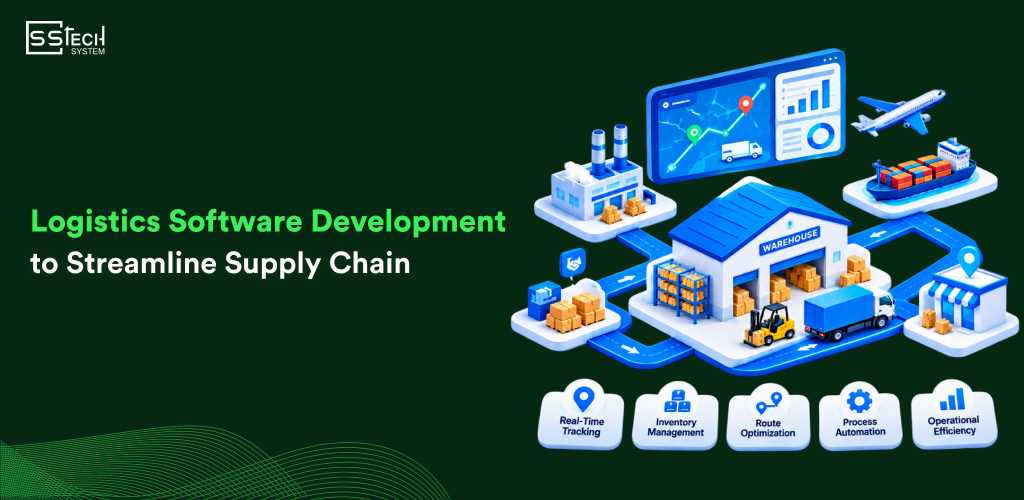
Centralized management of shipments and vehicles leads to real-time delivery tracking and identification of delivery delays. Visibility solutions enhance carrier and warehouse coordination.
Automates Repetitive Processes in Logistics
Supply chain management Software automates order processing and related paperwork, dispatch schedule planning, invoicing and collection, and other repetitive tasks. It enhances the overall efficiency and reduces manual errors.
Improves Transportation and Route Planning
Route Optimization Software, when integrated with Fleet Management Systems, improves fleet utilization and reduces fuel wastage.
Improves Warehouse and Inventory Management
A Warehouse Automation solution integrated with Inventory Management Systems and Barcode Scanning solutions improve stock accuracy and increase productivity.
Improves Supply Chain Partner Coordination
Logistics software integrates the entire supply chain from suppliers to customers.
Provides Data for Making Strategic Business Decisions
Analytics empower managers to make decisions based on delivery, inventory, and transportation cost data.
Positively Impacts the Bottom Line of the Business
Optimization of Logistics Operations through logistics process automation and route optimization leads to lower fuel wastage and improved resource utilization.
Creating a Positive Impact on Customers
Logistics software builds customer trust and confidence through real-time delivery tracking, delivery notifications, and proof of delivery software.
Essential Features of Logistics Software Solutions
When developing Logistics Management Software, vendors must include the following features.
- Real-Time Tracking and Location: Tracks shipment location and movement of vehicles.
- Route Planning and Optimisation: Determines delivery routes based on existing operational conditions.
- Fleet Management: Monitors vehicle performance and driver assignments.
- Inventory and Warehouse Management: Manages storage of inventory in a warehouse.
- Order and Dispatch Management: Processes and assigns delivery orders.
- Proof of Delivery: Captures evidence of delivery by the customer.
- Carrier Integration Solution: Connects third-party logistics and transportation service providers.
- Analytics: Monitors delivery performance, cost and KPIs.
Protects business information with access and permission controls. Allows drivers and customers to access logistics information via mobile apps. Facilitates simpler invoicing, calculations of freight, and payment document generation. Allows businesses to develop types of logistics software that meet their requirements. Different businesses require different digital supply chain solutions.
Types of Logistics Software Businesses Can Develop
- Transportation Management System (TMS)
- Warehouse Management System (WMS)
- Fleet Management Software
- Last-Mile Delivery System
- Order Management System (OMS)
- Supply Chain Visibility Solution
Businesses can develop a single application or integrate multiple solutions to manage logistics activities from the first mile to the last mile.
Businesses must consider their needs, budgets and long-term goals when deciding between custom and ready-made software. Custom Logistics Software Development allows businesses to have full control and flexibility to adjust their application as needed.
Custom Logistics Software vs. Ready-Made Solutions
Choosing between custom and ready-made software depends on business requirements, budgets, and long-term objectives.
| Comparison Factor | Custom Software | Ready-made Software |
|---|---|---|
| Customization | Designed around specific workflows | Limited to available features |
| Integration | Can support specific business systems | Depends on vendor capabilities |
| Scalability | Can grow with business requirements | Relies on subscription and product limits |
| Cost | Higher initial investment | Usually lower initial cost |
| Ownership | Greater control over functionality | Vendor-dependent |
Read more: Custom Software vs. Ready-Made Software: Which Is Better for Growing Companies?
Key Steps in Logistics Software Development
A typical software development life cycle helps build a robust and scalable logistics software.
- Analysis: Understand operational gaps, business goals, end-user requirements and essential features.
- Plan and Design: Finalise application architecture, technology stack, user workflow and interface.
- Develop and Integrate: Develop application modules and integrate with other systems (ERP, CRM, payment, warehouse management, 3PL, etc.)
- Test and Deploy: Perform acceptance, load, security and integration testing and deploy the application.
- Migrate Data and Train Users: Import business data and train end users of the application.
- Maintain and Scale: Monitor application performance, resolve issues, enhance the application, and scale to handle increased application load.
Implementation Challenges to Consider
Businesses should also plan for legacy system compatibility, ERP integration, data migration, employee adoption, and budget control. Defining project scope early and involving operational teams throughout development can reduce implementation risks. Development costs and timelines depend on application complexity, integrations, features, technology choices, and testing requirements.
How to Choose the Right Logistics Software Development Company
Choosing the right development partner is important when creating logistics applications. Some factors to consider are:
- Industry Experience: Do they have experience with logistics, transport and supply chain applications?
- Customisation: Can the team build software to fit specific business workflows?
- Technology: Do they offer cloud application development service, AI and IoT in combination with automation?
- Integration: Can the team build integrations with different business applications?
- Security and Scalability: Does the application support different levels of data protection and access control?
- Support: What type of agreement do they offer for support and maintenance after development?
- Pricing and Portfolio: What are their engagement models and case studies? Are client references available?
How SSTech System Helps Build Logistics Software
SSTech System has extensive experience developing logistics software. With custom software development, businesses can access different API integrations, build cloud applications, and use AI and IoT for predictive analytics and real-time tracking.
Emerging Technologies in Logistics Software
Demand forecasting and delivery window predictions are a few examples where Artificial Intelligence (AI) can improve logistics. Using technology to make logistics operations management more connected, automated and efficient is the future.
Internet of Things (IoT)
IoT application development makes real-time vehicle location tracking and shipment tracking possible.
Cloud Computing
Cloud computing makes data available from anywhere, integrates various systems and offers flexibility for the business to scale as required. These technologies benefit the e-commerce, retail, manufacturing, 3PL, freight and cold chain business.
Read more: Drones and Self-Driving Vehicles in Last-Mile Delivery
Conclusion
Logistics application development is one of the IT industry’s fastest-growing verticals. The number of companies opting for custom development of freight management software to enhance their supply chain and improve supply chain efficiency is increasing. Using the latest AI, cloud and IoT technologies, companies can scale their operations and improve their supply chains. When partnering with a development firm, the goal of the partnering firm should be to expand and evolve the customers’ businesses.

Frequently Asked Questions
What is logistics software and how does it improve the supply chain?
Logistics software is used to automate and improve various facets of the supply chain and includes shipment tracking, delivery route optimisation, and other warehouse and transportation integration.
What are the benefits of having custom logistics software?
There are countless logistics software options available in the market. However, there are certain business requirements which are unique and cannot be addressed by these off-the-shelf solutions. These include unique and complex business workflows and integrations.
What is the cost of custom logistics software development?
This varies case to case. Simple custom solutions are relatively cheaper, while more advanced and complex solutions for things like shipment visibility solution and tracking may cost more.
Can a logistics software be integrated with other enterprise software development systems?
Logistics software can be easily integrated with systems such as the ERP, WMS and other third-party systems via APIs and other integration technologies.
How does AI impact logistics and supply chain processes?
AI helps businesses with demand forecasting, delivery window prediction, optimising transportation routes, identifying risks and disruptions, and analysing process and operating data for planning purposes.
How long does it take to create logistics software?
It depends on the software's complexity and the specific requirements of the project. Simple software may take a few months to create, while more advanced logistics management software may take a year or longer.
How does logistics software protect data?
Logistics software may use a number of safeguards such as encryption, role-based access controls, secure APIs, MFA, monitoring, and testing to protect data.
Related Article