


The warehouse is no longer only a storage facility as it used to be in the past, but it is the center of efficient supply chain operations. With businesses dealing with increasing order quantities and rising customer demands, traditional inventory methods such as manual data entry, paper records, and periodic stock counts are no longer enough. These are the old ways of doing things that tend to give rise to inventory differences, delays in fulfillment, and increased operational expenses.
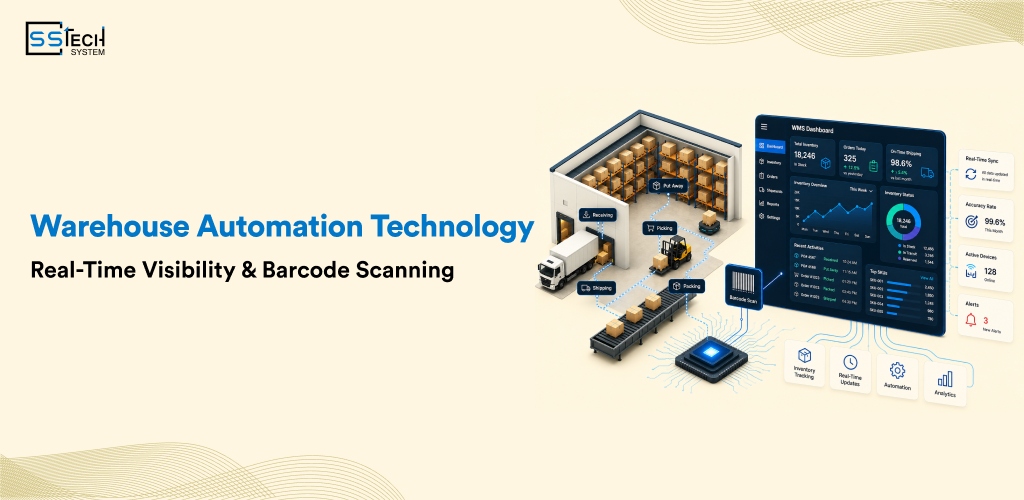
It is at this point that warehouse automation technology comes in. Combining smart software, connected devices and digital workflows, businesses can automate daily activities in the warehouse and retain total control of the inventory. All movements of stock are tracked in real-time through a warehouse management system (WMS), enabling real-time inventory tracking and faster decision-making.
As warehouses handle growing order volumes and customer expectations, businesses are rapidly investing in automation technologies. Industry research indicates that warehouse automation is growing at more than 10% annually, with robot shipments projected to increase by up to 50% each year through 2030, highlighting the industry’s shift towards smarter and more efficient operations.
One of the forces behind this change is barcode scanning in warehouse management. Each barcode scan updates the inventory records in real time, enhancing accuracy and generating complete real-time inventory visibility. In conjunction with warehouse management software, inventory tracking software and warehouse automation software, barcode technology can assist a business in streamlining its operations and optimizing warehouse efficiency.
This article will discuss the use of warehouse automation technology in providing better real-time warehouse tracking, the role of barcode scanning in modern warehouse operations, and why it is a good idea to adopt these technologies and ensure smarter, faster and more efficient inventory management.
What Is Warehouse Automation Technology?
Warehouse automation technology means digital systems, software platforms, and smart equipment to automate warehouse operations and enhance operational efficiency. It also helps businesses to monitor inventory movement, manage warehouse operations and fulfill orders with minimal manual intervention.
Key components
Warehouse automation is not built around a single solution. Rather, it integrates a number of technologies that complement each other to form a highly efficient warehouse ecosystem.
-
Warehouse Management System (WMS)
Warehouse Management System (WMS) serves as the control hub to the warehouse operations. It coordinates the stock locations, the warehouse processes, labor distribution, inbound deliveries, and outbound order fulfilment.
-
Warehouse barcode scanning system
A warehouse barcode scanning system makes sure that there is proper documentation of all the movements of the inventory. Each product is assigned a special barcode tag which is also scanned during receiving, storage, picking, packing, and shipping.
-
IoT and connected devices
The implementation of IoT in warehouse management has introduced a new dimension of operational intelligence. Connected sensors constantly track the actions within the warehouse and give immediate reports that assist managers in acting promptly to the challenges in operations.
-
Artificial intelligence
Modern AI warehouse management solutions analyze both historical and real-time operational data to enhance warehouse performance.
-
Cloud-based warehouse platforms
Cloud technology has become another essential part of digital warehouse management. A cloud warehouse management system enables businesses to access warehouse data records from various locations and maintain a record of inventory throughout the organization.
Why Does It Matters Today?
Warehouse automation has shifted from being a competitive advantage to becoming a business necessity. This has been fueled by customer demands that are growing, scarcity of labor, and more and more complicated supply chains that demand warehouses to be faster and deliver with more precision than ever.
This shift is also reflected in market growth. The global warehouse automation market is estimated at $29.98 billion in 2026 and is expected to reach $59.52 billion by 2030, growing at a CAGR of 18.7%. The rapid expansion demonstrates how organisations worldwide are investing in automation technologies to improve productivity, inventory visibility, and operational resilience.
By implementing warehouse automation technology, businesses can:
- Improve warehouse efficiency
- Reduce manual data entry
- Increase inventory accuracy
- Enable order fulfillment automation
- Improve real-time warehouse tracking
- Strengthen inventory optimization
- Reduce labour costs
- Speed up customer deliveries
- Support business scalability
What Is Real-Time Warehouse Visibility?
Real-time warehouse visibility is a situation where the situation in the warehouse is continuously monitored by tracking the inventory, the assets of the warehouse, the employee activities that operate within the warehouse as well as the progress of orders that are being tracked in the warehouse via the connected technologies.
All the inventory movements are automatically recorded in the warehouse management system (WMS) and thus inventory information is kept up to date in all the warehouse locations. Such flow of information helps businesses to maintain Real-time inventory visibility, reduce stock discrepancies, and improve overall warehouse inventory management.
Key Elements Of Real-Time Visibility
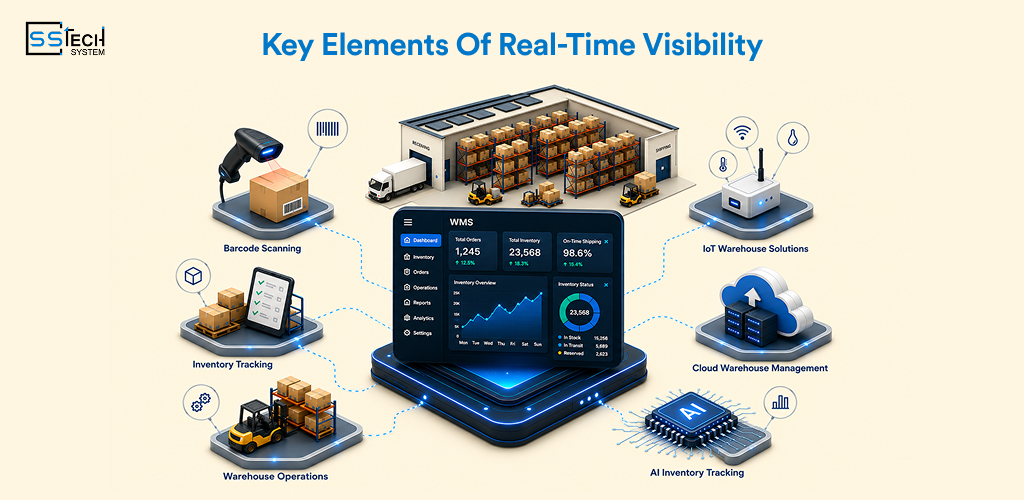
Achieving complete warehouse visibility requires multiple technologies working together. Although the WMS is the central control mechanism, other digital solutions make sure inventory information is updated properly on a regular basis.
The key components include:
- Warehouse Management System (WMS) to centralize warehouse data.
- Barcode scanning software for instant inventory updates.
- Inventory tracking software to monitor stock movement.
- Warehouse operations software for task management.
- IoT warehouse solutions for monitoring warehouse assets and environmental conditions.
- Cloud warehouse management system for synchronizing data across multiple facilities.
- AI inventory tracking tools for analyzing warehouse performance and identifying operational trends.
These technologies, when combined, form an interconnected ecosystem that enables digital warehouse management and enhances decision-making across the entire supply chain.
Why Does Real-Time Visibility Matters?
Without accurate visibility, warehouse teams spend valuable time locating products, checking inventory, and fixing stock discrepancies. Such delays tend to cause mistakes in filling orders, rising operational expenses and customer dissatisfaction.
Real-time inventory tracking has a number of business benefits such as:
- Faster inventory updates
- Improved inventory accuracy
- Better warehouse planning
- Reduced stock shortages
- Improved workforce productivity
- Faster response to supply chain disruptions
- Greater supply chain visibility
- Better customer service through accurate order status updates
What is barcode scanning?
Barcode scanning involves the process of capturing product information with handheld scanners, mobile computers or fixed scanners. Each barcode has a distinct identifier that is connected with product information stored in the Warehouse Management System (WMS).
The system will automatically update the inventory records whenever a barcode is scanned by the warehouse staff, eliminating the need to input such information manually.
This supports accurate:
- Barcode inventory management
- Barcode inventory control
- Barcode asset tracking
- Barcode-based inventory management
- Warehouse barcode automation
Types Of Barcodes Used In Warehouses
The barcode formats vary among different warehouses based on the nature of inventory, industry demands, and complexity of operations. Although all barcode systems enhance the accuracy of the inventory, each serves a different purpose.
1D Barcode
The conventional linear barcodes normally found on retail products and labels in the inventory of warehouses are One-dimensional (1D) barcodes. They include product identification numbers that are scanned within seconds during receiving, picking, and shipping operations.
QR Code
QR (Quick Response) codes can store significantly more information than traditional linear barcodes. They can also contain a batch number, a serial number, manufacturing details, URLs or warranty information along with the identification of the product.
GS1 Barcode
The GS1 barcodes are based on globally recognized standards that enable the products to be identified globally across supply chains.
Challenges That Limit Real-Time Warehouse Visibility
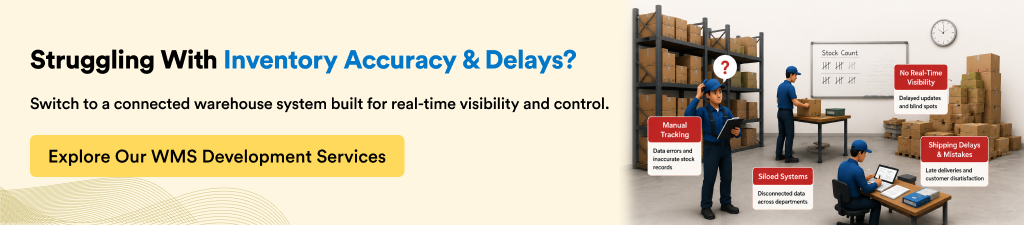
Real-time inventory visibility is often not achieved easily, particularly in situations where warehouses employ manual processes or detached systems. In the absence of the appropriate warehouse automation technology, a business organization may find it difficult to uphold proper records of its inventory, track stock movement, as well as react fast to changes in operations.
Delayed inventory updates
When inventory records are updated manually, there is often a delay between physical stock movement and system records. This may create false stock levels, slow processing of orders and bad replenishment planning.
Inventory inaccuracies
Manual data entry and paper-based tracking result in high chances of misplaced inventory, duplicate records and stock discrepancies. Such inaccuracies can cause stockouts, overstocking, and incorrect customer shipments.
Limited visibility across warehouse operations
Businesses fail to track inventory movements across receiving, storage, picking, and shipping without a connected Warehouse Management System (WMS). This lack of visibility complicates the process of tracking bottlenecks and optimizing the workflows at the warehouse.
Slow operational decision-making
Outdated or incomplete warehouse data prevents the managers from making timely decisions on inventory replenishment, distribution of workforce and prioritization of orders. Therefore, there is a reduced responsiveness of warehouse operations to fluctuating demand.
Challenges in managing multiple warehouses
Companies with a presence in more than one location tend to maintain uneven inventory records, as well as to suffer a lack of coordination among warehouses. In the absence of centralized visibility, stock transfers, inventory balancing and fulfilling orders become complicated and time-consuming.
How Barcode Scanning Strengthens Warehouse Automation?
Having an integrated warehouse barcode scanning system eliminates manual record-keeping while supporting faster workflows throughout the warehouse.
Faster receiving operations
Receiving inventory is often one of the busiest stages of warehouse operations. Manual product verification can slow unloading processes and increase the risk of inventory errors.
Through mobile barcode scanning, the warehouse employees can scan the products received, place purchase orders and update inventory in the barcode Warehouse Management System (WMS) within a few seconds.
Accurate put-away processes
Once products are received, they must be stored in the correct warehouse location. Poor storage may cause lost inventory and make the picking process slow.
Barcode scanning will be used to verify that every put-away operation in the warehouse management system is appropriate by confirming the assignment of the products to the appropriate location.
Improved picking accuracy
One of the most popular causes of fulfillment errors is order picking as it happens to be one of the most labor-intensive activities in the warehouse.
Warehouse workers scan the barcodes of each item using barcode scanning software before adding it to a customer order. The system has alerts that allow the staff to immediately know when the wrong item has been chosen.
Streamlined packing and shipping
The barcode check is maintained throughout packing and shipping with all orders being packed with the right products before delivery. Such a high degree of automation empowers the work of the warehouse and customer satisfaction.
Simplified inventory audits
Traditional inventory audits often require significant labor and may interrupt warehouse operations. Barcode inventory system technology allows businesses to perform inventory cycle counts, though with handheld scanning equipment, while normal warehouse activities continue.
Enhanced product traceability
Many industries require full access to the product’s supply chain. Barcode asset tracking helps a business track individual products from receiving to shipping, and, as a result, manage the recall, warranty claims, regulatory compliance and quality assurance. It finds application mostly in the fields of healthcare, pharmaceuticals, food manufacturing, and other highly regulated industries.
Benefits Of Combining Warehouse Automation With Barcode Scanning
When barcode scanning and warehouse automation technology work together, a networked warehouse ecosystem can be developed in which the data on the inventory is scanned with precision, and the operational procedures can work much more efficiently.
Some of the most significant benefits include:
Increased warehouse productivity
Automation lowers the number of manual tasks that fall under repetitive activities and enables the warehouse personnel to concentrate on the value-added activities.
Reduced human errors
Replacing manual data entry with barcode scanning in warehouse management dramatically reduces inventory inaccuracies.
Faster order fulfillment
Real-time inventory updates enable the teams in the warehouse to serve customer orders more effectively.
Lower operational costs
Although warehouse automation requires an initial investment, business organizations are likely to recover their costs through improved productivity and lower operational expenses.
Better customer satisfaction
Customers have a better experience due to correct inventory records and quick fulfillment. The end users can have access to precise inventory and better monitoring of orders.
Improved compliance and reporting
Automated inventory records make it easier to comply with reporting and generate full audit trails for all inventory transactions. This enhances the accuracy of reporting for both internal management and regulatory authorities.
Industries benefiting from warehouse automation technology
Despite the fact that the automation of warehousing is advantageous to practically all industries, there are those that have experienced significant changes.
Retail and e-commerce
Retailers use warehouse management for eCommerce to handle large volumes of orders, seasonal demand, and fulfill orders through multiple channels and keep proper records of inventory.
Manufacturing
Automation helps manufacturers manage raw materials, work-in-progress inventory, and finished goods while improving production planning.
Third-Party Logistics (3PL)
WMS for 3PL providers allows logistics companies to handle inventory on behalf of several clients and still have full visibility of the inventory.
Wholesale distribution
Distributors use warehouse software for distributors to achieve optimization of their inventory movement, lower the fulfillment times and maximize the productivity of their warehouse.
Healthcare and pharmaceuticals
Automation enhances inventory traceability, batch management, and regulatory compliance while ensuring product integrity.
Read more: Why Pharmaceutical Companies Need Advanced Warehouse Management Systems
Food and beverage
Food manufacturers rely on barcode technology and warehouse automation to monitor expiry dates, product batches, and inventory movement throughout the supply chain.
Best practices for implementing warehouse automation
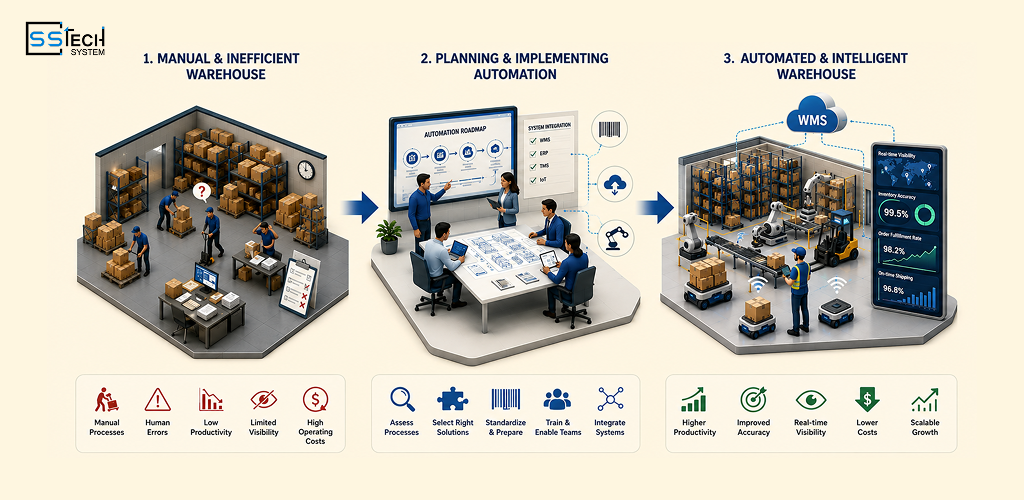
Successful warehouse automation is more about planning than merely implementing a new technology.
Assess existing warehouse processes
Assess existing processes to determine bottlenecks, manual tasks, and opportunities for automation.
Choose the right automation solution
Select warehouse automation solutions that will be compatible with your existing warehouse management software, ERP platform, and logistics systems.
Standardize barcode labeling
Standard barcode standards enhance precision in scanning and decrease errors in operations.
Train warehouse staff
The new workflows and the knowledge of the technology should be taught to employees so that the benefits of automation can be maximized.
Integrate warehouse systems
Integrate your warehouse management system, inventory management software, transportation systems, and business applications to develop a unified digital environment.
Monitor performance metrics
Track KPIs such as:
- Inventory accuracy.
- Order fulfillment time.
- Picking accuracy.
- Warehouse utilization.
- Labour productivity.
- Order processing costs.
Regular performance monitoring helps identify opportunities for continuous improvement.
Read more: Driver Management and Driver Tracking: Why Your Delivery Business Needs It
Future Trends in Warehouse Automation
Warehouse technology is still developing with more intelligent and interconnected solutions being implemented by businesses. Industry analysts predict that by 2030, nearly 50% of new warehouses in developed markets will be designed as robot-centric facilities, where human involvement becomes optional for many routine operations.
Some of the most important trends include:
AI-powered warehouse management
AI will keep enhancing inventory forecasting, labor scheduling, route optimization, and operational planning.
Autonomous Mobile Robots (AMRs)
Autonomous Mobile Robots (AMRs) are becoming an essential part of modern warehouse operations. According to Interact Analysis (2025), the global installed base of mobile robots is projected to exceed 4.2 million units by 2030, highlighting the rapid growth of robotic automation across warehouses, manufacturing facilities, and distribution centres.
IoT-enabled smart warehouses
Advanced IoT warehouse solutions will also give more insightful information on warehouse performance, equipment health, and movement of inventory.
Computer vision technology
The computer vision systems will be used to automate the product identification process, quality checks as well as inventory verification with little human input.
Predictive analytics for inventory management
Using predictive inventory analytics will allow businesses to more accurately forecast the need to proceed with inventory purchases, preventing both stock shortages and excess inventory.
Conclusion
With more supply chain complexity and increased customer demands, companies must have increased speed, accuracy, and visibility in their warehouse-related operations. Warehouse automation technology is the basis of attaining these targets through connecting people, processes, and digital systems into a unified operational ecosystem.
When combined with barcode scanning in warehouse management, automation can also allow real-time inventory tracking, proper barcode inventory management, efficient workflows and real-time warehouse tracking throughout all levels of warehouse operations. From receiving and put-away to picking, packing, shipping, and inventory audits, each scan creates a reliable set of data that enhances decision-making and minimizes inefficiencies in operations.
Companies which invest in modern warehouse management software, warehouse barcode scanning systems, IoT warehouse solutions, and AI-driven technologies are in a better position to maximize the efficiency of warehouses, minimize operational expenses, enhance supply chain visibility and provide quicker and more reliable customer experiences. As digital transformation continues to reshape logistics, warehouse automation will remain a critical driver of operational excellence and long-term business growth.

Frequently Asked Questions
How does warehouse automation improve real-time visibility?
To ensure the information is accurate, warehouse automation constantly monitors the changes in inventory and creates updates which inform teams about the current stock, the position of the orders, and the work underway in the warehouse.
Why is barcode scanning important in automated warehouses?
Barcode scanning assists in eliminating manual mistakes and enhances quick inventory and product identification in receiving, storing and retrieving items and shipping.
Can warehouse automation reduce inventory discrepancies?
Yes. The automated data capture system and real time inventory synchronization reduces the occurrence of stock imbalances, enhances the level of accuracy, and facilitates best inventory management throughout the warehouse operations.
How does automation improve order fulfilment?
Automation makes picking, packing, and shipping faster and provides real-time inventory data to help businesses fill orders faster and more accurately.
Is warehouse automation suitable for growing businesses?
Yes. Scalable automation will help companies to accommodate the increasing amounts of inventory, optimize operations and allow companies to accommodate the future expansion without having to confront the critical effect of manual overload.
What should businesses consider before implementing warehouse automation technology?
Organizations should give a thought to the integration capacity, scalability, compatibility with barcodes and reporting and operational requirements with a perspective to giving the solution an orientation towards long term business objectives.
Related Article