


Every passing year adds another layer of complexity to the freight transportation industry. Increase in fuel costs, manpower shortages, consumer requirements that demand quicker delivery and increasing supply chain disruptions are compelling freight businesses to transform their operations. Traditional transportation systems are unable to meet these challenges, resulting in increased costs, inefficiencies, and missed opportunities. This is where AI transportation management software is making a significant difference.
Supported by artificial intelligence, machine learning, automation, and real-time data analysis, modern transportation platforms assist freight companies to be more intelligent in their choices, utilize resources more efficiently, and enhance the efficiency of operations.
The growth of artificial intelligence in the transport system is exceptionally transforming, stats showcase the market is estimated to reach $157.6 billion by the year 2033. In this guide, you will know how AI transportation management software is changing the way freight works, the main characteristics of its implementation, the practical use, and the new trends that are changing the face of freight logistics.
What is AI transportation management software?
AI Transportation Management Software is an enhanced type of transportation management software for freight companies that uses technologies of artificial intelligence to plan, execute, monitor, and automate freight transportation operations.
In contrast to the traditional freight transportation management system, AI platforms will constantly review data related to shipments, carriers, traffic volumes, weather, fuel usage, and performance to generate recommendations and automate decisions.
The modern AI logistics software assists companies in enhancing their freight planning, route optimization, carrier location, shipment tracking, and risk management while reducing manual intervention.
The systems are the basis of intelligent transportation management, where organizations are able to shift their operations towards proactive and predictive logistics management instead of reactive operations.
Read more: How Custom Software Development Can Transform Your Logistics Business
Why do freight companies need AI-powered transportation management?
Traditional transportation platforms often rely on static planning and manual operations. Although they can cope with simple transportation duties, they are unable to deal with the dynamic freight environments.
Common challenges include:
- Limited visibility into shipment status
- Manual dispatching and scheduling
- Inaccurate delivery predictions
- Poor route planning
- Slow response to disruptions
- Inefficient carrier utilization
- Higher operational costs
These constraints can have a major impact on profitability and customer satisfaction as the freight networks continue to become more complicated.
-
Increasing freight network complexity
Global supply chains are now associated with various forms of transportation, warehouses, carriers and fulfillment centers. This level of complexity can only be managed through a sophisticated freight management platform that is able to process a large amount of data in real time.
-
Labor and driver shortages
Driver shortages remain one of the greatest issues affecting freight transportation. AI helps automate planning activities that would otherwise require extensive human resources.
-
Rising transportation costs
Transportation costs continue to rise because of the price of fuel, maintenance costs, lack of labour and even regulatory requirements. AI helps companies to discover opportunities to save costs by optimizing and automating them.
-
Customer expectations for real-time visibility
Modern customers expect accurate tracking and real-time shipment updates. The AI Transportation Management System Market was valued at 4.42(USD Billion) in 2025 and is projected to grow to 15.2(USD Billion) by 2035, at a CAGR of 13.2%. This demand has accelerated investment in digital freight management technologies.
Real-world use cases of AI in freight transportation
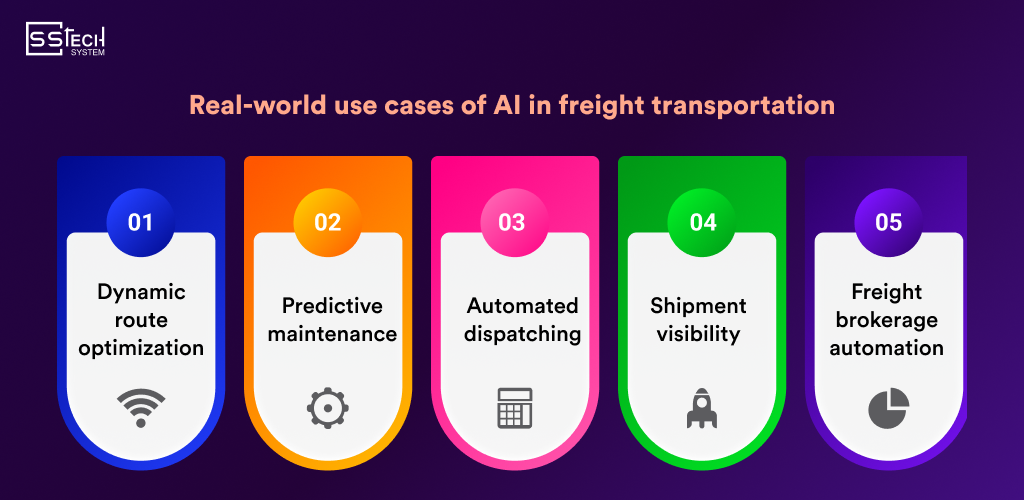
AI is already changing freight activities in various areas.
-
Dynamic route optimization
There is an ongoing optimization of routes by AI compared to the traffic, weather conditions, priorities of the delivery, and the availability of vehicles.
-
Predictive maintenance
Artificial intelligence can anticipate a possible equipment failure even prior to its happening using sensor data and predictive maintenance for fleets.
-
Automated dispatching
Advanced AI-powered dispatch software automatically assigns loads to appropriate carriers and drivers automatically.
-
Shipment visibility
Advanced AI shipment tracking systems offer real-time shipment tracking and predictive delivery updates.
-
Freight brokerage automation
AI assists freight brokerage software platforms by pairing loads with carriers and automating pricing recommendations.
Read more: How WMS Software Improves Picking Accuracy and Reduces Fulfillment Time
What are the key features of AI transportation management software?
-
Intelligent route optimization
AI route optimization is one of the most demanded attributes of AI transportation management software.
The software evaluates:
- Traffic conditions
- Delivery schedules
- Fuel costs
- Vehicle capacity
- Driver availability
This assists in coming up with the most effective delivery pathways.
Businesses tend to use dedicated route optimization software as a part of their transport infrastructure to achieve efficiency.
-
Predictive ETA and delivery forecasting
Machine learning is used to analyze historical and real-time data which help it come up with very precise arrival predictions.
-
Automated carrier selection
AI automatically evaluates carriers based on:
- Pricing
- Service quality
- Delivery performance
- Capacity
- Compliance records
This enhances productivity and minimises the amount of effort on procurement.
-
Real-time freight visibility
Modern systems can serve to provide visibility in the shipment lifecycle, acting as advanced freight tracking system solutions.
Real-time tracking often includes:
- GPS monitoring
- Status updates
- Exception alerts
- Delivery forecasting
-
AI-powered load planning
AI enhances the use of vehicles by examining their load dimensions, destinations, schedules, and transportation restrictions. The ability will aid in the freight operations management more efficiently.
-
Predictive risk management
Through predictive logistics analytics, AI forecasts likely disruptions prior to their impact to operations.
Examples include:
- Weather risks
- Traffic congestion
- Capacity shortages
- Route disruptions
Major benefits for freight companies
-
Lower transportation costs
One of the biggest benefits of AI in freight management is cost reduction.
AI minimizes:
- Empty miles
- Fuel consumption
- Manual planning costs
- Delivery delays
This identifies how AI reduces transportation costs across freight networks.
-
Improved asset utilization
AI helps to make vehicle, drivers, and transportation assets more efficient. This helps the aspirations of a scalable freight management platform.
-
Faster decision-making
AI constantly runs on huge data sets and advises the most appropriate action in real-time. This facilitates automated transportation planning and faster operational decisions.
-
Better customer experience
Better visibility, accurate ETAs, and proactive communication bring more customer satisfaction. The 2025 Asia Pacific Logistics Occupier Survey (CBRE) reports that 41% of occupiers struggle to adjust to tariff volatility, complicating long-term strategy (CBRE Report).
Most organizations integrate the transportation tools with the supply chain visibility solutions in order to improve the experiences of customers.
-
Enhanced compliance and reporting
AI makes reporting and regulatory compliance simpler by automatically collecting and analyzing operational data. Stats reveal that 30% of companies report improvement in customer satisfaction after integrating intelligent transportation management systems.
How AI transportation management software supports different freight operations?
-
Truckload (TL) freight
For truckload operations, AI improves:
- Carrier selection
- Route optimization
- Fleet utilization
- Delivery forecasting
These capabilities will enhance the overall transportation execution software performance.
-
Less-than-truckload (LTL) freight
LTL operations involve greater complexity because shipments from multiple customers share transportation capacity.
AI improves:
- Consolidation planning
- Load optimization
- Shipment scheduling
- Cost allocation
-
Third-party logistics (3PL) providers
3PL businesses manage transportation for multiple customers simultaneously.
AI helps optimize:
- Carrier networks
- Freight planning
- Customer visibility
- Operational efficiency
This is particularly useful in organizations that offer complete services as far as transportation logistics solutions are concerned.
Essential features to look for when choosing an AI TMS
-
Scalability, cloud-based deployment, and vendor support
The modern platforms should be used as a cloud transportation management system that is scalable with business requirements.
Leading providers offer:
- Flexible scaling options
- Cloud deployment
- Continuous updates
- Training programs
- Technical support
Generally, SaaS transportation management software is more favourable to many businesses as it lowers the infrastructural requirements and enhance accessibility.
-
Integration capabilities
Effective platforms must support:
- WMS and TMS integration
- Carrier API integration
- EDI integration logistics
- GPS tracking integration
Integration also supports systems such as:
- Inventory management software
- Warehouse automation solutions
- Order fulfillment software
The strong transportation software integration will eradicate the silos within the operations.
-
AI and predictive analytics capabilities
Advanced systems should provide:
- AI-driven supply chain management
- predictive logistics analytics
- Automated recommendations
- Scenario planning
These characteristics must be of great interest to organizations that are interested in AI transportation management software for logistics companies.
-
User-friendly dashboard
A centralized dashboard enables transportation teams to monitor shipments, carriers, costs, and operational performance from a single interface.
-
Security and compliance
Security is also paramount as the transportation processes are making a shift to a more digital level.
Businesses should verify:
- Data encryption
- Access controls
- Regulatory compliance
- Audit capabilities
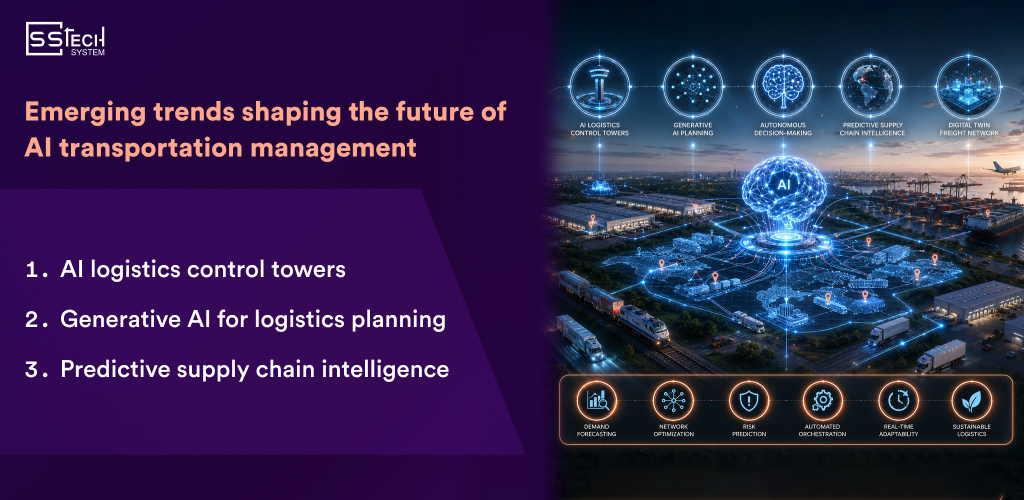
What are the emerging trends shaping the future of AI transportation management?
-
AI logistics control towers
AI-powered control towers offer end-to-end logistics visibility across logistics operations..
These platforms consolidate data from:
- Carriers
- Warehouses
- Fleets
- Customers
- Suppliers
This facilitates more end-to-end supply chain management.
-
Generative AI for logistics planning
Generative AI is increasingly being used for:
- Capacity planning
- Demand forecasting
- Scenario simulation
- Transportation recommendations
-
Predictive supply chain intelligence
The systems of the future will be more predictive; using real-time information and AI, future systems will be able to forecast the disruptions and stop them.
This evolution will strengthen:
- Logistics management software
- Supply chain visibility software
- Logistics optimization software
- Shipment management system
- Logistics technology solutions
Those companies that currently invest in enterprise logistics software are preparing themselves for this future.
Conclusion
The future of freight transportation is becoming smarter, connected and data-intensive. AI transportation management software is assisting companies working in the freight business to overcome operational hurdles, cut expenses, enhance clarity, and make quicker judgments.
With the ever-increasing complexity of freight networks, organizations investing in smart freight management software and modern freight management software solutions will have an edge over the competition. AI is transforming the manner in which freight moves in global supply chains through AI route optimization and predictive analytics, real-time visibility, and automated decision-making processes.
When considering the selection of the best transportation management software for freight companies, scalability, integration, predictive features, and future adaptability fall under consideration. Those organizations which adopt future of AI in freight logistics innovations today will be the most well-positioned to succeed tomorrow.

Frequently Asked Questions
What is AI transportation management software?
AI Transportation Management Software is high-tech transportation software that makes use of artificial intelligence, machine learning, and predictive analytics to automate freight planning, carrier selection, route optimization, shipment tracking, and execution of transportation. It can assist freight companies to be efficient, cost-effective, and make data-driven decisions.
How does AI improve freight transportation operations?
One of the areas where AI enhances freight operations is through the analysis of massive transportation data in real time. It is able to determine the most efficient routes, predict time of delivery, automate the dispatching of packages, track the performance of the shipments, predict a possible disruption and identify it before it affects the operations. This causes quicker decision making as well as a more efficient freight movement.
Can AI transportation management software reduce transportation costs?
Yes. Cost reduction is one of the main reasons why businesses invest in AI Transportation Management Software. The use of AI can reduce empty miles, optimize fuel consumption, enhance usage of vehicles, lessen manual administrative tasks, and avoid expensive delays. In the long run, such enhancements can provide great operational savings.
What is the difference between a traditional TMS and an AI-powered TMS?
A traditional transportation management system mainly promotes transportation planning and execution by predefined rules and manual inputs. An AI-based TMS has gone a step ahead and is constantly learning based on operating data, making predictive recommendations and automating workflows and adjusting to the dynamic state of transportation.
Is AI transportation management software suitable for small freight companies?
Absolutely. Some quality solutions based on AI-driven transportation tools have become affordable to small and medium-sized freight companies because of several other providers that are providing cloud-based solutions and subscriptions. Without having to make big investments into IT, smaller organizations can enjoy the benefits of route optimization, shipment visibility, and automated planning.
How does AI help with route optimization?
AI simultaneously analyses various factors, including traffic conditions, weather predictions, fuel use, vehicle capacity, driver schedules and delivery priorities. It uses this information to create the most optimal directions and assists the companies to reduce their transportation costs and transit time.
Can AI predict shipment delays?
Yes. Modern AI systems take into account past shipping history, route statistics, weather data, and carrier performance indicators to determine patterns which could predict future delays. These prediction abilities enable transportation managers to make corrective measures before service disruptions are experienced.
What integrations should freight companies look for in an AI TMS?
The top integration that should be considered by freight companies is in connecting to warehouse management systems, ERP, GPS tracking, carrier APIs, EDI, inventory management systems and customer portals. Strong integration capabilities enhance data accuracy and eliminate information silos throughout the supply chain.
How long does it take to implement AI transportation management software?
The implementation times also differ in accordance with the complexity of the organization and the number of the integrations to be made. When focused on a small scale, the deployment can be completed in a couple of weeks, whereas a large scale implementation of an enterprise involving several locations and portals can take months.
What are the future trends in AI-powered freight management?
Emerging trends include AI logistics control towers, generative AI-based planning systems, autonomous decision systems, predictive supply chain intelligence, logistics operations digital twin and real-time visibility platforms. Such innovations will keep enhancing efficiency and resiliency across freight networks.
Does AI transportation management software support real-time shipment tracking?
Yes. Most modern solutions include real-time tracking capabilities that combine GPS data, telematics information, and predictive analytics. This enables businesses to keep a track of the location of shipments, the delays, and to give accurate updates on shipments to customers.
How can freight brokers benefit from AI-powered transportation management systems?
The use of AI can help freight brokers to automate carrier matching, optimize pricing strategies, implement carrier performance, find available capacity, enhance shipment visibility, and simplify customer communications. Through these capabilities, brokers enhance productivity besides offering improved service to their customers.
What industries can benefit from AI transportation management software?
Industries such as manufacturing, retail, eCommerce, food and beverage, pharmaceuticals, automotive, construction, and third-party logistics providers can all benefit from AI-powered transportation management. Intelligent transportation technologies can add efficiency in any organization which depends on the freight movement.
Is cloud-based AI transportation management software secure?
Best practices by leading providers to investigate new security mechanisms include encryption, authorization, active surveillance, recovery systems, and regulatory systems. As a result, modern cloud-based transportation management platforms tend to be safer compared to the traditional on-premise systems.
How does AI support long-term logistics growth?
AI enables businesses to scale operations without proportionally increasing administrative workloads. Automation, predictive analytics, and intelligent planning will enable organizations to process increased shipment volumes, improve resource utilization efficiency, and being more responsive to market dynamics. This places AI as one of the important elements in the strategies of growing logistics sustainability.
Related Article