

As companies scale, so too do their software needs. The programs that successfully ran the company’s day-to-day operations may become inadequate as the business serves more customers, has larger teams, and more complicated and varied ways of working.
It is common for businesses to have disconnected systems, repetitive tasks, and be unable to produce the reports they need. Furthermore, the number of software subscriptions a business has may also increase. Because of these issues, choosing software becomes a strategic business decision.
Package software is easily available and fairly inexpensive. Custom software development, on the other hand, is more expensive and takes longer. However, both have their advantages. Their long-term impact depends on how well they help the business with its day-to-day operations and how they help the business grow.
There are several factors that must be evaluated with respect to costs, flexibility, scalability, integrations, security, and other technology and business considerations. We will look at how each of these is impacted by off-the shelf and custom software development.
What Is Custom Software?
Custom software is business-specific software that is developed to meet the company’s specific needs. Because packaged software does not always meet a company’s needs, custom software development offers companies the flexibility to build the software to work exactly as they want it to, with the features they deem necessary, and to integrate it with other company software the way they see fit.
Through custom software development, companies have greater control over how the software functions and the features it includes. Because of this, companies can tailor the software to their business the way they see fit.
Modern custom software can take several forms:
- Custom web and mobile applications
- Internal business applications
- AI-powered applications
- Low-code and AI-powered builds
- Custom integration layers
Custom software development could help integrate these systems, especially if no software on the market does it. Custom development helps address specific needs and provides a good level of control over how software functions, what it integrates, how it manages data, and its future direction.
What is Ready-Made Software?
Ready-made software, also known as off-the-shelf or commercial off-the-shelf software (COTS), is software developed for the broad market rather than a single organization. It is designed with standard features and functionalities and requires minimal configuration to be used by an organization.
It is available in different ways of access and usage:
Software as a Service (SaaS)
These are cloud-based applications that are accessed via an internet connection, and organizations pay a monthly or annual subscription based on users, features, or usage.
Licensed off-the-shelf software
These are sold via one-time or recurring licenses, and depending on the agreement, the software could be hosted by the vendor or installed on the organization’s premises. Some off-the-shelf software for small businesses comes with integrated AI.
For example, a CRM could provide AI-generated customer insights, or a business process automation could provide summaries and automate task updates. Businesses can be limited in their control of AI models used, integrations, customizations, and data access in ready-made software. The main attraction of off-the-shelf software is that businesses get software features quickly and without the cost of a full cloud application development project.
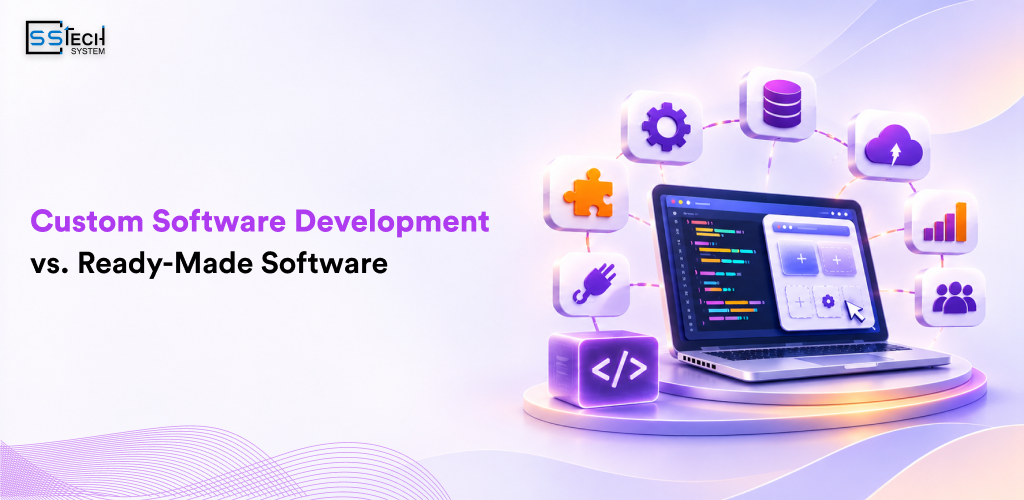
Custom Software vs. Ready-Made Software: Key Differences
Both types of software help facilitate business operations, but they differ in areas of ownership, flexibility, costs and control in the long run – factors: custom software vs off-the-shelf software for growing businesses.
| Factor | Custom Software | Ready-Made Software |
|---|---|---|
| Ownership | Source code and IP ownership depend on the development agreement. | Vendors generally own the product and source code. |
| Flexibility | Built around specific business workflows. | Limited to available features and configurations. |
| Time to launch | Requires planning, AI software development, and testing. | Usually available for immediate or quick deployment. |
| Ongoing cost | Maintenance, hosting, upgrades, and support. | Subscriptions, licenses, add-ons, and usage charges. |
| Upfront cost | Generally higher due to software product development. | Usually lower, particularly for SaaS. |
| Scalability | Can be expanded according to business requirements and architecture. | Depends on vendor infrastructure, plans, and pricing. |
| Integration | Can be designed around existing systems. | Depends on supported APIs and integrations. |
| Vendor lock-in | Can be reduced through ownership and portability agreements. | May involve dependency on vendor pricing and infrastructure. |
| AI readiness and data access | Greater control over AI integrations and data pipelines. | Depends on vendor-provided features, APIs, and data policies. |
| Support | Managed internally or through a development partner. | Usually provided through vendor support plans. |
Custom software vs off-the-shelf cost comparison
Cost is a major consideration in the build-versus-buy decision. To evaluate the true costs of software, both short-term and long-term costs must be analyzed.
Short-term costs associated with custom software development include the features, complexity, design, technology and integrations, data and security. Custom software development can range in price from a few thousand dollars to many hundreds of thousands of dollars. SaaS software development typically has a lower up-front cost than other software products.
One drawback of SaaS products is that costs can increase if a business expands (e.g., if 20 employees of a company use the SaaS product, each user would cost ₹1,000 a month. After one year, the cost would be ₹2,40,000. After five years, the cost would be ₹12,00,000).
The SaaS product also doesn’t address all the business’s needs. Integration and additional premium features aren’t usually included in the base cost of the SaaS product. There are also training, data migration, legacy system modernization and other costs associated with implementing the SaaS product.
Which Software Is Better for Business Growth and Scalability?
Scalability means software can manage increasing users, transactions, data, and operational complexity without major performance or cost problems. Typically, off-the-shelf software provides scalability. Businesses can add users or upgrade their subscription plans to meet their needs. The vendor manages most of the infrastructure and maintenance.
But there are limits to scalability, such as per-user pricing, storage and API limits, and customization.
With custom software, control over scalability is in the business’s hands. The architecture can be designed to accommodate a greater volume of work and support other business functions and integrations.
For example, let’s say a business starts out by just managing products and orders. As the business grows, it may need to automate its warehouse, offer personalized product recommendations, and manage various vendors. Custom software can accommodate all of these through planned development.
Poor design, inadequate infrastructure, and lack of maintenance can limit scalability for custom applications as well. The better software is the one that supports the business’s expected growth and expansion, without creating unmanageable financial and technical limits.
Read more: Cloud TMS vs On-Premises: What’s the Right Call for Mid-Size Shippers?
When Should a Growing Company Choose Custom Software?
Consider custom and enterprise software development when your business processes are constrained by the inability of off-the-shelf software to meet your key business requirements.
Unique workflows and processes
Some businesses may have operations that are too unique or too complicated to be implemented by off-the-shelf software. In such situations, businesses can work with a custom web application development company to implement a solution that integrates with the existing business processes.
Feature and integration gaps
Sometimes, a business may have software tools that create data silos due to integration gaps. In such situations, a business may want to implement a custom software solution to connect these gaps and provide functionality that may be missing in existing software.
Competitive advantage and unique control
Companies may want to develop custom software to gain competitive advantage by controlling and maintaining unique functionality and access.
Unique AI and Security Requirements
In certain situations, a business may want to incorporate AI, unique controls, audit trails, and other security, data governance, and risk management features in a custom software solution that is integrated with the core business software.
When Vendor Lock-in and cost increase
Custom software may be more viable if a subscription-based product has increased its fees significantly, locked a business’s data, or charged an excessive per-user fee.
When Is Ready-Made Software the Better Choice?
Custom software is not always the best option for every business. Off-the-shelf software is more viable if business requirements are mundane and would only lead to the unnecessary complexity of a custom solution.
When the business is time constrained
Sometimes, a business may want to quickly start its operations and may not have the time to wait for software to be developed. In such situations, the company can opt for off-the-shelf software to immediately start its operations.
When budget is limited
For a small or medium enterprise, capital constraints may dictate that the company opt for off-the-shelf software.
Resources are finite
Vendors are generally in charge of software or mobile app development, infrastructure, and maintenance.
The software is not a competitive differentiator
There is not much benefit in developing a differentiator in a component that can be solved through standard software.
Needs are changing
Startups can test different processes through standard software before investing in custom development. For example, a small company may not need to develop a custom HR management system.
Can a Company Combine Custom and Ready-made Software?
Yes, a hybrid or composable approach can work for growing businesses.
A growing company can:
- Use off-the-shelf solutions for accounting and finance software.
- Opt for SaaS solutions for HR and employee records.
- Use custom CRM software for managing customer interactions and workflows.
- Use API integration services to connect and integrate business applications.
- Develop custom AI solutions to augment reporting and internal corporate functions.
In this scenario, a business has developed tailored solutions for specific functions and retained standard off-the-shelf software for other functions. This can aid gradual business digital transformation.
E.g. a growing e-commerce retailer can:
- Use the same e-commerce platform.
- Develop custom inventory management systems and integrations.
- Logistics: A transportation company with an intricate fleet, warehouse, and delivery operations invests in custom transportation management software to integrate route planning, tracking, dispatch, and notification of customers.
- Professional services: A firm offering software consulting services uses off-the-shelf solutions for accounting, payroll, and project management and builds a custom dashboard to integrate project performance, employee utilization and revenue.
A successful hybrid implementation requires the right integration of APIs and governance of data.
Read more: How to Integrate Custom AI Agents into Enterprise Workflows
How to Choose the Right Software for Your Business
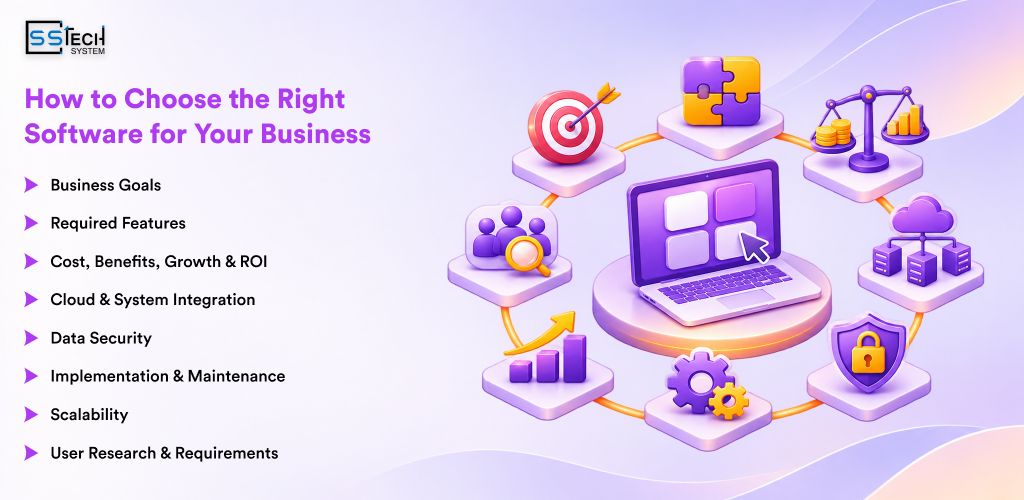
Prior to investing in custom and ERP software development or purchasing off-the-shelf solutions, evaluate your current requirements and future needs.
Use this decision framework:
- Define your goals
- Decide on features
- Estimate cost and benefits of custom software for growing business
- Assess data migration and integration
- Review control of data and security
- Evaluate implementation resources
- Assess partner reliability and expertise
- Think about maintenance and expansion
- Understand exit options
A structured evaluation helps businesses make software investments based on long-term needs rather than short-term conveniences.
Common Mistakes Growing Companies Make When Choosing Software
Even with robust software features, a product can be a poor investment if it does not adequately meet the needs of the business.
Some common mistakes include:
Making purchases based solely on the initial price: increases in subscription costs, maintenance and migration expenses in the long run can increase expenses.
Over-customizing
Making the software conform to business needs by extending and modifying the software with additional features can add complexity, increase software maintenance and support burden and reduce usability.
Failing to connect software
This results in data silos and increases manual work.
Focusing on current needs
Software that meets the needs of the business today may not be able to meet the needs of the business in the future.
Ignoring threats to the business
Using software with inadequate access controls creates an exposed attack surface and increases the risk of a security breach.
Not addressing vendor lock-in
This can increase the cost of migrating to another vendor.
Making choices without a clear end in mind
Undefined goals and a lack of planning when making decisions about CRM software development can be costly.
Conclusion
As a growing company, you face the challenge of choosing between the convenience and lower up-front cost of off-the-shelf software and the control and long-term direction of your software by developing it in-house. Custom software allows for complete control over the product in the long term. In the end, it depends on your workflows, your budget, your scalability requirements, and your security and competitive requirements.
If your business needs software to integrate and connect your current systems and enable long-term digital transformation of your business, then partnering with an experienced custom logistics software development company can help you evaluate and strategize your next move. SSTech System is part of our valued network of partners. They help businesses assess tailored software solutions.
Frequently Asked Questions
How to choose between custom and off-the-shelf software?
Custom software is developed to address specific business needs. Ready-made software offers fewer functionalities to cater to a wider market. While custom software can be more flexible, ready-made software is generally easier to implement and costs less upfront.
What is best for a growing business: custom or ready-made software?
This largely depends on the business. Ready-made software is usually adequate for simpler business processes such as accounting and payroll. Complex and integration-heavy processes are better suited for custom software.
Is custom software more expensive than ready-made software?
The upfront cost of custom software is generally higher than ready-made software. However, the operational inefficiencies and costs of ready-made software can become more than the costs of custom software in the long run.
What is the total Cost of ownership (TCO) for custom software vs. SaaS?
Want to know the cost of custom software vs SaaS for mid-size companies? TCO is the total expense associated with a software over its lifecycle. TCO for custom software includes development, maintenance, and support costs. TCO for SaaS is the subscription and additional costs of premium features, integrations, and training, as well as potential future price increases.
When should a growing business choose custom software?
A business should consider custom software when the company outgrows existing software, tools and integrations. Rising per-user costs of SaaS also justify consideration for custom software.
Can off-the-shelf software be customized later?
Yes, numerous extensions and plugins are available. Depending on the vendor, customization may be possible. If key requirements cannot be satisfied through extensions and plugins, businesses may opt for custom development or a hybrid approach.
Is custom software more secure than off-the-shelf software?
Not automatically. Custom software enables better control over security architecture, access control and data handling. Like other software, security depends on the development practices, testing, and maintenance. Established software vendors may have dedicated development teams and processes.
How long does custom software development take?
This is largely dependent on the complexity of the application and features. Simple applications may take a few months, while large and complex enterprise applications may take longer, even a year or more.
Is AI reducing costs and increasing speeds for custom software development?
Using AI for software development can help speed up coding, testing, documentation, and prototyping. Low-code/no-code development platforms can also aid in software development. Nonetheless, building and deploying business applications continues to require a development team to build, integrate, and test software components, as well as define security and quality assurance policies.
What is vendor lock-in, and how can growing companies avoid it?
Vendor lock-in is when a company relies too much on a single software provider, making it difficult and expensive to change providers. Companies can minimize this risk by assessing a provider’s data export and/or APIs, contract terms, backups, and/or software modernization services.
What is a hybrid software approach?
A hybrid approach is using pre-made software and integrations along with custom software, making a company’s solution best-of-breed for core functionalities, and using off-the-shelf software along the edges. This approach balances development costs, solution flexibility and scalability for core functionalities of a business.
Related Article