


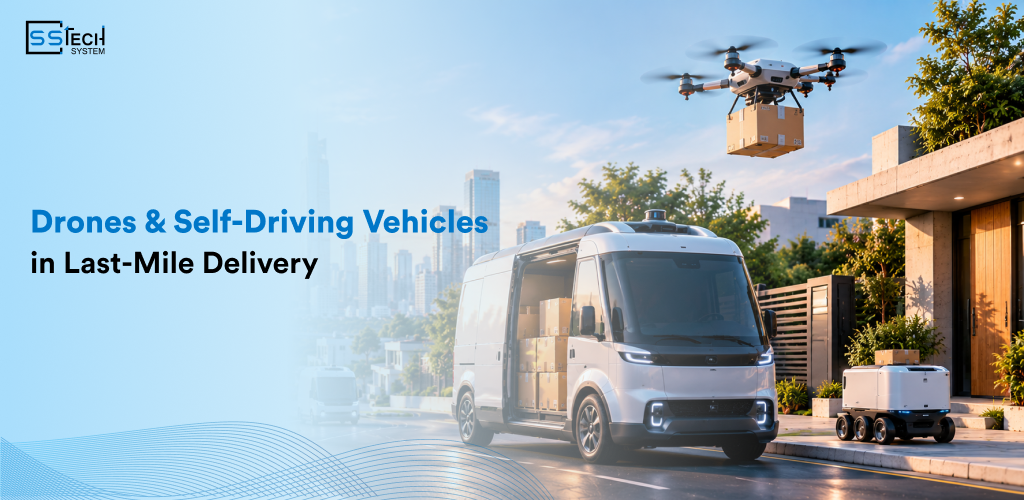
Autonomous last-mile delivery has been a topic of discussion in the logistics industry for several years, and it is now gradually moving from pilot programs to real-world commercial operations. Drones, sidewalk robots and self-driving vehicles are already being used for actual deliveries, although their use remains largely limited to specific areas and controlled conditions.
While this technology has made substantial progress, there remain various legal and regulatory restrictions that limit its use. Other delivery systems remain tethered to and/or supervised by a human operator.
Beyond the competing autonomous delivery systems, numerous related, but separate technologies need to be developed and integrated for a fully functional and economical delivery system to be realized. These include systems for processing payments, logging deliveries, customer acceptance and other operational considerations.
What Is Autonomous Last-Mile Delivery?
In logistics, delivery of goods from a source to a customer is considered a ‘last-mile’ delivery. Traditionally, this is done by a human driver. Autonomous Last-Mile Delivery refers to the use of drones or robotic vehicles to perform last-mile delivery in an unsupervised or minimally supervised manner.
Autonomous Delivery has the potential to disrupt traditional delivery systems in a variety of ways. For example, instead of people being the ones to collect deliveries from a central location and deliver them to customers, it may be transport management software and machinery that perform those tasks.
An order can be assigned, a vehicle automatically scheduled and routed, progress tracked, and the customer notified of the delivery, all automatically. This significantly improves the efficiency of last-mile delivery.
As autonomous systems improve and the cost of human drivers remains significant, it is likely that delivery systems will increasingly use autonomous delivery technology to transfer predictable loads and employ human drivers to deliver unpredictable loads or to perform customer service functions.
There are various levels of autonomy. A delivery system could be completely autonomous or could operate delivery functions without constant human supervision. The latter, however, could retain the ability to contact a human operator for assistance, if necessary.
The use of remotely order fulfillment software systems by customers could result in more efficient delivery, as well as timed delivery notifications, the ability to track the delivery, and more precise deliveries. The use of an autonomous vehicle to make the last leg of a delivery may make the remainder of the delivery system, including dispatch and fulfillment functions, less dependent on human employees.
Improvements in freight operations software and delivery management software may allow many delivery functions to be automated. Delivery management systems integrate multiple components, similar to an aircraft drone system. The required hardware and software for delivery systems management are rapidly improving.
Drone Delivery Technology: Where Does It Stand Today?
How Drone Delivery Systems Work
A drone is assigned to an order, and the system plans a route. Restrictions considered may include physical limitations (distances, obstacles, barriers) and operational limitations (regulations, conditions, permissions). Route planning and flight management systems help guide the drone and adjust to external factors along the route. Upon arrival at the delivery location, the drone may use a delivery mechanism to lower the package.
Where Are Drones Most Useful?
Drones can be beneficial in logistics to deliver items over distances where using road infrastructure is difficult or time-consuming.
Examples include transporting
- Blood products and other time-sensitive medical supplies
- Packaged foods and other time-sensitive goods
- Package delivery over distances and times that are not practical with road-based delivery systems
- Hard-to-reach locations without a convenient road infrastructure
Who Is Operating Drone Delivery Today?
A U.S. Federal Aviation Administration report on commercial drone delivery services indicated that companies with authorized Part 135 operations and commercial drone delivery services include Amazon Prime Air, Zipline, Causey Aviation Unmanned, DroneUp and Drone Express.
The scope of the operations is increasing. In January 2026, Wing announced it would build drone delivery systems for 150 Walmarts, adding to the over 100 Walmart systems it was already building, giving it over 270 delivery systems, enabling delivery to over 40 million people.
Amazon Prime Air also has plans for expanding its drone delivery systems. In March 2022, the FAA approved an Environmental Impact Statement for Amazon to build Prime Air’s drone delivery infrastructure in the Detroit area. Each of the two Detroit-area fulfillment centers would be permitted to conduct up to 1,000 MK30 drone deliveries per day.
What Are the Benefits of Drone Delivery?
Drones can use routes that are more direct, which can decrease delivery times for packages that aren’t large or heavy. Because drones require no traditional delivery vehicle, they can also eliminate the need for a delivery vehicle in combination with other benefits, like contactless delivery, to improve and expedite delivery of items like medical supplies.
What Are the Challenges of Drone Delivery Technology?
There are many challenges of drone delivery technology that make it commercially limited. Flight times and delivery ranges are restricted by the drone’s battery. Weather conditions and air traffic can impede flights. Drone delivery is also not efficient for transporting larger or heavier cargo.
Urban areas introduce other challenges for drone delivery. Buildings and power lines obstruct flights, and there are even more potential conflicts with other forms of transportation and delivery. As a drone network operates at greater density, an operator must be able to demonstrate that the network does not violate privacy or increase noise.
Self-Driving Vehicles in the Logistics Industry
How Self-Driving Vehicles Work
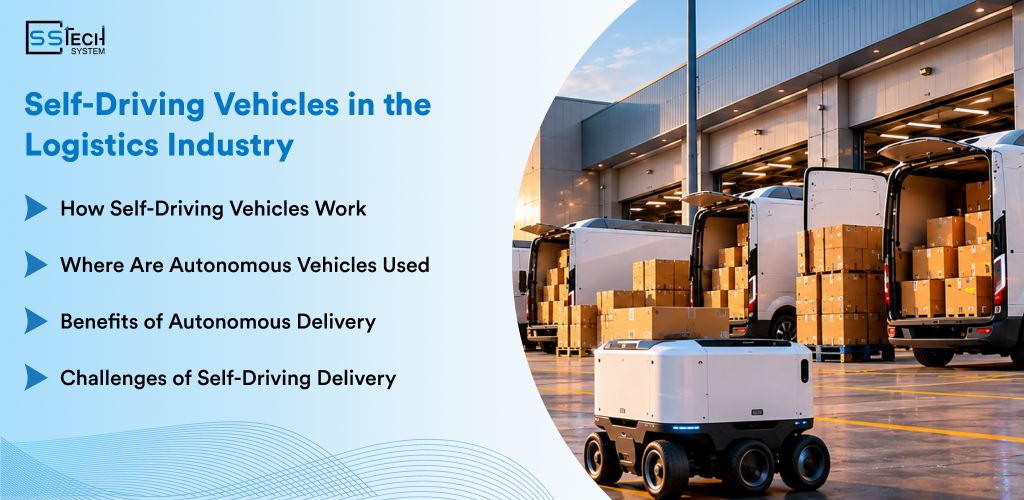
A range of technologies can be used to create a self-driving delivery vehicle. The vehicle may use different combinations of technologies, including GPS, sensors, radars, cameras, and artificial intelligence.
The vehicle is programmed with custom software development to analyze and interpret surrounding conditions. The software may make decisions for the vehicle regarding maneuverability and safety.
The technology may range from basic vehicle maneuverability to higher levels of control. The NHTSA states that to be at Level 4 automation, a vehicle must be able to safely control all aspects of driving in specified conditions and environments, and do so without a human driver.
Where are Autonomous Delivery Vehicles Operating?
Vehicles at levels 4 and 5 are being tested on both public and private roads. The features of these vehicles allow them to operate in various environments and conditions. For example, Nuro reports 2 million miles of autonomous operation without an at-fault collision. Also within this space are delivery robots designed to operate within very small (e.g. campus) and defined environments.
Benefits of Autonomous Last-mile Delivery and Self-Driving Delivery Technology
Continuous route repetition allows self-driving vehicles to collect data for process improvement. This also allows logistics providers to optimize routes and improve visibility into deliveries. As an added benefit, this data can be used in other areas of logistics, like storage and order fulfillment.
Read more: Explore how software can help improve fleet visibility, route optimization, and delivery operations.
What Are the Challenges of Self-Driving Delivery Technology?
There are a number of unpredictable factors in the road environment, like construction, poor weather, and other drivers. Delivery robots face similar challenges as driving robots and must also traverse uneven and unexpected surfaces.
There are a number of constraints to fully autonomous systems. Operators must be able to communicate with one another and define a protocol for what to do when the system reaches a limit of its capabilities.
Drone Delivery vs. Traditional Delivery What Changes?
Roads, of course, are for other vehicles, including traditional delivery. Drones can bypass roads and congested areas, but still face constraints on where they can operate.
Delivering packages by drones may also still require traditional delivery to bring the packages to and from the drones. Traditional delivery may also be a better option for heavy or bulky packages.
Autonomous Delivery Vehicles vs. Drones Which Fits Which Use Case?
Drones handle lightweight goods and quick deliveries efficiently, especially when road conditions create challenges. Delivery vehicles work better for longer routes, while autonomous ground robots (ATGs) suit heavier goods and short-distance deliveries in mapped, structured, and controlled road or sidewalk environments.
Controlling different last-mile delivery systems can be accomplished in a hybrid manner. For example, in a given delivery area, ATGs can be used to transport the bulk of the delivery orders, while drones can be used to deliver the most urgent orders. Flexibility can be introduced to the last-mile delivery system to meet the most stringent business requirements.
Regulation and Safety Where Can These Systems Legally Operate
There are more regulations prohibiting fully autonomous systems than facilitating them.
United States
While the U.S. FAA regulates commercial aviation, including drone package delivery, the applicability of existing regulations to these types of services is debated. Proposing a delivery corridor would likely require the FAA to use its discretion to authorize an exemption to existing rules and regulations.
European Union
Under the EU’s UAS framework, an operator wishing to conduct beyond visual line-of-sight (BVLOS) operations would require special operational authorization.
India
The DGCA has established regulations and guidelines pertaining to drone operations. BVLOS operations would require special authorization.
China
Autonomous logistics solutions, including ATGs and drones, are likely to be the focus of significant country investments. In general, a request for a BVLOS operation would require an operator to request a special operating authorization.
Ground Vehicles and Sidewalk Robots
Compliance with local and agency requirements will also govern the deployment of ATGs and robots. Focus on safety will drive widespread adoption. Safety must be integrated into a system at all levels, including the integration of various sub-systems.
What Does the Technology Stack Behind Autonomous Delivery Look Like?
Although the focus is currently on the hardware for delivery, there are layers of software that control delivery networks.
These layers help to connect various components of the delivery process and may include:
- Last Mile Delivery software
- Delivery Workflow Automation
- Delivery Scheduling Software
- Courier Delivery
- Electronic Proof of Delivery
- Delivery Analytics
- Transportation Management
- Logistics Development
- Carrier Integration
- Shipment Visibility
These layers of integration may also be used to control Freight Delivery and warehouse management systems. Some delivery networks use more sophisticated integration and may include AI Logistics, IoT, Cloud Logistics, Predictive delivery analytics platform and other next-gen delivery solutions.
Read more: How Digital Proof of Delivery Software Reduces Delivery Disputes
How Autonomous Delivery Is Changing Last-Mile Logistics
There are numerous systems and processes in the logistics chain that must be integrated in order for autonomous delivery systems to be fully functional. These include order management, inventory, warehousing and fulfillment systems. Autonomous delivery systems or shipment visibility platform must connect to these AI logistics solutions in much the same way that traditional delivery systems are integrated.
When these systems are fully integrated, logistics systems will be able to select the most appropriate transport method based on a number of factors including cost and distance. This includes the ability to choose the most appropriate delivery mechanism from among thousands of drones, robots, or other systems.
Key Challenges Holding Back Autonomous Last-Mile Delivery
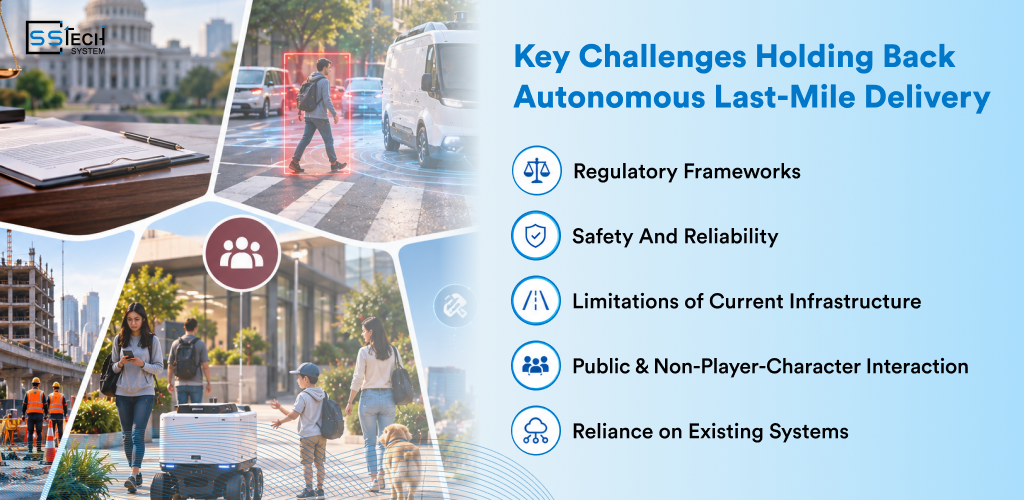
Regulatory Frameworks
Developing and testing autonomous systems is often easier than implementing these systems in the business world because of the differing and fragmented regulations.
Safety And Reliability
There are a number of failures that are difficult to foresee and routes that are uncertain. Because of this, there are a number of situations in which an autonomous system must be safe and reliable.
Limitations of Current Infrastructure
Mapping of transportation networks and public walkways, as well as available building and delivery zones, limits the deployment of autonomous systems.
Public and Non-Player-Character (NPC) Interaction
Drones and other delivery systems must be able to intelligently and safely operate in pedestrian and vehicular environments.
Reliance on Existing Systems
While some Fleet Management Systems (FMS) are autonomous, they still rely on associated systems for delivery management and order fulfillment. Poor system integration can negatively impact the value of the hardware.
Cost and Scale
Purchasing FMS is only one of many expenses. Resolving the challenges associated with FMS, including courier delivery software, connectivity, oversight, and compliance, will affect profitability.
Concerns of Environmental and Climate Change
Using Electric Vehicles (EVs) and other intelligent delivery networks for transport can reduce vehicle-related emissions, but they can potentially increase overall emissions due to their electricity source and utilization.
Noise and Privacy Concerns
The increased deployment of drone delivery systems will likely heighten public concerns about noise and privacy.
Autonomous Delivery Trends 2026 and Beyond: What Should Businesses Watch?
Drone Delivery Systems
Some companies, such as Wing, have plans to expand their commercial drone networks rapidly. In 2026, Wing plans to deliver packages to over 40 million people in the U.S. using drones to connect to 270+ Walmart locations.
Ground Delivery Systems
During the past year, several companies have launched last-mile delivery services in urban areas that use ground delivery systems. Many of these operations are based on the use of “fleets” of unmanned delivery systems vehicles to deliver packages to individual customers.
Smart Warehouse Solution
There is a growing trend toward integrating autonomous delivery with warehouse automation technology.
Real-Time Shipment
Many shipping companies are using technology that provides their end customers with the shipment location and status.
Hybrid Models
Fully autonomous systems for last-mile delivery are some years away. It is likely that, for the foreseeable future of the last-mile delivery will be completed by human couriers.
Conclusion
Relevant examples of ALMD technology include delivery by drones and sidewalk robots. Additionally, driverless driver technology cars are gathering experience driving in the real world. Even though examples of ALMD technology are becoming more common, it is still in an early stage of logistics software development.
It is more likely that delivery logistics will involve multiple forms of transport, i.e., delivery by drones and/or driverless cars, robots, and delivery by human couriers, all integrated into a single system. As regulations and software integrate better with the logistics of moving and fulfilling customer orders, this type of robotic delivery technology will become more widespread.
Frequently Asked Questions
What is Autonomous Last-Mile Logistics?
This is a delivery system that uses drones, robots or automated vehicles to deliver goods from a fulfillment center to the end-user with minimal human-to-human interaction.
Is it legal to use delivery drones?
Yes, but in order to deliver goods by drones, permission is required from the Federal Aviation Administration (FAA) of the country where the drone deliveries are conducted.
Is autonomous last-mile delivery of goods systems worth developing?
Yes, because it has the potential to reduce the cost of delivering goods by lessening the reliance on human couriers while also enhancing the efficiency of the supply chain.
What are the barriers to using drone delivery?
The primary barriers to using drone delivery systems are legislative constraints, privacy concerns, public safety and security, as well as the costs of developing the systems.
What are the applications of autonomous delivery vehicles?
Currently, self-driving vehicles in logistics industry are mostly used for local deliveries and other restricted transportation of goods.
Is drone delivery better than traditional delivery?
Drone delivery systems will probably never be able to fully replace traditional delivery methods. For some shipments, delivery systems that utilize drones can provide advantages.
Is an autonomous delivery system a good business idea?
The reason there is no clear answer to this question is due to numerous variables, including delivery volume, employee wages, regulations, the delivery system, the industry, and the company’s business strategy.
When will autonomous delivery become mainstream?
This question when will autonomous delivery become mainstream not have a clear, definite answer. The implementation and use of these systems will probably be determined by individual countries, the kinds of deliveries, regulations, and the delivery system's economics.
How much will an autonomous delivery system cost?
There are too many factors that influence cost to provide an answer. For example, delivery volume, how the delivery system is regulated, the delivery system's equipment, the delivery system's infrastructure, and the delivery system's utilization, to name a few.
Related Article