


If you are planning to invest in logistics technology this year, you are probably asking one critical question: how much does logistics software development cost in 2026?
If you run a courier business, 3PL or eCommerce supply chain, then understanding the Logistics Software Development cost is not a choice, it is a mandate that influences your margins, scalability and operational performance.
Logistics is much more than trucks and warehouses today. We are talking here about supply chain automation, real-time tracking of shipments, predictive route, and eventually, the digital control of every moving part. Calculating the Cost of logistics software development is an affordable and, you are not just charging to create code, you are charging for a long-term transformation.
In this guide, you will learn:
- The complete logistics software development cost breakdown
- Location-based logistics software pricing in 2026
- Hidden costs of software development
- Hiring and engagement models
When estimating how much it will cost to create a logistics management software, this guide will help you set a real logistics software development budget, either if you build a logistics management software, a transportation management system (TMS) or a warehouse management system (WMS).
Read more: How AI is Transforming Warehouse Automation?
What is Logistics Software Development?
Logistics software development is the process of designing and building digital products that operate in transportation and warehousing, inventory, fleet tracking, dispatch, and last-mile delivery.
This includes solutions such as:
- Transportation management system (TMS)
- Warehouse management system (WMS)
- Fleet management software
- Last-mile delivery software
- Route optimization software
- Freight and Freight Carrier Management platforms
Create software for courier services, 3PL operators, food chains, pharmaceutical suppliers, or business supply chains. Logistics tech is a broad term that covers a wide range of sectors- from Food Delivery app development to Pharma delivery app development to Grocery delivery application development.
Basically, if you are digitizing dispatch, automating routes, onboarding carriers, or tracking shipments in real time, then you are paying for supply chain management software development.
How Much Does Logistics Software Development Cost in 2026?
Cut to the chase, the burning question
In 2026, the price of custom logistics software usually falls between:
- $30,000 – $80,000 (basic MVP)
- $80,000 – $200,000 (mid-scale system)
- $200,000 – $500,000+ (enterprise-grade platform)
Realistically, the Supply Chain Software Development Cost largely relies on the complexity, integrations, automation level, and geography.
So, even if you need to spend a bit more sunshine on logistic software development, the cost will be much less if you outsource the work to a trusted logistics software development company in India and Eastern Europe.
Along with the logistics software development cost, it is important to look for the logistics software development timeline and the depth of application features and integration.
Logistics Software Development Cost Breakdown
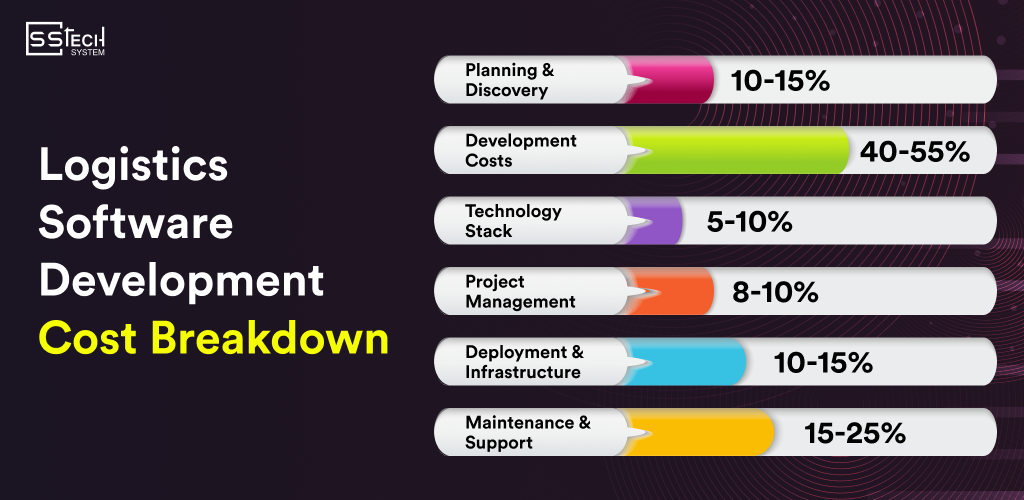
Let us break it down more, how the development of logistics software costs go, so that you know where your money goes.
A. Planning & Discovery (10-15%)
This phase defines your success.
- Business Analysis: You track workflows, operational inefficiencies, and identify where automation makes sense. So, if you need Carrier integration solutions or you need optimized dispatch logic, this has to be planned here.
- UI/UX Research: Your logistics process automation is as strong as its weakest link. If drivers, warehouse staff, and dispatchers find the interface difficult to use, then forget about it.
- Architecture Planning: Scalable architecture is the one, so you will not face a performance decrease when your business grows, and you get more clients.
Because proper discovery is so often skipped, looking deeper into the hidden costs of software development can later reveal yourself a regrettable pattern of coding and refactoring, which normally ends-of-nearing marketing deadlines.
B. Development Costs (40-55%)
This is one of the big components of the investments.
Frontend & Backend Development
Dashboards, driver apps, admin panels, customer portals, these are what end users interact with, and hence your system experience.
Here, the mobile cost layers are added if you are building via Logistics mobile app development services.
API integration for logistics systems
You may integrate:
- Payment gateways
- Carrier APIs
- GPS tracking services
- ERP systems
- Third-party marketplaces
Cost of logistics software development increases with every additional integration.
Database Engineering
An exemplary example will be a logistics platform processing high volumes of real-time data. Real-time Shipment Tracking and Analytics: The cornerstone of a successful shipment tracking solution is its database architecture.
C. Technology Stack
Whether you are a startup or an enterprise, your technology decisions drive initial cost and long-term ROI.
- AI in logistics software: Predictive analytics can be applied to logistics, demand forecast or smart dispatch, you name it.
- IoT in logistics: For pharma or food delivery businesses, IoT sensors are effective tools to monitor shipments that are sensitive to temperature.
- Cloud-based logistics software: Cloud deployment supports scalability and reduces infrastructure dependency.
- SaaS logistics platform: Saas subscription models facilitate the smooth monetization of your solution.
The cost of custom logistics software also increases with advanced AI routing, enterprise analytics, and Logistics IoT Solutions.
D. Software Development And Engagement Models
The correct engagement model affects pricing and risk.
In-house development team
Pros:
- Full control
- Deep business alignment
Cons:
- High recruitment cost
- Infrastructure overhead
- Long hiring cycles
This consequently ramps up the Hidden costs of software development.
Outsource software development
You are working alongside a professional logistics software development company which is already aware of freight management software development and supply chain management software development.
That minimizes excruciating delays in hiring, speeding up your software development timeline.
Hire Freelancers
The less expensive option but a greater coordination risk. Suitable only for small MVPs.
Hiring Cost Models (Pricing Structures)
- Fixed Cost Model: Best for clearly defined scope. Budget predictability is high.
- Dedicated Developer Cost: You pay every month for developers that are assigned to you. Perfect for scaling and long-term projects.
- Time & Material (Hourly-Based) Cost: Flexible. Best when scope evolves.
In the context of custom vs off-the-shelf logistics software recall, custom is great for long-term scalability; off-the-shelf loses the unique factor.
E. Deployment & Infrastructure
- DevOps: CI/CD pipelines facilitate seamless releases.
- Hosting & cloud expenses: Cloud costs depend on things such as traffic, storage, and API usage. Cloud infrastructure for a heavy traffic SaaS logistics platform.
F. Maintenance & Support (15-25%)
Maintenance is not optional, it’s continuous.
- Security compliance
- Third-party API fees
- Carrier integrations
- Scaling infrastructure
- Post-launch upgrades
There is a direct correlation between ongoing maintenance and the long-term ROI of your logistics software.
Factors Affecting Logistics Software Development Cost
The budget of a logistics platform is not determined by coding effort alone; but rather on depth of scope, number of integration layers, automation goals and long-term scalability planning. A true assessment of cost means not inadvertently low-balling on infrastructure, compliance, and integration complexities that can add costs mid-project.
- Project scope & feature complexity: The wider the scope i.e analytics, automation, real-time tracking the greater number of development hours you will need and higher the architecture complexity involved.
- Custom vs Off the shelf logistics software: Although a custom system comes with a higher initial cost, they will scale with you and set you apart from the competition, whereas off-the-shelf tools require a much lower upfront cost, but they restrict flexibility.
- Number of required modules (TMS, WMS, fleet management software, last mile delivery software, etc.): More the number of modules more backend logic, database design, API integrations, and testing work.
- Supply chain automation: In other words, automated dispatch, smart routing and predictive alerts increases the engineering and integration costs massively per level of automation
- Artificial intelligence logistics software integration: Conducting predictive analytics, demand forecasting, or AI-based route optimization needs data modelling, algorithm development, and higher computing infrastructure.
- Carrier Integration: Integrating different carrier APIs increases technical complexity, compliance validation, and maintenance cost.
- Freight Carrier Management integration: Freight billing, tracking integration, and contract rate management have higher ERP-level integration needs.
- Needs based on Industry (courier, 3PL, eCommerce, pharma, food delivery, grocery delivery): Compliance standards, temperature monitoring, batch tracking, or SLA enforcement are highly specific to an industry and influence the architecture of the system directly.
- Mobile app development services for logistics (driver & customer apps): Development of a cross-platform driver and customer applications involves the additional effort of UI testing and increases complexity in synchronizing the backend.
Logistics Software Development Timeline
It’s uncertain how long does it take to develop logistics software, scope of features, team size, and integration complexity affect the timeline, but a structured execution enables predictable delivery. This allows considerable control of quality and keeps the stakeholders in sync in all phases of the lifecycle.
Discovery & Planning (2- 4 weeks): We document the business requirements, map workflows, and identify the risks while validating the technical feasibility.
Design & Architecture (Duration: 3-6 weeks): Prior to development, system architecture, database schemas, UI prototypes, and integration frameworks are finalized.
Core Development (3 months to 6 months): Frontend, backend, APIs, automation logic, and integration of modules are built and iterated on.
Testing & Optimization (4-8 weeks): Continuous functional testing, performance benchmarking, security validation, and bug resolution cycles are performed by QA teams.
Deployment & Training (2-4 weeks): The backend system is deployed, setup in the cloud for production use cases, end-users are trained on how to integrate the solution into their day-to-day work, and production use of the solution is monitored for production stability.
Logistics Software ROI: How to Calculate It
When possible, take a step back from the cost of development and measure the impact of implementation on operations instead when determining return on logistics technology investments. Generally, ROI in logistics software is calculated using a simple financial formula that compares annual savings with total investment.
ROI Formula:
The formula for ROI is Annual Cost Savings: Development Cost × 100
Some evidence of a good Return On Investment is that your software investment is returning tangible value and operational efficiency.
Measurable ROI Drivers
Decreased fuel expenses through route optimization systems: Smart routing lessens the distance travelled, reduces unnecessary transport, and decreases the fuel consumption of delivery operations.
- Increased accuracy in warehouse execution: Less shrinkage from scanning bar codes and digital inventory and stock movements.
- Cutting the cost of your fleet with fleet management software: The fleet management software helps to track the performance of the vehicles in real-time and thus quickly provides a preventive maintenance schedule to reduce breakdowns and repair costs.
- Last mile delivery software minimizes delivery failures: Automated dispatch with upfront route visibility minimizes failed attempts, reduce returns & SLA penalties.
- Advantages of Automation with logistics process automation: Repeats that time-consuming schedule process, with its attendant paperwork and coordination efforts, but automation is used to replace the time-consuming manual tasks that are staffing costly – period.
- Real-time shipment tracking makes tracking better: With live tracking, customers inherently have fewer queries, better communication, and improved service reliability.
Read more: How to cut down your last-mile delivery cost to increase your profit margins?
Cost Savings & Efficiency Improvements
Logistics software provides tangible time savings and cost reductions that influence your bottom line. The benefit of these improvements is cumulative over the years and builds up long-term profitability when planned wisely.
- Lowering of manual labor costs: Automated dispatch, digital documentation and workflow automation decrease reliance on manual coordination teams.
- Lowering inventory carrying costs: real-time stock tracking avoids overstocking and lowers capital stuck in surplus inventory.
- Enhanced fleet utilization: Optimized scheduling ensures higher vehicle usage with reduced idle time across your fleet.
- Quicker processing of orders: Integrated systems supercharge order allocation, picking, packing, and dispatch workflows.
- Reduced compliance penalties: With automated documentation and digital audit trails, RPA prevents regulatory violations and penalties for delayed delivery.
- Making data-driven decisions by Predictive Analytics in logistics: Modelling historical data facilitates demand prediction and operational adjustments in an anticipatory manner.
Emerging Technologies in Logistics Software
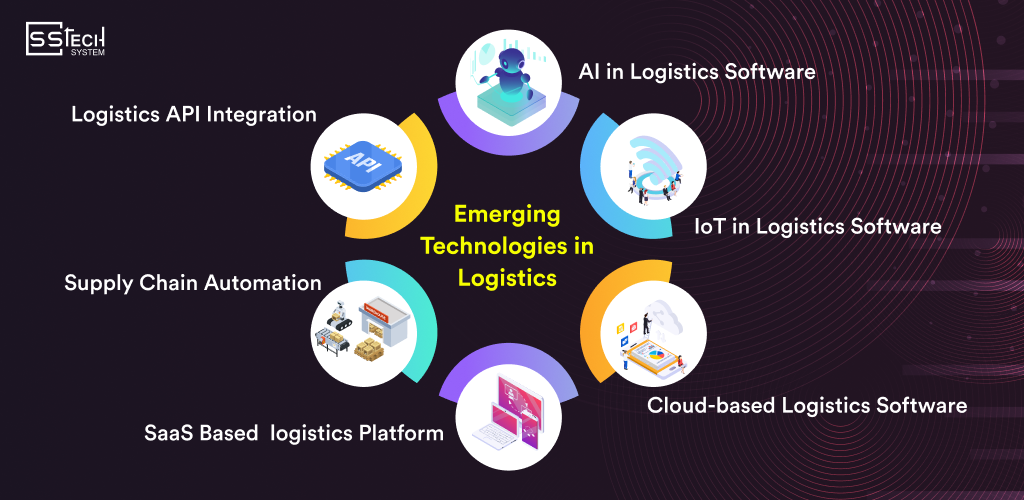
Continuous tech innovation & digital transformation initiatives are transforming modern logistics platforms. Such technologies not only make the business more efficient but also re-architects both the concepts of scalability and the concepts of competitive advantage.
- AI in logistics software: Predictive routing, demand forecasting, anomaly detection, and effective dispatch automation are made possible with the use of AI.
- IoT in Logistics Software: IoT in the Supply Chain: relevant IoT sensors check e.g. temperature, location, and vehicle condition in real-time, in particular important for pharma & food logistics.
- Cloud-based logistics software: Cloud deployment allows scalability, remote access, minimum dependency on infrastructure, etc.
- SaaS logistics platform: SaaS models allow for subscription-based access, automatic updating, and much lower upfront infrastructure investment.
- Supply Chain Automation: The end-to-end process automation minimizes manual intervention and enhances process consistency.
- Logistics system API integration: Integration allows a seamless function together with ERP, payment gateways, carrier networks and marketplaces.
Why Outsourcing Logistics Software Development Makes Strategic Sense
Logistics software development is like outsourcing execution to work faster with lower structural overhead. Businesses can utilize specialized external partners with a demonstrated history in logistics, rather than build large internal teams.
- Accelerated go-to-market with seasoned third-party teams
- Provides access to the logistics domain experts specializing in various areas like TMS, WMS, fleet, and last mile
- Reduced infrastructure and hiring overhead
- Dependent resource allocation correlated with project phase
- Risk-sharing through contractual accountability
- Predictable budgeting with well-defined engagement models
Outsourcing brings technical precision, faster execution cycles, and structured delivery frameworks, all with no long-term payroll commitments to the organization.
Conclusion
Investing in logistics software is not now an optional cost however, a tactical decision that certainly impacts the operational efficiency, client happiness rate and the future profitability of the business in the long run. The development costs may seem daunting at first, but the measurable ROI from automating end-to-end processes, optimizing routes, ensuring accuracy in warehouses, and achieving aggregate fleet efficiency normally balances out the investment in a few months.
Focus on cost-saving drivers you can measure, working from structured financial models to calculate ROI. You gain the ability to make informed technology decisions, free from pressure to react to market forces. Similar to above, emerging technologies such as AI/ML, IoT, predictive analytics, and cloud infrastructure are also accelerating the creation of value in logistics operations.
If you insource or outsource to specialized partners, how you ultimately deliver the software doesn’t matter, as long as you’re focusing your investment in software in a manner that ties to measurable business results. Used properly, logistics software is more than simply a tool to help keep you operational, it is a growth engine.
Frequently Asked Questions
What is the average cost of logistics software development?
The cost of logistics software development typically ranges from $30,000 to $300,000+, depending on system complexity, features, and integrations. Basic solutions cost less, while enterprise-level platforms with TMS, WMS, and IoT integrations require higher investment.
How can logistics software improve operational efficiency?
It eliminates manual processes, optimizes routes, and provides real-time tracking, which reduces delays, improves accuracy, and boosts productivity across logistics operations.
What is the cost of maintaining logistics software?
Maintenance typically costs 15–20% of the initial development cost annually, covering updates, bug fixes, and performance improvements.
Can logistics software integrate with existing systems?
Yes, logistics software can integrate with ERP, CRM, payment gateways, and third-party APIs to create a unified and efficient ecosystem.
Is logistics software suitable for small businesses?
Yes, small businesses can start with an MVP and scale gradually. Modular solutions allow cost-effective implementation based on business needs.
Related Article