


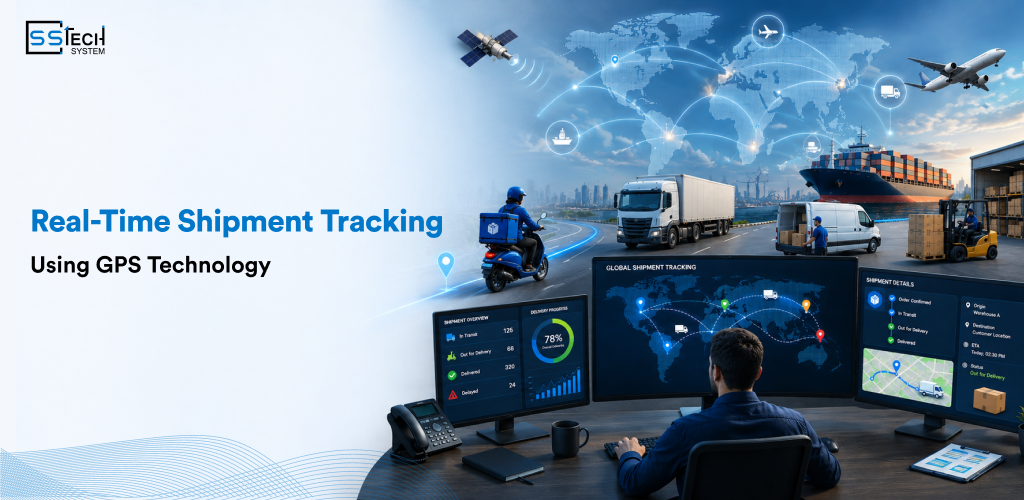
When it comes to delivery updates, customers need accurate information, and logistics teams need full visibility over every shipment. Spreadsheets and status checks do not provide the required visibility. GPS technology gives businesses a view of everything, including vehicles, shipments, routes, and delivery statuses.
Many companies recognize the importance of this visibility. According to CMR, 57% of organizations surveyed cited real-time visibility as a primary issue for their supply chains, expecting to address this by 2025. GPS tracking of shipments can improve business visibility of multiple carriers, vehicles, and delivery points. This helps businesses make quicker decisions, improve overall shipment visibility, and enhance logistics.
What Is Real-Time Shipment Tracking?
Real-Time Shipment Tracking uses GPS-enabled devices and combines them with software and networks to provide tracking of shipments on the move. A shipment tracking system collects location data and sends it to a centralized location.
Based on the information gathered, state-of-the-art real-time shipment tracking systems can show:
- The current location of vehicles/cargo
- Shipment status
- The estimated arrival time
- Tracking shipment progress
- Tracking exceptions and delays
- Driver activity and behavior
- Cargo status and condition
How Does GPS Shipment Tracking Work?
In a nutshell, there are two main components of GPS shipment tracking: (1) a GPS tracking device and (2)
GPS tracking software. The GPS tracking device contains a GPS receiver to calculate the device’s location. The device then sends the location information through a cellular, satellite, or other communication network to the GPS tracking software.
The tracking software collects the data and displays the tracking information to the user through a mobile app, tracking website, or dashboard. The integration of transportation management systems allows the software to automatically update the status of each shipment. This creates a complete transportation tracking system rather than a simple location pin.
Types of GPS Shipment Tracking Systems
Fleet Telematics
GPS tracking, vehicle diagnostics, ELDs, and driver safety data are some of the features in fleet telematics. Businesses are able to manage their vehicles better by using fleet tracking software, fleet monitoring software, or a fleet management system.
Real-Time Transportation Visibility Platforms
RTTV platforms combine data from carriers, GPS devices, telematics systems, TMS platforms, and other sources. This creates a single logistics visibility platform for end-to-end tracking.
Asset and Cargo Tracking
Whether an entire cargo shipment is being transported by one vehicle or not, cargo sensors can be used to track the status and condition of a shipment, such as its location and temperature, humidity, shock, and tamper.

Key Features of GPS-Based Shipment Tracking
For broader operations, businesses can connect cargo tracking software, order tracking software, and delivery monitoring system capabilities within one platform.
A modern shipment tracking software solution can include:
- Live vehicle location
- Route tracking
- ETA updates
- Geofencing
- Delay alerts
- Historical trip data
- Driver activity monitoring
- Shipment status updates
- Cargo condition monitoring (temperature, humidity, shock, tamper alerts)
- Multi-carrier and multi-modal tracking (road, rail, ocean, air)
- Customer-facing tracking links and automated notifications
Read more: Courier Delivery Software: Solving the Biggest Delivery Challenges
Benefits of Real-Time Shipment Tracking for Logistics Businesses
Improved Shipment Visibility
GPS data gives teams a current view of shipment movement. This helps improve freight visibility, logistics visibility, and overall real-time shipment logistics.
Faster Response to Delays
Teams can identify route deviations, traffic problems, missed checkpoints, and unexpected stops. This helps businesses reduce delivery delays before they affect customers.
Better Delivery Planning
Live data supports better scheduling, dispatching, and route decisions. It can also help improve on-time deliveries.
Reduced Operational Costs
Better routing and fewer unnecessary stops can help optimize transportation costs and reduce logistics costs. Businesses can also improve fuel efficiency through better fleet utilization.
Improved Customer Experience
Customers can receive accurate ETAs instead of calling support teams for updates. McKinsey found that around 50% of surveyed consumers track order status to check whether shipments remain on time.
FedEx reported that 68% of surveyed shoppers considered real-time tracking a basic e-commerce delivery feature in 2025.
Better Fleet Management
Businesses can monitor vehicle use, driver behavior, routes, idle time, and maintenance needs. This can increase fleet efficiency and support stronger logistics operational efficiency.
Role of GPS Tracking in Supply Chain Management
GPS tracking provides one layer of data within broader supply chain visibility software. When connected with logistics management software, businesses can link shipment movement with inventory, warehouses, orders, carriers, and customers.
PwC found that 98% of surveyed supply chain and operations leaders said digital tools improved end-to-end operational visibility.
PwC found that 98% of surveyed supply chain and operations leaders said digital tools improved end-to-end operational visibility. A transportation management system (TMS) can use GPS data for transportation planning, dispatch, carrier coordination, and delivery monitoring. This makes GPS tracking vital for transportation optimization software, freight management software, carrier management software, and logistics automation software.
GPS Tracking vs Traditional Shipment Tracking
Comparing GPS shipment tracking with manual tracking highlights a clear shift from reactive monitoring to proactive management.
GPS Tracking vs Real-Time Transportation Visibility Platforms
GPS tracking has a specific scope, i.e., one or a few vehicles. Meanwhile, RTTV has a wider scope since it aggregates information from different carriers, modes, GPS devices, telematics, and logistics applications. Simply put, while GPS provides location, RTTV systems provide end-to-end shipment visibility.
Challenges and Limitations of GPS Shipment Tracking

GPS tracking has its own limitations. Signals can become too weak to be useful inside buildings, tunnels, remote areas, and places with poor satellite visibility.
Businesses face the following challenges as well:
- GPS signal limitations in certain locations.
- Dependence on network connectivity for data transmission.
- Device installation and maintenance costs.
- Data security and privacy concerns.
- Integration challenges with existing logistics software.
- Need for trained staff to use tracking dashboards.
- Incorrect or delayed data when devices or networks experience technical issues.
- Cybersecurity risks from connected tracking devices and shared data feeds.
Read more: How Warehouse Automation Technology Enhances Real-Time Visibility
How Businesses Can Implement GPS Shipment Tracking
For large-scale operations, businesses can connect cargo tracking software, order tracking software, and delivery tracking software within a single unified platform.
Businesses can follow these steps to implement GPS shipment tracking easily:
- Understand the requirements of fleet, cargo, and shipment visibility.
- Choose GPS hardware and sensors.
- Pick logistics tracking software with useful dashboards.
- Integrate it with other TMS systems like ERP, WMS, and order systems.
- Configure notifications based on ETA, geofencing, and routes.
- Get your logistics and driving teams trained.
- Deploy tracking once you’ve run some tests.
- Review data and rework your transportation processes.
Real-World Use Cases: Industries Using GPS Shipment Tracking
Last-mile delivery and e-commerce tracking: Last-mile delivery, tracking, proof of delivery, and scheduling software are examples of solutions that businesses use to manage doorstep deliveries.
- Logistics of cold chains and pharmaceuticals: GPS in combination with IoT sensors allows for cargo position and temperature to be monitored.
- Logistics of retail and FMCG: Companies can now monitor their distributors, track delivery against schedule, and monitor delivery routes.
- Logistics of manufacturing and automotive: GPS can be used to track components, raw materials, and finished goods across a supply chain.
Future of GPS-Based Shipment Tracking
In future market scenarios, GPS is expected to integrate with AI, IoT, automation, and extend to incorporate end-to-end supply chain platforms. With AI support, predictive ETAs, best route selection, exceptions, and automated decisions will be supported.
Eventually, exception transportation cases may be resolved through machines with Agentic AI that may be informed (either directed or suggested) to take action. Agentic AI may even perform or suggest transportation exception handling, including approved rerouting, within the bounds of the rules and the value of GPS.
The connected logistics tracking-device market is projected to grow from $5.26 billion in 2020 to $15.63 billion by 2033, according to Grand View Research. Future systems will integrate GPS with transportation planning, dispatch, management, and delivery control software, integrated with automation and tracking solutions.
Conclusion
GPS has the potential to improve logistics by providing real-time location updates for each shipment at every step in the movement. It will help the company save costs and improve customer satisfaction as shipments can be delivered faster and delays can be addressed in a timely manner.
From freight GPS tracking systems to supply chain GPS shipment tracking, the importance of GPS technology in logistics becomes increasingly apparent. As part of an integrated system with TMS, WMS, IoT, AI, and more, it can create visibility spanning the entire transport network.

Frequently Asked Questions
What does real-time shipment tracking with GPS mean?
This involves the use of GPS devices, a communication network, and software that allows for the shipment status and location to be tracked in real time.
How does GPS tracking work?
GPS determines the location of tracking devices through communication with satellites.
Why is GPS tracking of shipments important?
It enables visibility, promotes rapid response to delays, boosts fleet optimization, and controls logistics costs.
Do GPS tracking systems reduce shipping delays?
Yes, this system allows shipping personnel to identify and respond to delays in a timely manner due to route deviations, unforeseen stops, and traffic-related delays.
Are shipment delays directly related to customer tracking of shipments?
Yes, customers can be directly involved in tracking shipment status, location, and time of arrival.
Is GPS shipment tracking important for small businesses?
GPS shipment tracking for small businesses is equally important as it allows small businesses to manage fewer deliveries, better route planning, and constantly communicate delivery status to customers.
What is the difference between a GPS tracking system and RTTV?
Generally, GPS tracking relies on a single device, vehicle, or asset, while RTTV technology relies on carrier, GPS, telematics, and other data integration to create a single visibility layer.
Does GPS tracking work for ocean and air freight?
Yes. Businesses can use specialized GPS, satellite, IoT, and carrier data solutions for multimodal tracking. For ocean and air shipments, GPS may be combined with carrier and milestone data.
Related Article