


The logistics and courier industry has undergone a major change in the past few years. Consumers are now demanding rapid deliveries, real-time delivery tracking, real-time notifications, and impeccable delivery experiences. Meanwhile, courier companies are grappling with escalating gasoline prices, shortages of drivers, mounting order volumes and growing complexity in everyday operations.
Manual procedures can no longer be used to accommodate the requirements of contemporary delivery. Companies that continue using a spreadsheet, telephone, or paper dispatching usually have difficulties with late deliveries, missing shipments, and the expensive operational costs.
This is where courier delivery software comes into play. The global courier software market grows from US$12.7 billion in 2026 to US$31.7 billion by 2033, advancing at a 14.0% CAGR, outpacing past growth. Modern courier management software or courier delivery management software automates the operation of delivery, increases the visibility of the fleet, optimises the routes of delivery and allows the business to deliver faster and save money.
In this guide, we will discuss the biggest issues courier companies are struggling with and how an integrated courier software solution can address them.
Why Delivery Companies Are Facing More Challenges Than Ever
Customers have never had higher expectations. Companies have begun to vie in terms of speed of delivery as much as the quality of products. It can be eCommerce or pharmacy delivery, a grocery or warehouse delivery, customers demand accurate ETAs, real-time delivery tracking, and a fulfilment option on the same day.
Meanwhile, courier companies face several operational challenges:
- Rising fuel costs
- Driver shortages
- Increasing parcel volumes
- Multi-stop delivery complexity
- Failed deliveries
- Lack of shipment visibility
- Manual dispatch processes
- High customer service workload
To stay competitive, companies need an intelligent courier delivery system that automates operations instead of relying on manual coordination.
Biggest Problems Faced by Courier Delivery Companies

Smart Route Optimization
Even now, a lot of delivery companies use manual assignment that results in superfluous miles, traffic jams and ineffective working schedules of the drivers.
Poor route planning results in:
- Higher fuel consumption
- Longer delivery times
- Increased overtime
- Reduced fleet productivity
Modern route optimization software uses AI-powered algorithms to calculate the fastest and most cost-effective delivery routes while considering traffic, delivery windows, road conditions, and multiple stops.
Smart delivery route planning enables businesses to complete more deliveries using fewer resources.
Read more: AI Transportation Management Software for Freight Companies: Benefits, Features & More
Real-Time GPS Tracking
Customers want complete visibility from dispatch until delivery.
Without real-time delivery tracking, businesses face:
- Frequent “Where is my order?” enquiries
- Customer dissatisfaction
- Delivery disputes
- Lack of shipment visibility
Modern courier tracking software provides live GPS updates, allowing dispatch teams and customers to monitor deliveries in real time.
Improved parcel tracking systems also help businesses identify delays early and respond proactively.
Automated Dispatch Management
Assigning deliveries manually becomes increasingly difficult as delivery volumes grow.
Common challenges include:
- Slow dispatch decisions
- Driver scheduling conflicts
- Uneven workload distribution
- Communication gaps between drivers and dispatchers
An intelligent dispatch management system automates order allocation based on driver availability, location, vehicle capacity, and delivery priority.
Today’s courier businesses also require instant and on-demand dispatch capabilities to support same-day, express, and hyperlocal delivery services. Automated dispatch significantly improves delivery speed while reducing human errors.
Using courier dispatch software allows businesses to streamline order dispatch management and improve overall courier workflow automation.
Missed or Failed Deliveries
Failed deliveries are expensive.
Reasons include:
- Incorrect addresses
- Customer unavailability
- Poor communication
- Delivery disputes
Every failed delivery increases operational costs while reducing customer satisfaction.
Modern proof of delivery software eliminates disputes by capturing:
- Customer signatures
- Delivery photos
- GPS location
- Delivery timestamps
Digital Proof of Delivery (POD) provides complete delivery verification, reducing redelivery attempts and improving accountability.
Increasing Operational Costs
Fuel expenses continue to rise, while driver shortages have become one of the biggest operational challenges facing courier businesses in 2026.
Without automation, companies spend more on:
- Fuel
- Labour
- Vehicle maintenance
- Customer support
- Administrative work
Modern delivery management software reduces costs by improving route efficiency, minimising idle time, automating repetitive tasks, and sending automated customer notifications that reduce support calls.
These improvements contribute directly to delivery cost optimization, helping businesses reduce delivery costs while maintaining service quality.
Difficulty Managing Large Delivery Fleets
Managing dozens or hundreds of vehicles manually becomes increasingly complex.
Businesses often struggle with:
- Driver monitoring
- Vehicle utilisation
- Delivery performance
- Fleet visibility
- Driver productivity
A centralised fleet management software dashboard provides complete control over vehicles, drivers, deliveries, and operational performance. Integrated driver management software also helps improve courier fleet management and supports better workforce planning.
Read more: Driver Management and Driver Tracking: Why Your Delivery Business Needs It
How Courier Delivery Software Solves These Problems?
Modern courier delivery software combines multiple technologies into one unified platform that simplifies end-to-end delivery operations.
Smart Route Optimisation
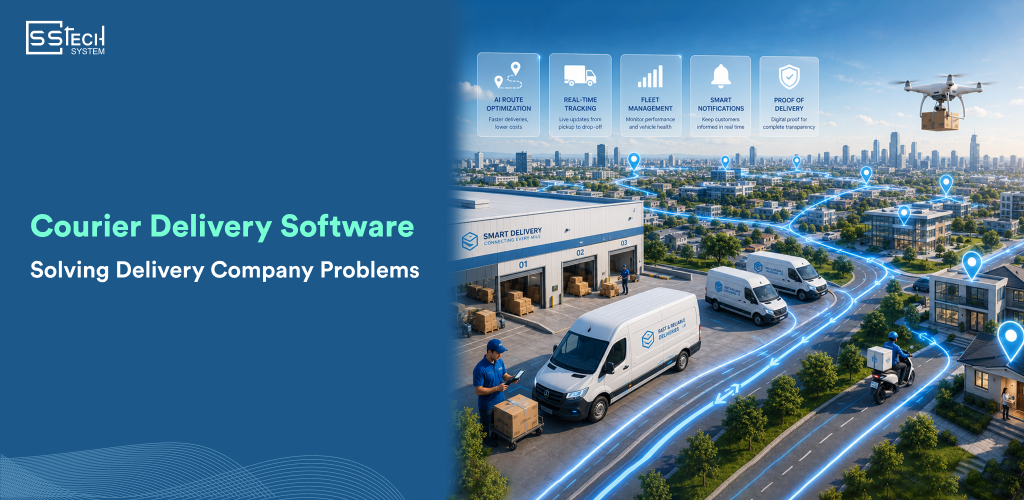
AI-powered route optimisation automatically identifies the fastest routes based on live traffic, delivery priorities, multiple stops, and customer locations.
This improves multi-stop delivery optimization, reduces travel distance, and supports same-day delivery optimization.
Real-Time GPS Tracking
Live GPS tracking provides complete shipment visibility for dispatchers, customers, and delivery teams.
Real-time updates improve transparency while reducing customer enquiries and enhancing delivery accuracy.
Automated Dispatch Management
An intelligent automated dispatch software instantly assigns deliveries to the most suitable driver.
Factors include:
- Current location
- Vehicle capacity
- Driver availability
- Delivery priority
- Route efficiency
This improves intelligent delivery management while significantly reducing manual workload.
Digital Proof of Delivery (POD)
Electronic POD ensures every delivery is verified using:
- Signature capture
- Image capture
- GPS verification
- Timestamp logging
This reduces disputes and supports effective delivery exception management.
Driver Mobile Application
Driver apps provide everything delivery personnel need from one interface, including:
- Navigation
- Delivery schedules
- Customer information
- Route updates
- POD capture
- Delivery status updates
Mobile applications also improve courier performance tracking while enhancing driver productivity.
Automated Customer Notifications
Customers receive automated:
- Order confirmations
- Dispatch alerts
- Estimated delivery times
- Live tracking links
- Delivery confirmations
These notifications improve communication and significantly improve customer satisfaction.
Centralised Fleet Management
A single dashboard helps businesses monitor:
- Active deliveries
- Fleet performance
- Driver productivity
- Delivery success rates
- Operational KPIs
Centralised management enables businesses to optimize courier operations using actionable insights.
Key Features to Look for in Courier Delivery Software
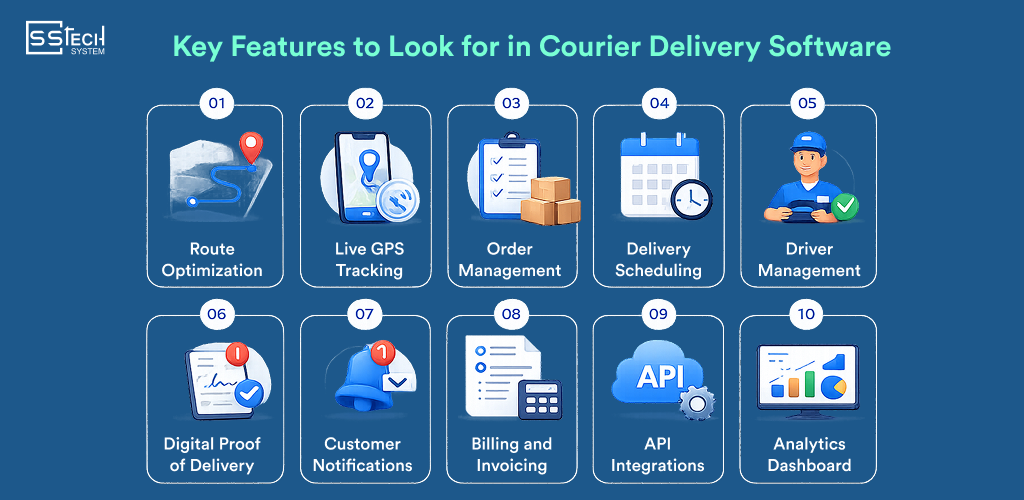
When selecting a courier management system, look for features that support both current and future operational needs.
Essential features include:
- Route optimisation
- Live GPS tracking
- Order management
- Delivery scheduling
- Driver management
- Digital proof of delivery
- Customer notifications
- Billing and invoicing
- API integrations
- Analytics dashboard
Businesses should also look for software that integrates with existing warehouse management systems, transportation management software, freight management software, and broader supply chain management software to create a connected logistics ecosystem. Cloud-based platforms with flexible APIs also simplify integration with ERP systems, CRM platforms, and eCommerce marketplaces.
Benefits of Using Courier Delivery Software
Faster Deliveries
Automated routing, intelligent dispatching, and real-time tracking enable businesses to complete deliveries more efficiently while meeting customer expectations.
Lower Fuel Costs
Optimised routes reduce unnecessary travel, minimise idle time, and improve overall fleet utilisation, resulting in significant fuel savings.
Improved Customer Satisfaction
Customers appreciate accurate ETAs, live shipment tracking, and timely notifications. These features build trust and encourage repeat business.
Fewer Delivery Errors
Automation reduces manual mistakes in dispatching, scheduling, address management, and delivery verification, helping businesses reduce failed deliveries and improve operational accuracy.
Which Businesses Can Benefit from Courier Delivery Software?
Courier delivery software supports organisations across multiple industries, including:
- Courier service providers
- Logistics companies
- eCommerce businesses
- Grocery delivery services
- Food delivery companies
- Pharmacy delivery providers
- Retail chains
- B2B distribution businesses
Whether managing local deliveries or nationwide logistics networks, a scalable delivery management system helps organisations improve efficiency and customer service.
How to Choose the Right Courier Delivery Software
Not every solution fits every business. Before investing, evaluate the following factors.
Understand Your Business Size
Choose software that matches your current delivery volume while supporting future expansion.
Scalability
As your business grows, your software should handle increasing deliveries, vehicles, drivers, and operational complexity without requiring a complete replacement.
Ease of Use
Drivers, dispatchers, and managers should be able to use the platform with minimal training.
Mobile Compatibility
Since drivers operate in the field, mobile-friendly applications are essential for efficient delivery management.
Integration Capabilities
The ideal courier software solution should integrate with your ERP, CRM, eCommerce platform, accounting software, and other logistics software solutions.
Businesses investing in custom software development services, enterprise software development, mobile app development services, AI software development, or IoT application development should also prioritise software that supports seamless API connectivity and cloud-based architecture.
Customer Support
Reliable technical support, onboarding assistance, and regular software updates are critical for long-term success.
Conclusion
Competition is growing within the courier industry, with operational efficiency ever more significant. An increase in fuel prices, shortage of drivers, missed deliveries, and increasing customer demands demand the use of smarter technology by businesses.
A modern courier delivery software platform integrates AI-powered route optimisation, automated dispatch, real-time tracking, digital proof of delivery, customer notifications, and centralized fleet management into a single intelligent platform. It allows courier enterprises to save money, enhance the delivery speed, automate processes, and provide outstanding customer experiences.
You may be a newly-formed courier startup with ambitious expansion plans in the future or an established logistics company, but investing in appropriate courier management software can render your business future-proofed and lead to successful growth.
Frequently Asked Questions
How does courier delivery software improve delivery efficiency?
It automates dispatching, optimises routes, provides real-time tracking, and reduces manual tasks, enabling faster and more accurate deliveries.
Can courier delivery software reduce fuel costs?
Yes. Intelligent route optimisation reduces travel distance, idle time, and unnecessary mileage, lowering fuel consumption and overall delivery expenses.
Is courier delivery software suitable for small businesses?
Absolutely. Many cloud-based solutions are scalable, making them suitable for startups, SMEs, and large logistics enterprises alike.
Does courier delivery software provide real-time tracking?
Yes. Most modern solutions include live GPS tracking that allows dispatchers and customers to monitor deliveries throughout the journey.
What features should I look for in courier delivery software?
Search route optimisation, automated dispatch, driver management, schedule delivery, proof of delivery, customer notification, API integrations, billing, and analytics.
Can courier delivery software integrate with eCommerce platforms?
Yes. Majority of the contemporary courier systems are also API integrated to various eCommerce systems, ERP software, CRM platforms, and warehouse management systems.
How does proof of delivery work in courier delivery software?
Through a mobile application, drivers can record electronic signatures, delivery images, GPS position, and timestamp to give a sure digital assurance that the shipment has been completed successfully.
Related Article