



The pharmaceutical sector depends on accuracy, compliance, and efficiency to deliver medicines safely. Inventory, storage environments, and traceability of products have continued to be complicated with the growth of supply chains. A modern pharma warehouse management system enables companies to simplify the processes and keep the regulatory standards.
The reasons why pharmaceutical companies need warehouse management systems have been a growing concern as the nature of the supply chains is becoming more complex. The increased use of advanced technologies in warehouses indicates the outstanding benefits of WMS in pharma industry in terms of improved visibility of inventory, regulatory adherence, and efficiency.
What is a Warehouse Management System in the Pharmaceutical Industry?
A warehouse management system for pharma is a niche software application that is used to control the activities of a pharmaceutical warehouse. It assists in monitoring inventory, tracking stock movement and optimization of the storage process. Pharma inventory management and regulatory compliance are supported by modern pharmaceutical warehouse software. It allows real-time monitoring of warehouse operations and stocks.
The global pharmaceutical warehousing market is projected to reach $99.1 billion by 2033, reflecting rising demand for advanced warehouse management solutions. WMS features batch tracking, expiry handling and product handling based on temperature.
It enhances operational efficiencies through incorporation with pharmaceutical supply chain management processes. Consequently, a pharma warehouse management system is beneficial in terms of product safety, accuracy, and compliance.
Major Challenges Faced by Pharmaceutical Warehouses
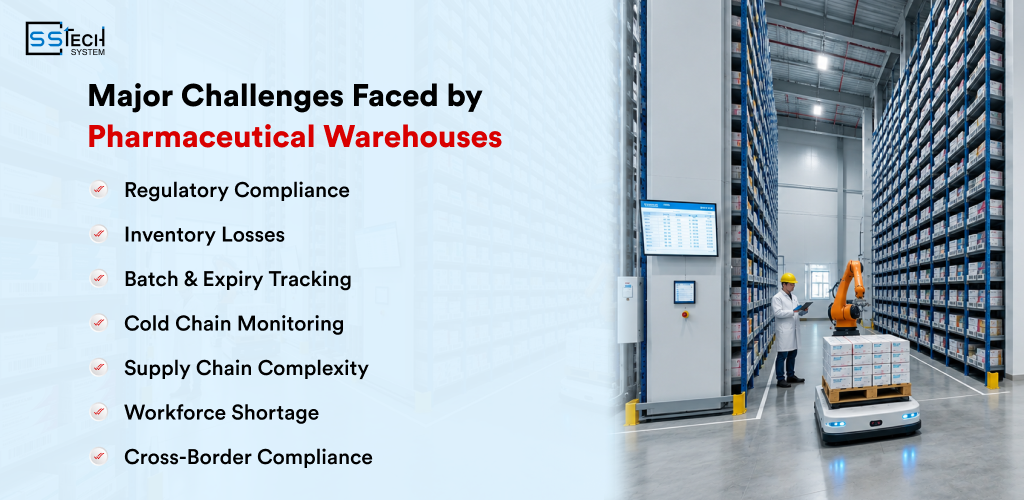
Below are some of the significant challenges in pharma warehouse management today. Businesses which lack the appropriate technology usually find it difficult to stay in compliance, maintain inventory and trace products.
Strict Regulatory Requirements
Pharmaceutical warehouses are required to meet complicated quality standards and industry regulations. Pharma compliance management maintenance must have proper documentation, storage control, and audit trail. Complex pharmaceutical regulatory compliance software assists in complianting with FDA compliance warehouse and GMP compliance in warehouse activities.
Inventory Errors and Product Loss
Inventory counts are prone to errors and stock variances due to manual processes. Pharma inventory management is compromised as well as operational risks are increased because of poor visibility. An effective drug inventory management system helps in enhancing inventory accuracy and reducing expensive product losses.
Managing Expiry Dates and Batch Tracking
There must be strict expiration checks and traceability of the pharmaceutical products. The use of an expiry date tracking system will ensure that the use of FEFO is prioritized against FIFO. Good batch tracking, and traceability minimizes waste as well as promotes regulatory compliance.
Cold Chain and Temperature Monitoring
A lot of medicines have to be stored at a particular temperature to be effective. Monitoring failures may lead to spoilage of products and compliance problems. The latest IoT in pharmaceutical warehouse systems include real-time environmental monitoring and automatic notifications.
Rising Demand and Supply Chain Complexity
The rise in healthcare demand is putting pressure on the pharmaceutical distribution networks. Pharmaceutical supply chain management processes are essential in managing inventory management across various locations. Pharma logistics software and pharma supply chain solutions have become important to businesses.
Skilled Workforce Shortage
Recruiting and retaining talented employees is a challenge in many warehouses. Human resource crises may decrease productivity and enhance inefficiencies in operations. Pharma technologies of warehouse automation are being implemented by companies to ensure performance and accuracy.
Cross-Border Regulatory Differences
In distributing pharmaceuticals worldwide, different countries have varying regulations. Compliance requirements vary usually when it comes to labeling, storage and product documentation. Sophisticated pharma solutions warehouse management system assists in streamlining processes and making things easier in overseas operations.
Why Pharmaceutical Companies Need Advanced Warehouse Management Systems
Improved Inventory Accuracy
A sophisticated warehouse management system offers precise stock data in various warehouse locations. It promotes the pharma capabilities of real-time inventory tracking and automated inventory control. Higher visibility will minimize the chances of manual errors and enhance inventory accuracy.
Better Compliance and Documentation
Pharmaceutical companies are required to keep detailed records to comply with industry standards. A modern pharma warehouse management system simplifies pharma compliance management via automated documentation and reporting. This shows how WMS improves pharma compliance by automating documentation, audit trails and simplifying regulatory reporting demands.
End-to-End Product Traceability
Tracing of products is essential in the pharmaceutical supply chain. High-level pharmaceutical warehouse software allows tracking and tracing in batches by their receipt up to final distribution. Complete product histories enhance transparency and help in serialization in pharma logistics.
Reduced Waste and Expiry Losses
Expiration dates are important in the management of pharmaceutical inventory. An efficient expiry date tracking system can assist in prioritising the stock movement based on FEFO principles. Effective inventory turnover can reduce pharmaceutical waste and minimize expensive losses of products.
Faster Order Fulfilment
Speed and accuracy are crucial in pharmaceutical distribution operations. A modern warehouse management system simplifies the processes of picking, packing and shipping within the warehouse. Accelerated processing enhances order fulfillment in pharma and customer satisfaction.
Enhanced Cold Storage Monitoring
A lot of the pharmaceutical products have a rigid temperature-controlled storage. Advanced interfaces use IoT in pharma warehouse to monitor the environment on a continual basis. Real-time warning will be used to guard the quality of products and regulatory compliance.
Data-Driven Decision Making
Modern warehouses produce huge amounts of operational and inventory data. Advanced analytics and AI in pharmaceutical supply chain solutions convert information into actionable insights. Higher visibility helps in smarter planning, forecasting, and allocation of resources.
Product Recall Management
Product recalls need to be quickly identified in terms of inventory and shipments. Advanced pharmaceutical supply chain management systems keep records of traceability throughout the network. Fast access to precise data speeds up the process of recall, and improves patient safety.
Key Features to Look for in an Advanced Pharmaceutical WMS
Evaluate the features of pharmaceutical warehouse management system platforms. Strong inventory control, compliance, automation, and integration capabilities improve warehouse efficiency and performance.
Real-Time Inventory Tracking
Real-time inventory tracking pharma capabilities will give immediate control of stock movement across the warehouse. They can assist in the removal of manual inventory variances and enhance accuracy. Stocks can be tracked by teams. This helps in improved pharma inventory management and eliminates inventory related disruptions.
Barcode and RFID Integration
RFID and barcode tracking technologies streamline product tracking and inventory update. They minimize human errors in the receiving, picking and shipping process.
It allows warehouse staff to find products more quickly. This greatly enhances operational efficiency and inventory accuracy.
Batch, Lot, and Serial Number Management
Good batch and lot tracking software allows the pharmaceutical companies to track products through their lifecycle. It also eases the process of identifying products when there is an audit or recall.
Serial number tracking enhances traceability and accountability. All these capabilities enhance the supply chain batch tracking and traceability.
Automated Compliance Reporting
Automated reporting tools assist in creating records of compliance automatically. They make inspection documentation and regulatory audits simpler.
Pharma compliance management can be maintained better by businesses. This is a crucial aspect of audit-ready warehouse systems and regulatory preparedness.
Temperature and Cold Chain Monitoring
The global cold chain monitoring market is expected to grow from $8.31 billion in 2025 to $15.04 billion by 2030, driven by rising pharmaceutical demand. Temperature control guarantees that the pharmaceutical products are in a condition of approved storage.
Teams are informed of possible problems in real-time by automated alerts. This feature helps IoT in pharma warehouse management and safeguard sensitive stock.
Integration With ERP and Supply Chain Systems
WMS for pharmaceutical companies must be integrated with ERP and supply chain platforms. Integration enhances uniformity of data within departments and business functions.
It improves the efficiency of managing the pharmaceutical supply chain. Connected supply chain management software can also enable businesses to streamline operations.
Cloud-Based Accessibility
Cloud-based pharma WMS will allow users to view the data of the warehouse at any location. It helps to deploy software faster and maintain it easier.
Read more: Top Benefits of Cloud Solutions for Growing Businesses
Cloud platform enhances cooperation among the various facilities. Many organizations adopt cloud software solutions to increase scalability and flexibility.
Benefits of Advanced WMS for Different Pharmaceutical Operations
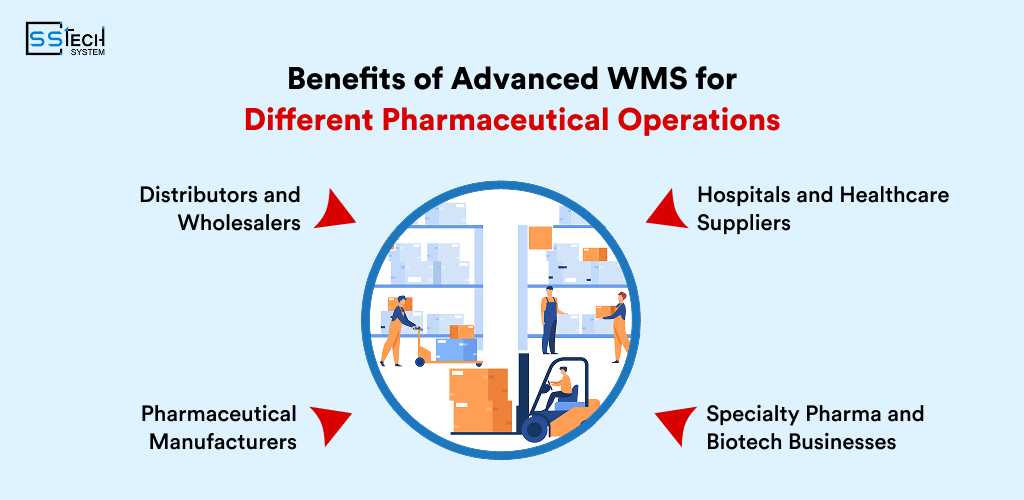
Pharmaceutical Manufacturers
A sophisticated pharma warehouse management system assists manufacturers to match inventory with production schedules. Real-time visibility prevents material shortages and operational delays. This enhances efficiency and facilitates the management of the pharmaceutical supply chain.
A pharma warehouse management system will give full visibility of raw materials. Stores are able to track inventory and replenishment requirements. This enhances inventory management of Pharma and production planning.
Distributors and Wholesalers
An effective WMS for medical distributor business accelerates the flow of inventory within the warehouses. The workflows of receiving, picking, and dispatching are enhanced with the help of automation. This increases the order fulfillment in pharma and overall productivity.
A complex pharmaceutical warehouse software will assist in minimizing delays by enhancing inventory visibility. Products and shipments can be located quickly by teams. This helps in efficient pharma supply chain optimization and quicker deliveries.
Hospitals and Healthcare Suppliers
An effective healthcare warehouse management system will make sure that critical medicines are available when required. Monitoring in real-time allows avoiding stock-outs and overstocking. This facilitates continuous care of patients and controlled inventory.
The use of modern inventory management software enhances inventory management in healthcare establishments. Employees are able to track the stock movement and expiration dates effectively. This improves accuracy and promotes an effective drug inventory management system.
Specialty Pharma and Biotech Businesses
Specialty pharmaceutical products demand strict storage conditions and handling. A cloud-based WMS for pharma assists in tracking inventory and environmental factors. This enhances protection of products and facilitates IoT in pharma warehouse processing.
Advanced systems ease complicated regulatory needs with automated documentation and reporting. They enhance pharma compliance management and keep proper audit records. This assists in developing trustworthy audit-compliant warehouse systems.
How Automation Is Transforming Pharmaceutical Warehousing
Use of AI and Predictive Analytics
Modern pharmaceutical warehouses are adopting AI in pharmaceutical supply chain operations to improve forecasting accuracy. Advanced analytics determine demand patterns and inventory trends. To streamline the work of warehouses and minimize disruptions, businesses are investing more in AI software development.
Robotics and Automated Picking Systems
Robotic technologies are transforming warehouse automation pharma processes by reducing manual effort. Automated picking systems enhance speed and consistency. These solutions improve order accuracy pharma and promote increased warehouse efficiency.
IoT-Based Monitoring Solutions
Pharma warehouse technology connects sensors driven by IoT constantly to observe the conditions of the storage. Live alerts are used to avoid product damage due to temperature. Compliance and inventory visibility are some of the reasons why many organizations use IoT application development.

Smart Alerts and Reporting
Automated systems generate instant notifications for inventory shortages, temperature excursions, and compliance issues. Real-time reporting improves decision-making and responsiveness. These capabilities support automated inventory control and enhance operational efficiency.
Digital Transformation in Pharma Logistics
Cloud-based WMS for pharma solutions are adopted by many businesses to enhance efficiency and scalability of the warehouse. They also combine pharma delivery software, pharmaceutical delivery software and medicine delivery software to improve distribution activities.
Common Mistakes Pharmaceutical Businesses Make Without an Advanced WMS
Relying Heavily on Spreadsheets
A lot of pharmaceutical companies continue to rely on spreadsheets when it comes to recording inventory. Use of manual data entry raises errors, and delays updates. Without a pharma warehouse management system, it is hard to maintain accurate pharma inventory management.
Delayed Product Recalls
Product recall involves instant recognition of the impacted stock. The recall process is usually slowed down by manual systems. Absence of batch tracking and traceability may create risks to compliance and patient safety.
Poor Inventory Visibility
Poor inventory visibility brings about uncertainties across warehouse operations. Teams might have difficulties in finding products fast. A pharma warehouse management system enhances visibility of the stock within pharma warehouse settings.
Compliance Risks
Regulations of pharmaceuticals demand proper records and full traceability. Manual processes make compliance management more challenging. Due to lack of proper pharma compliance management, organizations may fail FDA compliance warehouse requirements.
High Operational Costs
Unproductive workflows can result in unnecessary labor and storage costs. Inventory checks using manual methods are wasteful. Sophisticated pharmaceutical warehouse software helps reduce operational costs warehouse by automation.
Lack of Real-Time Reporting
Decision-makers require timely information to cope with inventory. Late reporting reduces responsiveness and accuracy of planning. Pharma features such as inventory real-time tracking help make business decisions more quickly based on data.
How to Choose the Right Warehouse Management System for a Pharmaceutical Business
Understand Business Requirements
Begin by analyzing your warehouse operations, inventory volume and product handling requirements. Consider factors such as storage conditions, distribution processes, and regulatory requirements. An appropriate pharma warehouse management system must be aligned with your present requirements and future business objectives.
Prioritize Compliance and Traceability Features
In pharmaceutical warehousing, regulatory compliance plays a vital role. Select a solution that will facilitate pharma compliance management, FDA compliance warehouse requirements, and batch tracking as well as traceability. Good compliance capabilities can minimize risks and make audits easier.
Evaluate Inventory Management Capabilities
Pharmaceutical operations require proper inventory management. Find features like real-time pharma inventory tracking, automated inventory control, and functionality of expiry date tracking system. Such capabilities enhance the accuracy in inventory and assist to avoid stock shortages or product expiration.
Check Integration and Scalability
The combination of a last-mile delivery software and a last-mile delivery software for pharmacy enhances delivery procedures. Fleet management software and route optimization software help to further improve transportation efficiency. These technologies assist to improve the last mile delivery pharma logistics performance and customer satisfaction.
Focus on Automation, Usability, and Vendor Support
Choose a solution to support the automation of the warehouse pharma with technologies such as barcode and RFID tracking as well as automatic workflows. The system must also be user-friendly to promote fast adoption by the warehouse staff. Constant updates and reliable vendor support guarantee long-term performance and compliance.
Future Trends in Pharmaceutical Warehouse Management
AI-Powered Warehouses
Pharmaceutical supply chain solutions leverage AI to improve demand forecasting and inventory optimization. Advanced analytics enhance the precision of planning and minimize stockouts. Innovations in AI software development will continue to automate warehouse processes and decision-making.
Blockchain for Traceability
Blockchain technology improves batch tracking and traceability by generating secure and tamper-proof transaction records. It enhances the levels of transparency in the processes of pharmaceutical supply chain management. The technology also enhances the compliance and product authentication processes.
Sustainable and Energy-Efficient Warehousing
Future warehouses will be geared towards minimizing energy and wastage. Pharma warehouse technologies using smart infrastructure and IoT allow managing resources better. These enhancements assist in sustainability objectives and reducing the operational expenses of warehouse operations.
Predictive Supply Chain Management
Predictive analytics is used to enable firms to predict demand fluctuations and supply chain disruptions. Supply chain solutions for pharma provide real-time insights to do proactive planning. This solution promotes optimization of the pharma supply chain and enhances resilience in overall operations.
Conclusion
A robust pharma warehouse management system is essential for maintaining compliance, product traceability, and inventory accuracy. Advanced warehouse management system for pharma assists in streamlining warehouse operations and minimizing operational risks. Good pharma inventory management will help businesses to keep optimal inventories and enhance product availability.
Modern pharmaceutical warehouse software increases the visibility, efficiency, and decision-making processes in the warehouse processes. Together with pharma delivery app development and logistics software development, these solutions illustrate how to manage pharmaceutical inventory efficiently and enhance the overall supply chain performance.

Frequently Asked Questions
What is a warehouse management system in the pharmaceutical industry?
A pharmaceutical warehouse management system is a software which handles inventory, storage, compliance, batch tracking, temperature and warehouse operations as well as supports pharmaceutical regulation.
What is the importance of inventory tracking in pharmaceutical companies?
Tracking of inventory helps to prevent shortages, reduce waste, enhance traceability and facilitate compliance with regulations.
What does an advanced WMS do to assist pharmaceutical compliance?
An excellent WMS automates the documentation, audit records, batch traceability, monitor storage condition, and simplifies compliance reporting.
What is FEFO in pharmaceutical warehousing?
FEFO is an abbreviation that means First Expired, First Out. It guarantees that products that expire early are distributed first and this will minimize wastage as well as improve inventory control.
Is a WMS able to enhance cold chain management?
Yes. High-level WMS solutions are paired with sensors and monitoring systems to monitor temperatures, create notifications, and preserve cold chain compliance.
What are the benefits of barcode and RFID technology in pharma warehouses?
Barcode and RFID tracking solutions enhance inventory precision, increase warehouse operations, improve product traceability, minimize manual errors, and help with regulatory compliance.
Related Article