


In the modern logistics world, where everything is becoming fast-paced, companies are constantly pressurized to be quicker, less expensive to operate in extended chains and to be transparent throughout. Transportation efficiency has a direct effect on your bottom line, regardless of whether you are managing a fleet or an e-commerce business, or a large-scale logistics network.
This is where a Transportation Management System (TMS) comes in. On the shelf solutions are basic in their functionality, and fail when your business expands or needs tailoring. This is the reason why nowadays, more companies are investing in the development of a custom TMS that will meet their specific operational requirements.
Everything you need to know about creating your own TMS will be in this in-depth guide, including features and prices, integrations and future trends.
What is a Transportation Management System (TMS)?
A Transportation Management System (TMS) is a computer program that helps businesses plan, implement, and optimize the flow of goods. It is a key aspect in supply chain management as it enhances efficiency, lowers costs, and offers real-time visibility.
A TMS typically helps you:
- Plan shipping routes
- Select carriers
- Track shipments in real time
- Manage freight billing
- Analyze transportation performance
The transportation management system market is forecasted to reach USD 37.04 billion by 2030, up from USD 18.50 billion in 2025, with a CAGR of 14.9% from 2025. Modern TMS platforms are often cloud-based and integrate with other systems like ERP, WMS, and CRM to create a seamless logistics ecosystem.
Who Needs TMS Software?
A TMS is not just for large logistics companies, it benefits a wide range of industries.
Logistics & Freight Companies
These are intensive businesses that depend on optimization of routes, carrier management and monitoring of shipment to enhance delivery efficiency.
eCommerce Businesses
As customer expectations of quick delivery increase, TMS will streamline the last-mile delivery and decrease the price of shipping.
Manufacturing Businesses
TMS helps manufacturers to optimize both inbound and outbound logistics to maintain the timely arrival of raw materials and finished products.
Retail Chains
Retailers enjoy enhanced inventory flow, enhanced coordination of warehouses and cost management.
3PL Providers
The features of TMS required in the 3PL companies are such that they can deal with multiple clients, shipments, and transportation methods.
Why Choose Custom TMS Development Over Off-the-Shelf Solutions?
Limitations of Ready-Made TMS
While ready-made solutions are quick to deploy, they often come with limitations:
- Limited customization options
- Features you don’t need (and pay for)
- Poor scalability
- Integration challenges
- Lack of industry-specific functionality
When Your Business Should Invest in Custom TMS
You should consider custom TMS development if:
- Your logistics workflows are unique or complex
- You need integration with multiple systems
- You want full control over features and scalability
- Your current system is slowing down operations
- You aim to gain a competitive edge through automation
Custom TMS ensures your software works exactly how your business operates, not the other way around.
Key Features of a Custom TMS
A well-designed TMS should include a robust set of features tailored to your logistics needs.
Order Management System
This module deals with all the life cycle of orders i.e. creation to the final delivery. It forms the basis of your TMS, as it gathers all information on orders in a central location.
It helps you:
- Track orders in real time
- Automate order processing and assignment
- Reduce manual errors and duplication
A good order management system will help in ensuring that there is a smoother coordination between a team and quicker response to orders.
Route Planning & Optimization
The route optimization is an advanced algorithm to calculate the most efficient delivery routes.
It takes into account various real-world factors like:
- Distance
- Traffic conditions
- Delivery time windows
Optimization of routes will enable businesses to use a considerable amount of fuel, lessen down time, and enhance delivery schedule. In the long-term, it results in improved resource use and cost savings.
Carrier Management
Handling several carriers may be time-consuming and ineffective. A TMS helps to do this by giving a centralized system to manage all carrier-related processes.
You can:
- Compare carrier rates easily
- Track carrier performance over time
- Automate carrier selection based on cost and reliability
This will guarantee that you always select the most appropriate carrier to make an individual shipment and also have a good relationship with your vendors.
Freight Audit & Payment
The aspect of freight billing is common in logistics and even small differences can result into losses in the long-term. This is a feature that aids the accuracy and transparency of finances.
It enables you to:
- Verify freight invoices against agreed rates
- Identify discrepancies or overcharges
- Automate payment processing
This not only reduces manual effort but also ensures you only pay for what is correct.
Real-Time Shipment Tracking
The aspect of real-time tracking has become a norm of contemporary logistics. Both customers and businesses desire to know the status of the shipment fully.
Using GPS and IoT-enabled devices, this feature provides:
- Live location updates
- Delivery status notifications
- Better communication with customers
It improves trust, reduces uncertainty, and enhances the overall customer experience.
Reporting & Analytics Dashboard
A TMS generates valuable data that can be used to improve operations. A powerful analytics dashboard transforms this data into actionable insights.
It helps you:
- Monitor key performance indicators (KPIs)
- Analyze delivery performance and delays
- Identify trends and cost-saving opportunities
Using data-driven insights you can make smarter decisions and constantly make your logistics strategy smarter.
Multi-Modal Transportation Support
In the case of business organizations, which operate regionally or internationally, it is impractical to depend on one mode of transport. A bespoke TMS ought to accommodate various modes of transportation under a single system.
This includes:
- Road transport
- Rail logistics
- Air freight
- Sea shipping
Multi-modal support allows you to choose the most efficient and cost-effective transportation method for each shipment.
Mobile App Support
On-ground activities that are essential like drivers and field teams need mobile accessibility. They are linked to the system via a special mobile application.
It enables:
- Seamless driver communication
- Real-time updates and alerts
- Digital proof of delivery (POD)
This reduces paperwork, improves coordination, and ensures faster updates from the field.
Best Frameworks for Developing Custom TMS Software
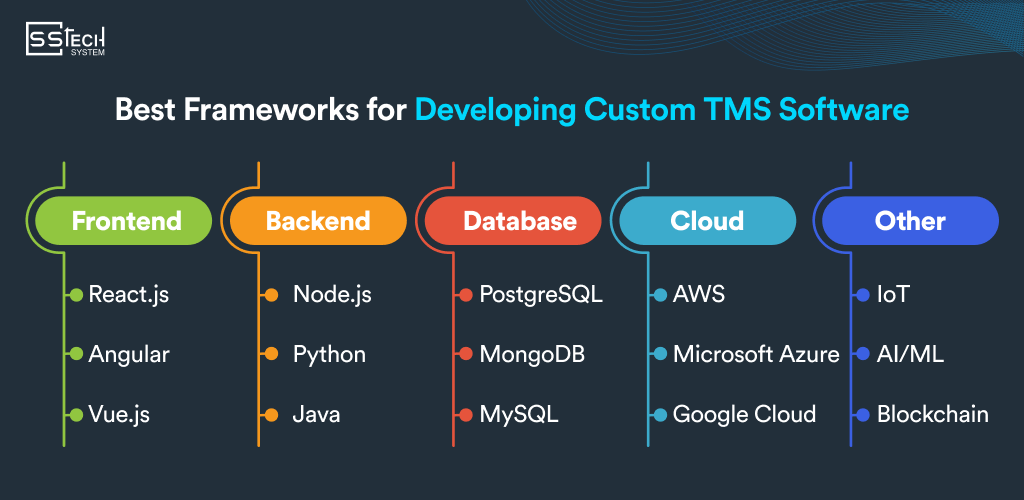
Choosing the right technology stack is crucial for performance and scalability.
Frontend Technologies
- React.js
- Angular
- Vue.js
Backend Technologies
- Node.js
- Python (Django/Flask)
- Java (Spring Boot)
Database Options
- PostgreSQL
- MongoDB
- MySQL
Cloud Platforms
- AWS
- Microsoft Azure
- Google Cloud
Other Technologies
- AI/ML frameworks for predictive analytics
- Blockchain for secure transactions
Cost and Efficiency of Custom TMS Development
The cost of building a custom TMS varies based on several factors.
Cost Factors
Project Complexity
More complex workflows and automation increase development time and cost.
Number of Features
Advanced features like AI-based route optimization or real-time tracking increase costs.
Integrations Required
Connecting with ERP, WMS, or third-party APIs adds to the budget.
Development Team Location
Costs vary depending on whether your team is based in India, the US, or Europe.
Technology Stack
Advanced technologies like AI, IoT, or blockchain increase development expenses.
Estimated Cost Range
| TMS Type | Estimated Cost |
|---|---|
| Basic TMS | $15,000 – $40,000 |
| Mid-Level TMS | $40,000 – $100,000 |
| Enterprise TMS | $100,000 – $300,000+ |
Cost-Saving Tips
MVP Approach
Start with a Minimum Viable Product (MVP) and scale later.
Modular Development
Build features in phases to manage budget effectively.
Choosing the Right Development Partner
A skilled partner can reduce long-term costs through efficient development.
Benefits of Transport Management System for Varied Domains
Logistics Industry
- Reduced operational costs
- Improved delivery timelines
- Better fleet management
Retail & eCommerce
- Faster last-mile delivery
- Enhanced customer experience
- Real-time tracking
Manufacturing
- Efficient supply chain coordination
- Reduced delays
- Better inventory flow
Healthcare & Pharmaceuticals
- Secure and timely delivery of sensitive goods
- Temperature-controlled logistics tracking
Food & Beverage
- Freshness tracking
- Optimized delivery routes
TMS Integration: Systems You Must Connect
TMS Integration is the backbone of a successful TMS. Your transportation system will be in isolation without proper integration, which can cause data silos, manual work, and inefficiencies. A well-integrated TMS means that there is clear communication between the various systems to facilitate better coordination, quick operations, and better decision-making.
Essential Integrations
To unlock the full potential of your TMS, it’s important to connect it with the following systems:
ERP Systems
Enterprise Resource Planning (ERP) systems help manage core business functions such as finance, procurement, and operations.
Integrating TMS with ERP allows you to:
- Synchronize financial and operational data
- Automate invoicing and billing processes
- Maintain accurate records across departments
This ensures consistency and reduces the chances of data mismatches.
Warehouse Management Systems (WMS)
A Warehouse Management System (WMS) handles inventory storage, picking, and packing processes.
When integrated with TMS, it helps:
- Coordinate inventory and shipment data
- Improve order fulfillment speed
- Reduce delays between warehouse and dispatch
This creates a seamless flow from warehouse operations to transportation.
Read more: How WMS Software Improves Picking Accuracy and Reduces Fulfillment Time
CRM Systems
Customer Relationship Management (CRM) systems store customer data and manage communication.
TMS integration with CRM enables:
- Better customer communication
- Real-time order tracking updates
- Improved customer service experience
It ensures customers stay informed throughout the delivery journey.
GPS & IoT Tracking Devices
Modern logistics relies heavily on real-time tracking technologies.
By integrating GPS and IoT devices, your TMS can:
- Provide live shipment visibility
- Monitor vehicle movement and conditions
- Detect delays or route deviations instantly
This enhances operational control and transparency.
Payment Gateways
Managing payments manually can slow down operations and increase errors.
With payment gateway integration, you can:
- Automate billing and invoicing
- Process payments faster
- Reduce manual intervention in financial workflows
This improves cash flow and financial accuracy.
Benefits of Integration
When your TMS is fully integrated with other systems, it creates a unified ecosystem that enhances overall efficiency.
- Data Synchronization
Eliminates manual data entry and ensures all systems are updated in real time, reducing errors and duplication.
- Automation
Reduces operational workload by automating repetitive tasks such as order updates, billing, and tracking notifications.
- Real-Time Visibility
Provides complete transparency across the supply chain, helping you make faster and more informed decisions.
- Improved Efficiency
Streamlines workflows by connecting processes, reducing delays, and improving coordination between teams.
Warehouse and Transportation Management System: How Does It Work?
A Warehouse Management System (WMS) and TMS work together to create a seamless logistics process.
How the Integration Works
- Orders are received in the WMS
- Inventory is picked and packed
- TMS plans shipment and assigns carriers
- Goods are dispatched and tracked
- Delivery updates are shared in real time
This integration ensures:
- Faster order fulfillment
- Reduced errors
- Better coordination
Future Trends in TMS Development
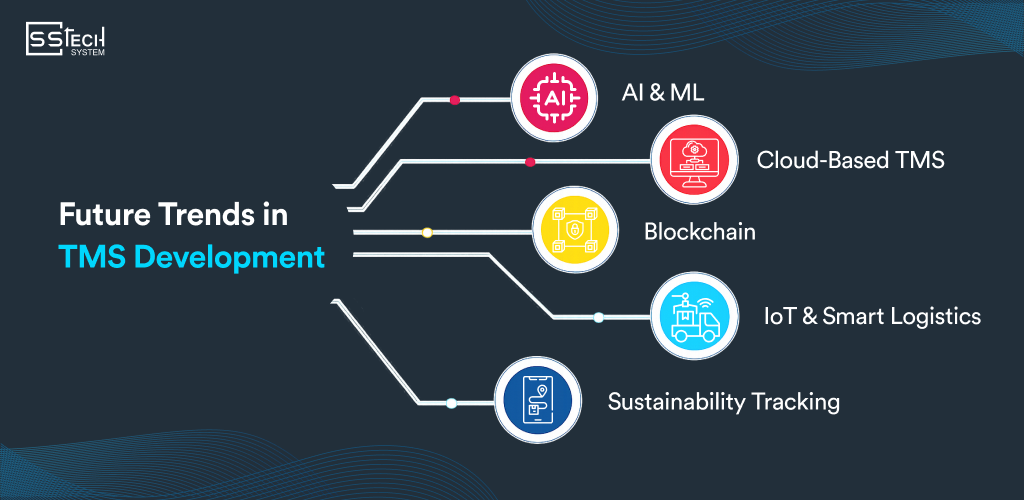
The logistics industry is evolving rapidly, and TMS solutions are becoming more advanced.
AI & Machine Learning
AI enables:
- Predictive route planning
- Demand forecasting
- Risk management
Cloud-Based TMS
Cloud solutions offer:
- Scalability
- Remote access
- Lower infrastructure costs
Blockchain in Logistics
Blockchain improves:
- Transparency
- Security
- Fraud prevention
IoT-Enabled Smart Logistics
IoT devices provide:
- Real-time tracking
- Condition monitoring
- Fleet optimization
Sustainability Tracking
Modern TMS solutions track:
- Carbon emissions
- Fuel usage
- Eco-friendly routes
How to Choose the Right TMS Development Partner
Selecting the right partner is critical for success.
Experience in Logistics Domain
Choose a partner with proven expertise in logistics software.
Portfolio and Case Studies
Review previous projects to assess capability.
Technical Expertise
Ensure they are skilled in modern technologies.
Post-Launch Support
Ongoing support is essential for updates and maintenance.
Communication & Transparency
Clear communication ensures smooth project execution.
Conclusion
The construction of a tailor-made Transportation Management System is an investment decision that can revolutionize your logistics services. A properly designed TMS offers long-term benefits from an increase in efficiency and cost reduction, as well as customer satisfaction.
The initial cost may be high but it is justified by the automation, optimization and data-driven decision-making that will lead to the return on investment. With attention to the appropriate features, integrations, and development strategy, you can develop a scalable solution that suits your business requirements.

Frequently Asked Questions
What is a TMS system?
A TMS is software that helps businesses manage, optimize, and track transportation operations efficiently, while also improving visibility, reducing costs, and streamlining overall logistics workflows.
How does a TMS handle international shipments?
It supports multi-modal transportation, customs documentation, and global carrier management, ensuring smooth cross-border logistics operations and compliance with international shipping regulations.
Can a TMS integrate with my eCommerce platform?
Yes, a custom TMS can integrate with platforms like Shopify, Magento, or WooCommerce, enabling seamless order processing, real-time tracking, and better customer communication.
What is the average cost of TMS development?
Costs range from $15,000 for basic systems to $300,000+ for enterprise solutions, depending on features, integrations, customization level, and overall system complexity.
How long does it take to build a custom TMS?
Development can take anywhere from 3 to 12 months depending on complexity, features required, integrations involved, and the size and expertise of the development team.
Is cloud-based TMS better than on-premise?
Cloud-based TMS is generally more scalable, cost-effective, and easier to maintain, while also offering better accessibility, faster updates, and improved data security.
Related Article