


Food delivery is a rapidly expanding segment of the digital economy. Delivery expectations are high. Meals must arrive swiftly and accurately in the right condition. This poses a challenge for restaurants, cloud kitchens and the myriad delivery services. They must meet customer expectations and delivery requirements while keeping costs as low as possible.
Much of the disruption in the food delivery industry has come from tech companies trying to solve these problems. For whatever reason, many businesses (too) often settle for outdated delivery systems such as spreadsheets, phone calls, and WhatsApp groups. While these methods may work for a small number of orders, they become massively inefficient as delivery volumes grow, and it is usually the primary reason businesses seek out alternative delivery systems.
As the demand for speed and accuracy has risen, so has the adoption of Food Delivery Software and automated dispatch systems. These systems allow businesses to streamline delivery processes, optimize driver distribution, minimize delivery times, and maximize customer satisfaction.
This article explains why manual dispatch fails in food delivery, the challenges it creates, and how automation is transforming modern delivery operations.
The Evolution of Dispatching Systems Over the Years
Dispatching systems have gone through a considerable transformation in the past two decades. In the early days of food delivery systems, a restaurant manager would assign orders to available drivers. Deliveries would be tracked using log books, phone calls, and a manager’s knowledge of drivers and routes.
As the need for a more sophisticated system to manage a higher volume of orders became clear, businesses would start using spreadsheets and simple scheduling systems. E-commerce and on-demand services have invented new shopping expectations. Customers want live order updates, speedy delivery, and exact delivery estimates. These demands have created challenges for most dispatch systems.
Today businesses now rely on food delivery dispatch software, delivery management systems, and AI-driven technologies that can make dispatch decisions in seconds. These restaurant delivery management systems make dispatch choices in seconds and have revolutionized the way businesses manage delivery services.
What is Manual Dispatching?
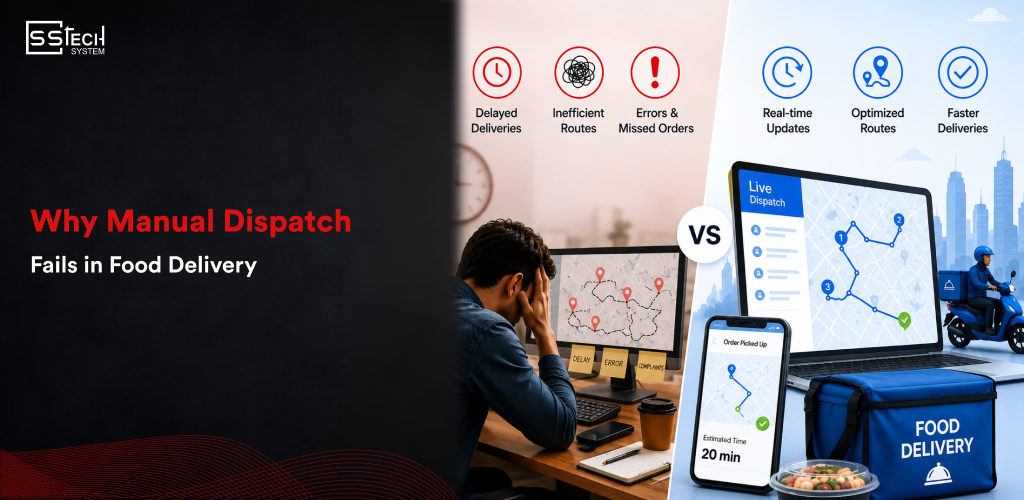
Manual dispatching refers to assigning delivery orders through human decision-making rather than software automation. The manual dispatch process involves the dispatcher reviewing incoming delivery requests; checking the availability of drivers; assigning requests; communicating with drivers; and providing updates to the customers.
This process has become more complicated as order volumes have increased. Dispatchers must balance many factors, including fairness in the distribution of driver workload, timely order deliveries, traffic conditions, and customer satisfaction. This has created a variety of challenges for the business.
Read more: How Food Delivery Businesses Scale Faster with Last-Mile Solutions
Identifying Inefficiencies in Manual Dispatching
Prone to Human Error
Managing hundreds of daily orders creates an environment where mistakes are a certainty.
Dispatchers may:
- Assign orders to the wrong driver
- Miss priority deliveries
- Overload certain drivers
- Enter incorrect addresses
- Create inefficient delivery routes
These errors result in delays, increased complaints, and higher operating costs. Modern order dispatch software reduces mistakes by automatically doing data checks and assigning orders based on the rules the business has set.
Time-Intensive Processes
Manual dispatching requires constant monitoring and communication.
Dispatchers spend hours:
- Reviewing orders
- Calling drivers
- Tracking delivery status
- Managing route changes
- Resolving delivery issues
Tasks that are repetitive by nature will slow operations. In contrast, automated order dispatch systems have the ability to fulfill hundreds of requests in a matter of seconds.
Limited Real-Time Adaptability
Food delivery environments change constantly.
Drivers encounter:
- Traffic congestion
- Road closures
- Vehicle breakdowns
- Weather disruptions
- Last-minute order changes
Manual dispatchers struggle to react quickly to these situations.
Static, Batch-Based Planning vs. Real-Time Disruptions
Many businesses still create delivery plans early in the morning and follow them throughout the day.
This creates the classic “5 a.m. route plan” problem. A route that looked efficient in the morning may become ineffective due to:
- Unexpected traffic
- Driver absenteeism
- Order surges
- Delivery priority changes
A static plan cannot adapt to dynamic delivery conditions. Modern dispatch optimization software updates routes continuously based on live conditions.
Inefficient Resource Utilization
Manual dispatch often leads to uneven workload distribution. Some drivers remain idle while others handle excessive deliveries.
This causes:
- Increased labor costs
- Driver fatigue
- Delivery delays
- Reduced productivity
An intelligent dispatch system ensures balanced driver allocation and better utilization of available resources.
High Operational Costs
Manual operations require more administrative staff and supervision.
Businesses spend more money on:
- Labor
- Fuel
- Overtime
- Customer support
- Delivery corrections
As delivery volumes grow, these costs increase significantly. Automation helps businesses reduce operational costs while maintaining service quality.
Impact of Manual Dispatching Inefficiencies on Business Operations
Increased Operational Costs
Inefficient routing and poor driver utilization increase fuel consumption and labor expenses. According to the research commissioned by the U.S. Department of Energy, there is a loss of fuel and an increase in the cost of transportation due to inefficient manual routing and traffic jams. Companies that depend on manual dispatching to this day will operate at a loss the more they expand their delivery network.
Poor Customer Experience
Customers want deliveries to be as fast as possible, with the estimated time of arrival being as accurate as possible.
Late deliveries result in:
- Negative reviews
- Refund requests
- Reduced customer loyalty
- Lost repeat business
Real-time visibility has become essential for modern food delivery management.
Lower Productivity of Field Teams
Drivers are spending more time waiting to receive a job assignment than on the delivery job itself.
This reduces:
- Driver efficiency
- Daily delivery capacity
- Revenue potential
Businesses using driver management software alongside dispatch automation can significantly increase delivery productivity.
Limited Ability to Scale
Manual systems may handle dozens of deliveries. They struggle with hundreds or thousands. As businesses expand into new locations, manual coordination becomes increasingly difficult. A scalable delivery operations software platform supports growth without requiring proportional increases in staff.
Read more: How AI-Powered Route Optimization Is Changing Logistics
Inability to Handle Real-Time Changes
Customer requests, route changes, and delivery exceptions require immediate action. Manual processes create delays in decision-making. An AI dispatch software platform responds instantly to changing conditions.
Missed Insights for Optimization
Manual systems generate limited operational data.
Businesses miss opportunities to:
- Identify delivery bottlenecks
- Improve route efficiency
- Optimize staffing
- Forecast demand
A modern delivery automation platform provides actionable insights for continuous improvement.
What is Automated Dispatching and Why is it So Important?
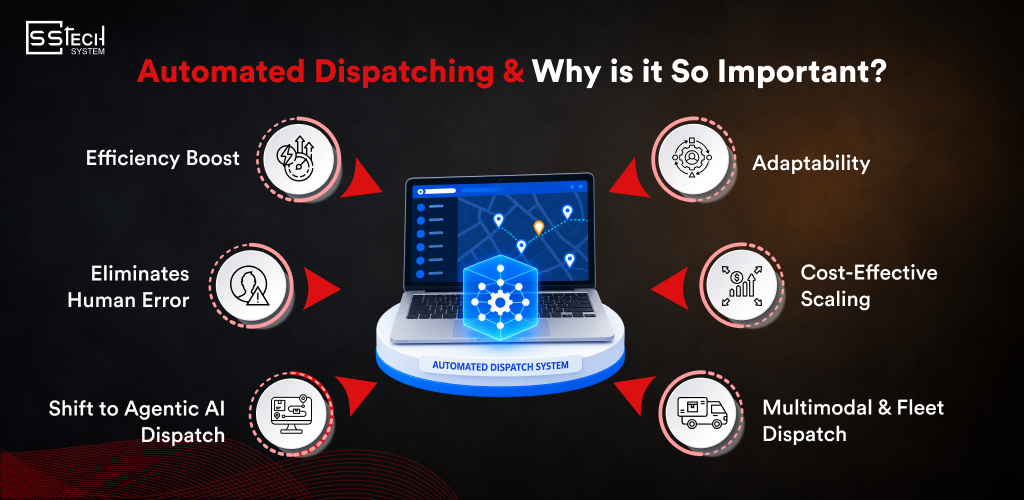
Automated dispatching eliminates the need for manual routing, job assignment and job scheduling by using software-based algorithms, AI, and real-time information. Use of modern food delivery management software offers a means to control and manage delivery operations.
Efficiency Boost
Automation reduces manual decision-making.
Orders are assigned instantly based on:
- Driver location
- Delivery priority
- Vehicle capacity
- Route efficiency
The result is improved delivery operations and faster order fulfillment.
Cost-Effective Scaling
As delivery volumes grow, automation handles increased workloads without requiring additional dispatch staff. This makes food delivery software for restaurants highly scalable.
Eliminates Human Error
An automated system follows predefined rules consistently.
This helps:
- Reduce dispatch errors
- Improve routing accuracy
- Enhance delivery reliability
- Improve order accuracy
Adaptability
According to a report by Deloitte, companies that employ intelligent automation can reduce both manual process time and cost of operation by a great margin. Real-time systems continuously adjust to changing conditions. Features such as GPS tracking integration, AI route optimization, and real-time delivery tracking enable faster responses to disruptions.
The Shift to Agentic AI Dispatch
The next generation of AI-powered delivery management goes beyond recommendations.
Agentic AI systems can:
- Reassign drivers automatically
- Adjust routes instantly
- Handle delivery exceptions
- Optimize workloads in real time
Instead of simply alerting dispatchers, these systems act on decisions immediately.
Multimodal & Hybrid Fleet Dispatch
Modern delivery networks increasingly combine:
- Cars
- Bikes
- Scooters
- Delivery robots
- Drones
Advanced automated fleet dispatch systems coordinate these resources through a single platform. This creates greater flexibility and delivery speed.
Transitioning to Automated Dispatching Systems
Assess Current Processes
Prior to automation, companies should rectify the issues that adversely affect their operations.
Review:
- Delivery delays
- Driver productivity
- Fuel consumption
- Dispatch workloads
Choose the Right Automation Tools
Look for a delivery management system that supports:
- POS integration
- ERP integration
- CRM integration
- API integration
- Payment gateway integration
- Kitchen management system integration
- Warehouse management integration
The right restaurant delivery software should also connect with last–mile delivery software, courier management software, fleet management software, and route optimization software.
Monitor and Optimize
With automation, the initial setup is just a starting point. Companies should routinely evaluate key indicators of performance to enhance the automation process. Tools powered by predictive delivery analytics and machine learning in logistics help identify optimization opportunities.
Roll Out Gradually
A test program allows teams to fine-tune the platform before official launch. All drivers, dispatchers, and managers need training to help ensure program adoption and success.
Why Businesses are Moving to Automated Dispatching
According to McKinsey, AI and advanced analytics can improve logistics costs by up to 15% and service levels by up to 65%.
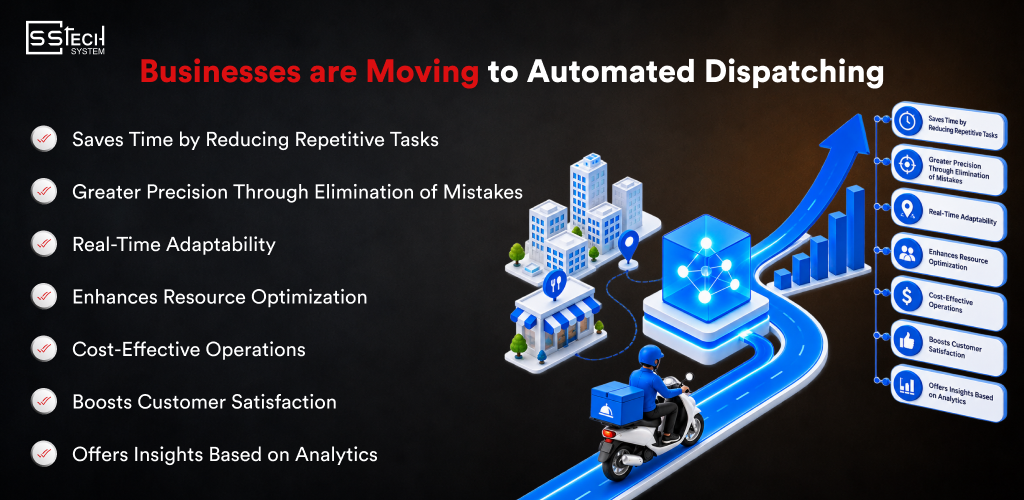
Saves Time by Reducing Repetitive Tasks
Automation does the tedious work of scheduling, planning routes, and assigning drivers. This allows businesses to speed up their delivery workflows and operations.
Greater Precision Through Elimination of Mistakes
Automated systems have consistent rules to minimize the mistakes that people make. This leads to better service quality and stronger customer trust.
Real-Time Adaptability
Businesses can respond instantly to changing delivery conditions. This helps reduce delivery delays with automation and maintain service reliability.
Enhances Resource Optimization
Automation distributes workloads more effectively. This helps increase driver productivity and improves fleet utilization.
Cost-Effective Operations
Businesses can optimize delivery operations while reducing labor and fuel expenses.
Boosts Customer Satisfaction
Customers benefit from:
- Faster deliveries
- Accurate ETAs
- Live tracking updates
- Better communication
Offers Insights Based on Analytics
Sophisticated reporting aids companies in strategic and tactical decisions and enhances company operations.
Industry Impact: Why Automation Is Winning
The competition in the food delivery industry increases year by year. Restaurants, cloud kitchens, grocery delivery, and courier services all have a sizable
- Dispatch scheduling software
- Same-day delivery software
- Proof of delivery software
- Smart dispatch software
- Logistics automation software
Businesses using modern dispatch software for cloud kitchens, meal delivery software, and grocery delivery software gain a significant operational advantage.
The growth of food delivery software India, dispatch software India, restaurant delivery software India, food delivery software USA, automated dispatch software USA, delivery management software Australia, and dispatch automation software Australia highlights the global demand for automation.
The Future of Dispatching
Autonomous Delivery: Dispatch is Now Full of Robots and Drones
Autonomous delivery systems are beyond the pilot testing stage and are being used in the real world.
Future dispatch systems will coordinate:
- Human drivers
- Delivery robots
- Autonomous vehicles
- Drones
A unified delivery dispatch software platform will manage all delivery channels simultaneously.
Digital Twins & Continuous Route Intelligence for City-Wide Planning
Digital twin technology allows businesses to create virtual delivery networks.
These systems simulate:
- Traffic patterns
- Delivery demand
- Driver availability
- Route performance
The combination of AI delivery management systems enables ongoing optimization of delivery operations.
Conclusion
The manual methods of dispatching deliveries no longer meet the demands of speed, flexibility, and accuracy. As the real operational demands of a delivery system move toward instantaneous, the costs, delays, and negative customer interactions inevitably increase.
Modern Food Delivery Software, food delivery dispatch software, and dispatch management software provide a smarter alternative. The investment in intelligent dispatch systems will provide the greatest competitive advantage to businesses. Automation and autonomous systems of the future will become the standards of the industry.
Frequently Asked Questions
What is the biggest problem with manual dispatching in food delivery
Manual dispatching can’t quickly adapt to things like current traffic conditions, order surges, or when a driver becomes unavailable.
How does automated dispatch software improve food delivery?
Routes can be optimized, orders can be automatically assigned, delivery can be faster, and mistakes can be reduced using automated dispatching.
What features should businesses look for in food delivery software?
Businesses should look for software that provides real-time order tracking, route optimization, AI dispatching, and reporting dashboards along with integration capabilities.
Can automated dispatch reduce delivery costs?
Definitely, automated dispatching reduces delivery costs by using routes optimally to reduce fuel costs, reduce delivery costs, and reduce mistakes made when dispatching drivers.
How can restaurants automate food delivery operations?
To automate food delivery operations, restaurants can use integrated food delivery management software, dispatching tools, and point of sale (POS) systems.
Related Article