


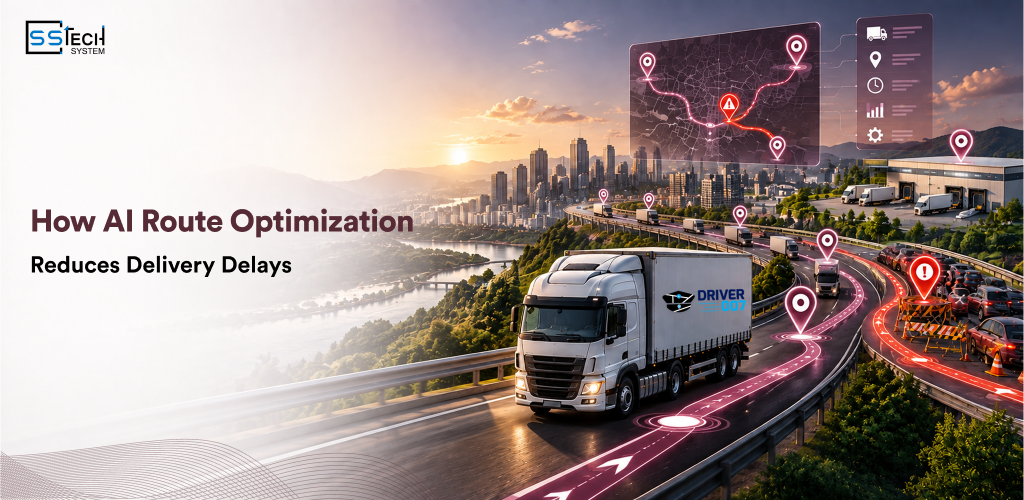
Long distances and poor road conditions are no longer the only causes of delivery delays. Logistics teams have to deal with tighter delivery windows, greater order volumes, the latest customer requirements, a shortage of drivers, heavy traffic, the limitations of the delivery vehicles, and last-minute changes to delivery requirements. Disruptions can impact multiple stops on the same route.
Real-time information, historical delivery data, traffic conditions, vehicle capacity, driver availability, delivery windows, and operational constraints are all things that AI route optimization takes into account when creating and modifying routes. This allows plans to be dynamic and flexible enough to respond to changing conditions during delivery.
This technology has the potential to significantly improve the duration and reliability of delivery commitments, as well as optimize the utilization of transport fleets for logistics companies. Routing can be conceptualized as a continuous decision-making process, aided by AI, rather than as a one-time planning process for businesses.
What Is AI Route Optimization?
Route planning refers to the process of determining the optimal way for vehicles to travel between two or more points. It can involve the use of fixed routes, manually selected stops, and basic mapping. AI route optimization builds upon these foundations and considers multiple elements to determine the optimal delivery routes.
An AI route optimization software platform can consider:
- Delivery locations and order priorities
- Traffic and road conditions
- Vehicle capacity and type
- Driver availability and working hours
- Delivery time windows
- Customer SLAs
- Number of stops
- Historical travel and delivery data
- New orders and unexpected disruptions
The focus is not on determining the shortest route. The goal is to provide a route that allows for faster, more predictable, and more efficient delivery executions.
Read more: How AI Transportation Management Software Transforms Freight
How AI Route Optimization Works
The process generally follows a continuous cycle:
Orders → Constraints → Real-Time Data → Optimization → Route Assignment → Driver Execution → Live Updates → Re-optimization
The system receives delivery orders and operational constraints. It then combines this information with GPS data, traffic information, historical patterns, and vehicle or driver availability.
An optimization engine evaluates possible combinations and assigns routes. Drivers receive their routes through a driver application. As conditions change, the system can recalculate routes and provide updated instructions. This creates a form of adaptive route planning instead of relying on a fixed plan created hours before delivery execution.
Why Traditional Route Planning Leads to Delivery Delays
Traditional route planning can work for simple operations with a small number of deliveries. However, complexity increases rapidly as order volumes and delivery constraints grow.
A route that is planned at the start of the day can become sub-optimal due to a number of factors such as traffic incidents, new orders, vehicle breakdowns, and failed deliveries.
Static planning also makes it difficult for dispatchers to evaluate hundreds of variables simultaneously. A dispatcher may know that a driver is delayed, but manually determining the best replacement route across multiple vehicles can take valuable time.
Poor route decisions can result in:
- Missed delivery windows
- Higher driver overtime
- Excess mileage
- Driver idle time
- Low vehicle utilization
- Failed delivery attempts
- Customer complaints
- Additional dispatch workload
This makes delivery delays an operational problem rather than simply a distance problem.
How AI Route Optimization Reduces Delivery Delays
Predicts Traffic and Travel Time
AI can combine current traffic information with historical travel patterns to estimate how long different routes may take. Traffic-aware routing helps dispatchers avoid routes that appear short on a map but regularly experience congestion. This supports more realistic scheduling and predictive ETA calculations.
Dynamically Recalculates Routes
A major benefit of route optimization systems powered by AI is their ability to recalculate routes based on the circumstances. If a system detects that a vehicle is stuck in traffic, for example, it will automatically recalculate the best route for the other vehicles. This form of route planning minimizes the impact of disruptions.
Optimizes Multi-Stop Delivery Sequences
The order in which delivery stops are made can impact the total time needed to complete all the deliveries. Multi-stop route optimization takes into account different orders of delivery stops and decides on the order that minimizes the total distance to be travelled. This can be very beneficial for delivery operations in e-commerce, courier, grocery, and retail businesses.
Considers Delivery Windows and SLAs
A route may be short but still fail if a driver arrives outside the customer’s requested time window. AI considers delivery commitments during route creation. It can also prioritise the shipping of time-sensitive and temperature-controlled goods.
Matches Orders With the Right Driver and Vehicle
An optimization engine can consider vehicle capacity, delivery requirements, driver availability, operating areas, and working hours before assigning an order. This improves fleet route planning and reduces unnecessary reassignment.
Improves ETA Accuracy
Dispatchers and customers benefit from improved ETA estimates. A.I. does not simply provide an ETA at the start of a route; it continuously updates arrival time estimates based on real-time traffic conditions, the vehicle’s location, and how the route is being driven.
Predicts Potential Delivery Failures
Historical data can reveal patterns behind failed deliveries. AI can use these patterns to flag potential problems before the delivery attempt.
Learns From Historical Delivery Data
AI systems can learn from previous routes, travel times, delays, completed deliveries, and operational outcomes. Over time, this can improve route intelligence and make route recommendations more relevant to the actual operating environment.
AI Route Optimization Is More Than Finding the Shortest Route
A common perception is that route optimization means simply that- finding the shortest distance between multiple locations. However, intelligent route optimization considers a lot more than that.
These can include:
- Time
- Cost
- Vehicle capacity
- Driver availability
- Traffic
- Delivery windows
- Customer priorities
- Shipment requirements
- Service-level agreements
- Vehicle restrictions
- Depot locations
Therefore, the objective of AI delivery route optimization is not always fewer kilometres. It is better operational performance.
AI Route Optimization vs Traditional Route Planning
- Factor: Traditional Route Planning AI Route Optimization
- Route creation: Manual or rule-based AI-driven optimization
- Traffic: Limited or static consideration; real-time traffic-aware routing
- Route changes: Manual vs dynamic recalculation
- Delivery windows: Basic rules; multi-constraint optimization
- Capacity: Manually considered; automatically incorporated
ETA Basic estimates Predictive ETA
- Scalability: Difficult with high volumes; designed for complex networks
- Historical learning: Limited; uses historical operational data
- Exceptions: Dispatcher intervention vs automated recommendations
- Dispatcher dependency: High; reduced through automation
- AI Route Optimization changes routing from a fixed planning activity into a continuous decision-making process.
Benefits of AI route optimization for logistics companies
Businesses can use AI-based routing to improve both delivery performance and operational efficiency.
Key benefits include:
- Increase on-time delivery rates
- Reduce fuel and transportation costs
- Increase deliveries per driver
- Reduce driver idle time
- Improve fleet utilization
- Reduce failed and repeated deliveries
- Improve customer delivery visibility
- Reduce dispatcher workload
- Improve SLA compliance
All of these lead to a reduction in delivery window breaches, an improvement in operational throughput, and a consistent customer experience.
AI Route Optimization Use Cases Across Logistics
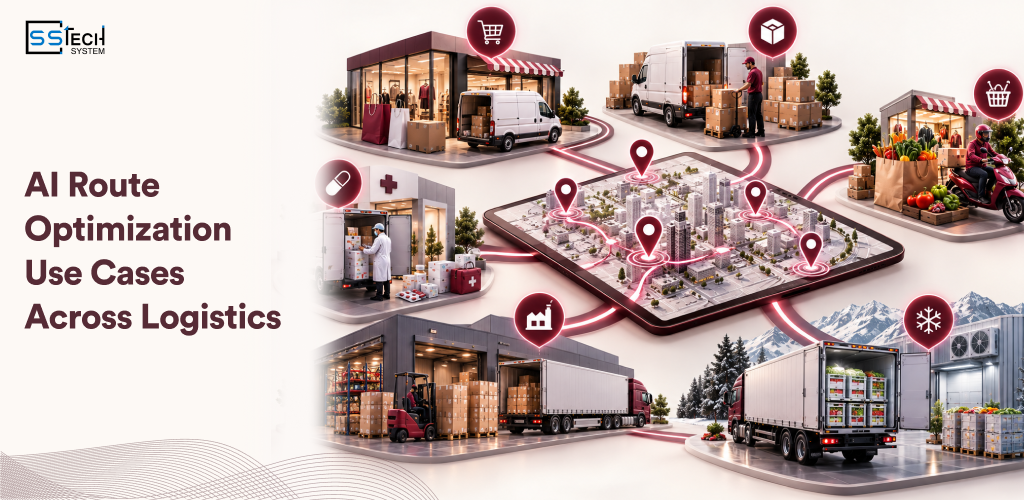
AI-based routing can support many types of delivery and field operations.
E-Commerce And Retail Delivery
Deliveries need to be efficiently planned to account for large numbers of customer orders, and AI’s ability to do just that is a huge benefit. AI can also consider time windows, vehicle capacity, and customer commitments.
Courier And Parcel Delivery
Delivery route optimization software or freight management software allows courier companies to efficiently plan for high stop volumes and delivery priority changes.
Food And Grocery Delivery
Deliveries of perishable goods require routing that takes into account the time windows as well as the priority of the orders. AI can be used for traffic optimization as well.
Pharmaceutical Delivery
Pharmaceutical logistics can include strict delivery windows and specific requirements for shipments. AI can help determine the best vehicles and routes for those shipments.
B2B Distribution
Distributors can take into account vehicle capacity and delivery schedules when planning routes between warehouses, customers, and retailers.
Cold Chain Logistics
With perishable goods, route optimization can help reduce the number of unnecessary service visits and help establish more reliable delivery windows.
Read more: Transform Your Supply Chain with Logistics AI App Integration
Fitting AI Route Optimization into a Supply Chain Management Software Stack
A contemporary workflow might look like this:
- Order Management
- Transportation Management Software
- AI Route Optimization
- Dispatch
- Driver App
- GPS/Telematics
- Proof of Delivery
- Customer Tracking
- Analytics
For example, Transportation Management Software can provide shipment information. The optimization engine can use that information to generate routes. A driver application can then deliver route instructions to drivers, while real-time shipment tracking provides visibility during execution.
A Proof of Delivery Solution can capture delivery completion data, which can later be used for analytics and route improvement. Businesses building a connected logistics ecosystem can also integrate Warehouse Management System, Delivery Management System, delivery planning software, Courier Delivery Software, route scheduling software, Driver Management Software, and Last Mile Delivery Software.
Real-Time Dynamic Routing: The Next Step in Delivery Optimization
Static routing creates a plan. Dynamic routing keeps that plan relevant. With dynamic route planning, routes can be recalculated when specific events occur.
These may include:
- Heavy traffic
- Vehicle breakdowns
- New delivery orders
- Optimized delivery routes
- Failed delivery attempts
- Customer priority changes
- Driver unavailability
- Road closures
- Urgent shipments
This is where an intelligent dispatch engine can provide significant value.
Emerging AI Trends Transforming Route Optimization in 2026
AI capabilities in logistics are moving beyond basic route calculation. Several developments such as warehouse automation technology, carrier integration solutions, real-time inventory tracking are shaping the next generation of routing systems.
- Predictive ETA and Delivery-Promise Management
- AI-Powered Dynamic Dispatch
- Emissions-Aware Routing
- Hyperlocal and Last-Mile Optimization
- Agentic AI for Logistics
How to Choose the Best AI Route Optimization Software
Businesses evaluating AI route optimization software should look beyond route creation.
Important capabilities include:
- Dynamic routing
- GPS tracking
- Multi-stop optimization
- Time-window management
- Capacity constraints
- Driver management
- ETA prediction
- Automated dispatch
- Proof of delivery
- Customer notifications
- APIs and integrations
- Analytics
- Multi-depot support
- Multi-fleet support
Depending on the business, IoT application development, API integration services, cloud-based logistics solutions, or custom software Development, AI software development may be required to connect existing systems.
How Businesses Can Implement AI Route Optimization
Implementation should be treated as an operational transformation rather than simply a smart route planning software installation.
A practical approach includes:
- Identify delivery bottlenecks
- Collect and clean operational data
- Define routing constraints
- Integrate existing logistics systems
- AI route optimization
- Connect driver applications
- Monitor performance
- Continuously improve the model
This phased approach can make digital logistics transformation easier to manage.
How to Measure AI Route Optimization ROI
Technology investment should be measured against operational outcomes. Businesses can establish a baseline before implementation and compare it with post-implementation performance.
Important metrics include:
- On-time delivery rate
- Cost per delivery
- Miles per delivery
- Fuel consumption
- Driver idle time
- Failed deliveries
- Deliveries per vehicle
- ETA variance
- Driver productivity
- Customer complaints
Common Challenges When Implementing AI Route Optimization
While the potential of AI routing is great, so are the risks associated with the quality of data and the operations of the business.
Common challenges include:
- Poor-quality or incomplete data
- Incorrect delivery addresses
- Incorrect routing constraints
- Legacy system integration
- Driver adoption
- Training requirements
- Change management
- API and map data costs
- Model accuracy
- Data security
- Need for human operational oversight
The best approach is automated route decisions with oversight.
AI Route Optimization for Different Fleet Sizes
Small Delivery Fleets
Even small business fleets can use AI to improve the use of business resources, especially when delivery demands change throughout the day.
Mid-Size Fleets
More drivers and larger vehicle capacities make subsequent delivery windows harder to coordinate in a mid-sized operation. AI can automate this process.
Enterprise Logistics Networks
Large enterprises have more than one depot, fleet, and carrier, along with a span of delivery regions. They need flexible fleet optimization software that can operate across large, integrated systems to coordinate extensive networks.
Conclusion: From Route Planning to Real-Time Delivery Management
Routing deliveries has become too intricate to solely depend on static plans. Equal concern to traffic and customer expectations are variations in order volume, driver availability, vehicle constraints, and the many unknowns that arise during the day.
AI Route Optimization provides an intelligence layer that connects orders, drivers, vehicles, traffic, customer commitments, and operational data. This technology is shifting from route planning to real-time delivery management.
This results in more efficient logistics operations with fewer delays, better Estimated Times of Arrival (ETA), higher fleet utilization, lower transport costs, and improved driver efficiency, resulting in a better customer experience.
Frequently Asked Questions
What is AI route optimization?
AI Route Optimization leverages artificial intelligence, real-time and/or historical data, and operational constraints to create and improve delivery routes. It factors in the customer’s order priorities, the availability of drivers and vehicles, delivery window time frames, and routes that consider traffic.
How does AI route optimization reduce delivery delays?
It utilizes traffic information, estimates time to deliver, selects optimal routes, automatically recalculates routes to new destinations, and reorders stops along the route to improve ETA.
How does AI route optimization work?
The system collects orders and routing constraints and uses real-time and historical data to perform analysis on potential routes, allocate the best route, manage the execution of the route, and continually re-optimize the route.
What is the difference between route planning and route optimization?
Route planning consists of creating a route between one or more locations. Route optimization consists of evaluating multiple variables and possible routes to satisfy business goals and operating constraints.
Can AI optimize delivery routes in real time?
Yes. Recently developed AI systems can consider traffic, new orders, breakdowns, failed deliveries, and other events to recalculate routes during delivery execution.
What data does AI use for route optimization?
AI can use the locations of orders, historical travel times, traffic data, GPS data, vehicle capacity, driver schedules, delivery windows, customer priorities, etc.
How does AI improve delivery accuracy?
AI can use real-time location data, traffic data, travel time data, delivery progress data, and other delivery data to update delivery ETA constantly.
How predictive routing reduces fuel costs
Yes, route optimization can reduce fuel costs by reducing unnecessary mileage and idle time and by reducing the number of repeated trips.
What is the future of AI route optimization in logistics?
Yes, small fleets can use AI to eliminate manual planning, improve route efficiency, and manage changing orders better.
How does AI route optimization integrate with Logistics Software Development?
AI routing can receive order and shipment information from a TMS, optimize routes using operational constraints, and send route assignments to dispatch or driver applications. APIs can connect the optimization engine with other logistics systems.
How much does AI route optimization software cost?
The cost will depend on the size of your fleet, the number of users, the volume of deliveries, the required integrations, the desired features, the deployment model, and the level of customization.
Related Article