


In a logistics world where empty miles, lack of real-time visibility, and manual coordination still plague operations, having a custom logistics app is no longer optional, it’s a strategic necessity. From delayed deliveries and inefficient route planning to inventory mismanagement, the challenges are stacking up faster than shipments can move.
This blog is designed to help you cut through the chaos and build a roadmap for smarter logistics. Whether you’re a startup building your first delivery app or an enterprise optimizing supply chain workflows, we’ll walk you through the key types of logistics apps, must-have features, recommended tech stacks, and cost factors that influence your development budget.
You’ll also get insight into how logistics app development services can reduce inefficiencies within warehousing, fleet management and last-mile delivery and much more. By the time it’s over you will know everything required to plan, build or scale your own logistics app.
Let’s get started.
Define the Types of Logistics Apps You Can Build
A proper logistics app development has to be in place to keep track of everything 24/7. Logistics and transportation apps can make tasks perfect and smooth. The logistics app solution makes the work across all departments visible and predictable.
As the logistics industry has several departments, logistics apps also vary by purpose, end-users, and the feature list. You need to decide which app’s type you are going to build and select one among the following.
a. On-Demand Logistics Apps
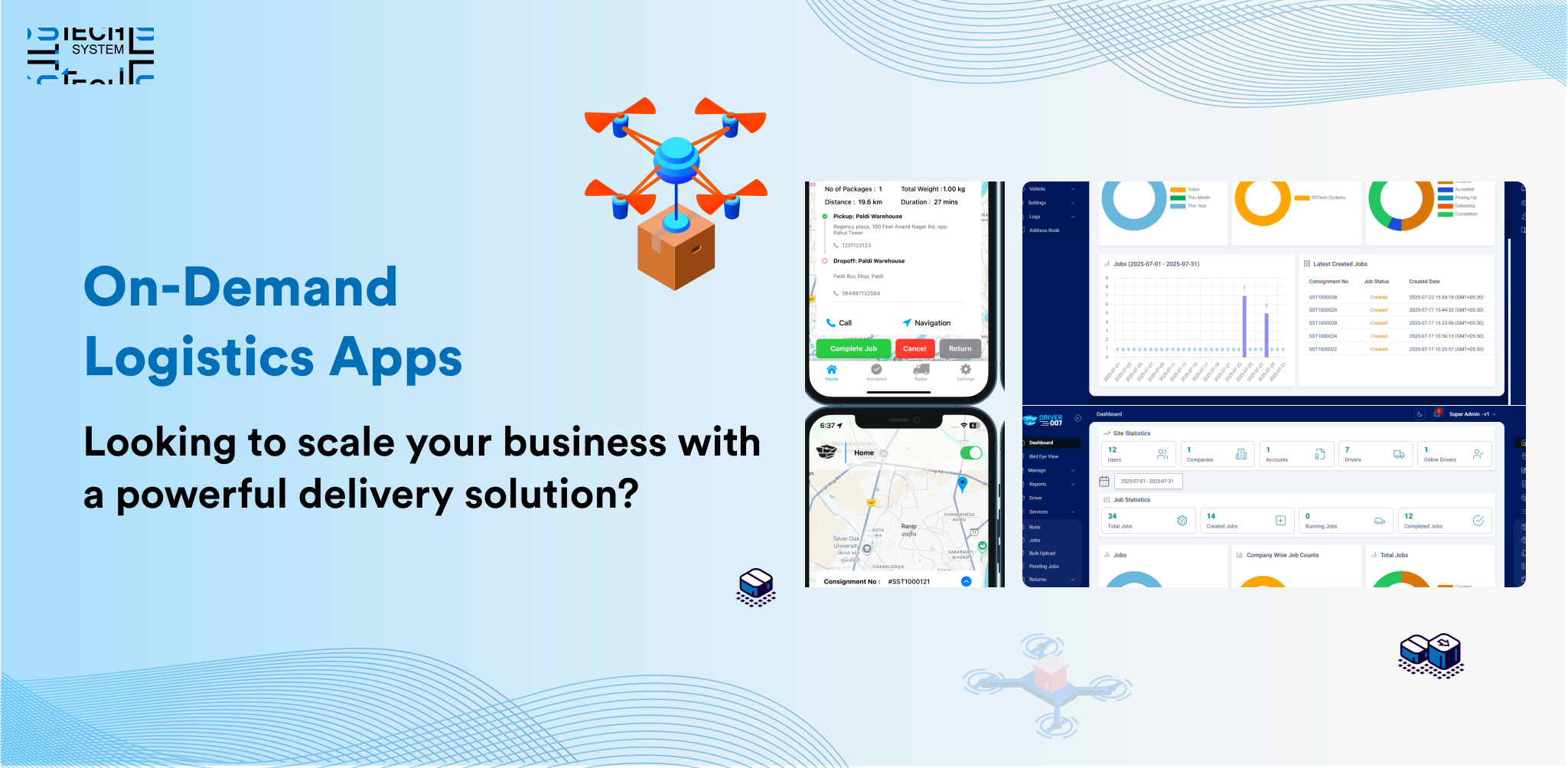
Vehicles do not always drive fully loaded, and if your drivers have extra space in their trucks, they can take some extra freight for the delivery. If you desire to increase the income of your logistics company, consider shipping on-demand mobile app development. This type of delivery logistics apps connects company-owned vehicle drivers and shippers who need their cargo to be delivered. Thus, these logistics apps consist of a carrier app, a shipper app, and an admin panel.
Features
- GPS or map box tracker to determine the driver’s location, suggest the nearest shipping requests, and show driving directions.
- Offers section, where the driver can view app shipping request nearby.
- Order page with details about the shipment origin, destination, size, weight, etc.
- A job with a history of completed orders, new shipping orders, and their status
- Digitized documentation, where the driver takes a picture of the POD, bill of lading, and inputs the name of a representative.
b. Fleet Management App
For an excessive fleet, you need to track the information about each vehicle and maintain them in time. A fleet management app helps you to record, manage, and store all the information about your trucks. With such logistics and transportation apps, you can track vehicle maintenance history, fuel consumption trends, service costs, and other essential metrics to give you deep insights into your total cost of ownership. Fleet management logistics apps involve a driver’s app where the user updates information on the vehicle and an admin web-based app where you can assign the user’s role, track statistics of your fleet, schedule maintenance reminders, and so on.
Fleet management software helps drivers to update information, track their fleet, and access fleet data anytime, anywhere. The app’s most essential features are
Features
- Real-time inspections submission (DVIR) and issue reports
- Barcode scanning for streamlined data updates
- Digital gallery with images, docs, and comments
- Integrated GPS for vehicle tracking
- Submission of work orders
c. Warehouse Management App
If a logistics business owns a warehouse management system, you need to ensure that all shipments will be delivered to the right origin within the stipulated time. At the same time tracking, managing, and updating the status of hundreds of deliveries in real-time is almost impossible. To digitize the management of your warehouse, consider barcode scanning app development. Such applications are empowered with third-party APIs to recognize various barcodes and integrate with your warehouse database to update information in real-time. Barcode scanning apps eliminate expenses on barcode scanners, reduce human errors, and increase your warehouse employees efficiency thanks to bulk barcode scanning.
Features
- Barcode scanner to read barcodes using a mobile device’s camera, and update the warehouse database within minutes.
- Integration with resource management software (ERP) so warehouse and logistics businesses can track freight being shipped in and out.
- Shipment tracking for finding a particular freight by the shipper, consignee, or PO and its status.
- Current position to find out about shipping geolocation, speed, navigation status, time of departure, arrival, and ETA at the final destination.
d. Tracking and Monitoring
Tracking management apps comprise of shipment tracking of all domestic as well as international freight. It maintains visibility on your physical assets at all times. Its features include assets directories with customizable fields, photo tagging, audit trail modules, interactive maps, and reporting tools, etc. It allows the admin to track the activities and trace the tasks assigned of jobs to the driver as the picker and dropper in the system for the workers.
After the driver collects and drops the assigned parcel to its destination, the pick-up, and the drop-in location is captured via RFID scanning. The end goal of the solution is to provide accurate parcel delivery details. With this app, you can effortlessly manage your shipment, vehicles, and drivers. With automated email/notifications and full mobile support, your logistical operations are guaranteed to be smooth.
Features
- Unified dashboard
All critical information in one place, the dashboard display job creation, completed pending, on-going, cancel jobs and earnings, allowing you to view vital statistics at a glance.
- Track your shipments
This feature allows you to receive real-time updates on the location and status of your shipment.
- Analyze operational data
Review your fleet’s fuel efficiency, inventory turnover, workforce efficiency, customer satisfaction rate.
- Optimize your delivery channels
Save time by automating tasks, such as route assignment and delivery confirmation emails. Allows a driver to update their statuses in real-time.
Key Features Of a Customized Logistics App
- Dashboard to view all the process in one place
- Admin panel to manage, monitor, and control the logistics operation.
- Management and tracking of fleet
- Push notification to update the status of orders to the customers
- Log reports viewing the status of the parcel delivery.
- Invoicing to make and access invoices
- In-app chat for drivers, managers, and customers to communicate
- Real-time tracking to search the exact location of the fleet
The transportation and logistics app has mainly three versions, admin, driver, and customer panel. All of them have different features
Comparing Different Types of Logistics Apps
There are different types of logistics apps, each designed for a particular type of operation. On-demand logistics app is also perfect for real-time booking and delivery, which customers use to schedule pickups, drivers use to manage deliveries and admins can keep track on the workings of apps such as courier services or hyperlocal delivery business.
Fleet management applications serve primarily on vehicle tracking, optimization of route; and the analysis of fuel usage therefore are crucial for transports or logistics companies that have a huge number vehicles. Warehouse Management Apps, on the other hand, are designed for inventory managers and their warehouse crew to boost efficiency with stock control, picking/packing and dispatch from storage areas.
Tracking and monitoring apps are used to view the status of a shipment in real-time, including its location, how far it is from delivery and how each driver is doing, all with frequent visibility into any problems that might arise. Each type of app is designed to solve a different bottleneck, whether that’s minimizing downtime, improving delivery accuracy and more.
| App Type | Primary Users | Use Case | When to Use |
|---|---|---|---|
| On-Demand Logistics App | Customer, Driver, Admin | Real-time pickup, delivery requests, and order tracking | Ideal for courier startups, same-day delivery, hyperlocal needs |
| Fleet Management App | Fleet Manager, Admin | Vehicle tracking, route planning, fuel & maintenance logs | Best for logistics firms managing large vehicle fleets |
| Warehouse Management App | Warehouse Staff, Admin | Inventory, stock movement, packing & dispatch tracking | Suitable for high-volume inventory and supply chain efficiency |
| Tracking & Monitoring App | Customer, Support, Admin | Shipment status, GPS tracking, driver performance | Useful for businesses prioritizing real-time customer updates |
Your logistics app is a combination of features from all these categories, albeit customised to the exact nature of your operational flow. They’re ideal for companies that want total control over warehousing, transportation and last-mile delivery solutions, all on a single platform.
Identifying Must-Have Features in Your Logistics App
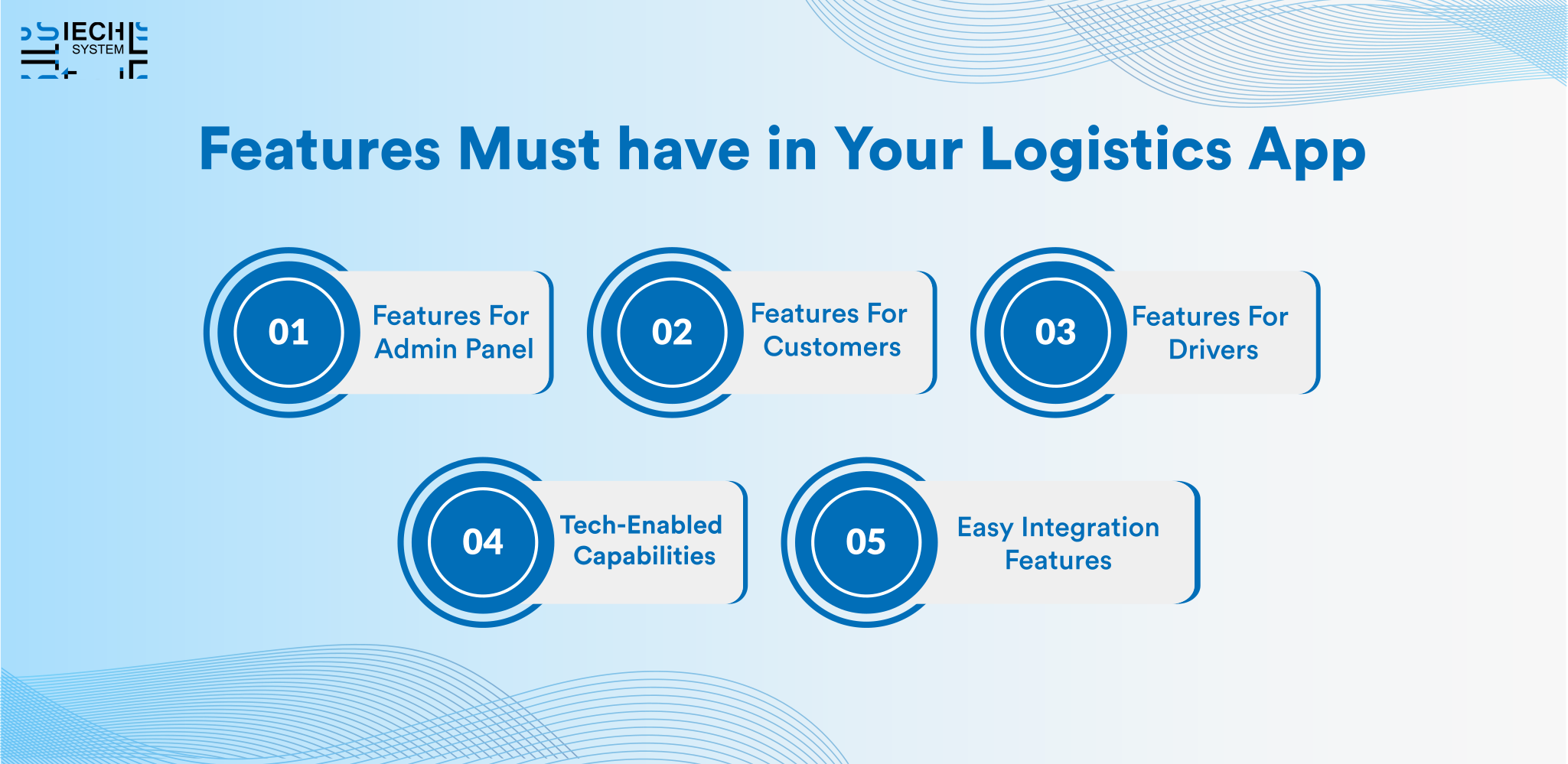
To build an effective logistics app, you need to focus on features that directly solve real-world bottlenecks, from automated dispatching to real-time GPS tracking. Each user role, whether it’s a driver, warehouse staff, or admin, requires purpose-built functionality to streamline their tasks and ensure smooth end-to-end logistics operations.
a. Essential Features For Admin Panel
- GPS System to perform various tasks ranging from navigation to tracking, monitoring, and managing fleet. The managers can track the drivers and coordinate with them, that leads to timely and safe delivery
- The dashboard allows the admin to see the status of all the orders. Manage, monitor, and control end to end delivery process. Stay connected with customers to resolve their queries quickly.
- Push notification to send real-time updates on order status, send the information regarding driver allotment, invoice, and order completion.
- Vehicle management facilitates the fleet manager to track the vehicles and keep the check on fuel consumption. The transporter manage the fleet effectively with this feature
- Machine-to-machine communication enables the admin to monitor the vehicle’s health from a remote place. It keeps the fleet managers aware of the vehicle condition and maintenance requirements.
- Analytics and Multilanguage support
b. Essential Features For Customers
Registration
Simple and easy signup or registration process to get the valuable data of customers like email addresses, names, and contact details.
Alerts
From order booking and invoicing to tracking and final delivery, customers stay updated with real-time alerts as soon as the vehicle leaves the warehouse and reaches its destination.
Payment Gateway
Customers can pay online, simply, safely, and securely with the help of a payment gateway.
Track Order
Customers can track their orders in real-time to find the exact location of the consignment and they can predict the time of delivery.
Rating and Feedback
Customer reviews or feedback after receiving the goods. Their feedback and suggestions are used to improve customer services.
Social Media
Integration of social media in-app chat.
c. Drivers Features
Registration
Driver signs up or registration through email or social media account.
Order Management
The driver can have details about the pick-up and destination with this feature.
Route Tracking
Map box or GPS technology allows the driver to search for the exact and shortest route of parcel delivery.
In-app Chat
It enables the drivers to remain in touch with the admin as and when necessary.
Bills Approval
Receipt of payments and bills approval an additional feature of the driver-side app.
Our estimation and development of logistics apps with customized features for different clients, the cost largely depends upon the number of features and complexities involved in the app. We consider our following services for payment, design, backend development, web development, iOS and Android app development, project management, quality assurance, support, and maintenance, etc.
d. Advanced Features and Tech-Enabled Capabilities
- Geofencing helps in automating alerts and tasks, especially when a vehicle on duty enters or exits a predefined location.
- Real-time information about vehicle health, driver behaviour and fuel consumption are provided by telematics.
- With real-time analytics, you can keep track of KPIs in a live dashboard such as, delivery speed, idle time, route efficiency, etc.
- The M2M (Machine-to-Machine) communication amongst smart IoT-enabled vehicles, sensors, and devices helps in the auto-coordination of logistics workflows.
e. Easy Integration Features
- ERP or WMS integration ensures no silos in data between inventory, order management, and dispatch systems.
- The efficiency of order processing without errors is still retained because of barcode scanner integration which helps in accurate product identification and tracking inventory.
- Fleet sensor connectivity monitors metrics related to vehicle temperature, tire pressure, and fuel use in logistics operations.
- Digital Payment Integration allows secure and real-time transactions while booking freight, Cash on delivery and any kind of digital payment.
- Cloud service integration provides extensive storage capability, improved data security, and access to real-time logistics information from virtually anywhere.
Choosing the right features is the foundation of a high-performing logistics app that meets your business goals, user expectations, and operational challenges. By aligning your feature set with the needs of your customers, drivers, and internal teams, you ensure your app delivers efficiency, scalability, and real-time visibility across the entire logistics chain.
Choose the Technology Stack That Powers Your Logistics App
Choosing the right tech stack is important to make sure that your logistics app scales, is secure, fast and reliable, all at the same time. The core stack typically consists of Twilio for SMS and auth, Stripe or PayPal for payments, MongoDB or PostgreSQL for data storage, and a cloud service like AWS, Google Cloud, or Azure for hosting and storage scale.
a. Native vs. Cross-Platform vs. Web
Your budget and timeline will significantly influence how you build your app. While native development (Swift for iOS, Kotlin for Android) maximizes performance and user experience, it is the most expensive due to separate codebases.
Cross-platform frameworks such as Flutter or React Native provide a compromise between cost (one code base, as opposed to two or more, i.e., build once, deploy everywhere) & quality. Web apps sacrifice some depth for speed and cost effectiveness, for example, they may not include native mobile features such as offline tracking or push notifications.
b. Infrastructure & Integrations
Logistics apps are all about integrations. Mapping APIs such as Google Maps or Mapbox (for route tracking), GPS/telemetry integration (for monitoring fleet location in real time), barcode and QR scanning SDKs (for warehouse operations), and ERP/WMS APIs (for backend coordination). These integrations enable automation and precision on every logistics stage.
c. Security, Scalability, and Device Management
Multiple users will be using the sensitive delivery and financial data which means data encryption, role-based access control, secure API calls, and GDPR/CCPA compliance are non-negotiable as well. You may also need to prepare for scalability-whether you’re rolling out in new cities or adding new fleet partners and initiate mobile device management (MDM) policies for field personnel with company-owned devices.
Understand the Cost Drivers & Budgeting for Your Project
Developing a logistics app is not a small investment; therefore, being aware of the cost drivers helps you with further planning. As per the industry estimates, a simple logistics app with limited features would cost $25,000 to $40,000, whereas a rich feature platform with real-time tracking, multi-role logins and API integrations could cost anywhere between $100,000 to $150,000 or even higher.
a. What are the Factors That Impact the Cost of Apps
These are the major factors affecting the Logistics app development cost
- Platforms: Creating unique apps for iOS, Android, and Web poses costly implications than having one platform/ Cross-platform.
- Backend Complexity: More complexity like advanced admin panels, real-time databases, and AI-driven features add more to the backend development and require higher investment.
- User Role Count: The higher the roles you need your app to perform (admin, driver, customer, warehouse staff etc.), the higher the number of screens, APIs, and logic needed.
- Third-Party Integrations: Third-party API integrations such as ERP, WMS, TMS, payment gateways, GPS API, and telematics systems contribute to the overall development cost.
- Design & User Experience: More design hours & testing are required for the development of custom UI/UX designs for different roles and devices.
- Security & Compliance: Implementing security features such as data encryption, role-based access control, and compliance with regulations like GDPR/CCPA increases the complexity of development.
- Scalability Requirements: Apps designed for huge scale (multiple cities, high traffic, complex logistics chain) need more infrastructure
- Maintenance & Support: Ongoing costs such as server hosting, app updates, fixes for bugs, and technical support after the launch
- App Marketing & Promotions: Your budget should take into consideration user onboarding, digital campaigns, and app store optimization.
- Project Management & QA: Management of design, dev, testing and stakeholders all add to the budget.
- Developing the rates: If you end up hiring developers in the US, the hourly rate can increase quite significantly as you would be subject to the market rates of hiring developers in the UK or Europe.
- Outsource to Countries such as India: Outsourcing your project to one of the talented teams in India, Philippines or Eastern Europe can help you save around 40–60% in development costs without compromising on quality, if done properly.
- Time Zone: Think about the time zone, precision of communication, and global cultural fit when you outsource.
- Access to Technical Expertise: India is home to a large talent pool in logistics tech, with expertise ranging from mobile development and ERP/WMS Integrations to Real-Time Tracking Systems.
b. Ongoing Costs to Consider
The outlay rolls on, once a launch is underway. You will have to allocate some funds on technical support, app maintenance, adding new features, cloud storage, and marketing or user acquisition. Apps must be periodically versioned to maintain compatibility with OS updates and third-party services.
c. How to Control Costs Effectively
Kick start with an MVP (Maximum Viable Product),minimal features to test your idea and user feedback. Phase your rollouts to keep the initial scope limited and reuse what you have (login/auth, simple dashboards) instead of custom-building every component. Choosing open-source libs or off-the-shelf integrations when relevant can reduce overall costs while maintaining functionality too.
| Country | Estimated Cost for Simple App (USD) | Estimated Cost for Medium/Complex App (USD) | Specific Considerations |
|---|---|---|---|
| India | ~$10,000 – $30,000 | ~$40,000 – $80,000 | Lower hourly rates (~$20–40/hr) |
| United States | ~$30,000 – $60,000 | ~$100,000 – $150,000+ | Higher rates, premium expertise |
| United Kingdom | ~$30,000 – $70,000 | ~$70,000 – ~$120,000 | Western Europe premium |
| Canada | ~$30,000 – $60,000 | ~$80,000 – ~$150,000 | Intermediate rate market |
| Germany | ~$40,000 – ~$80,000 | ~$100,000 – ~$200,000 | Strong tech ecosystem, higher cost |
| Australia | ~$25,000 – $50,000 | ~$70,000 – ~$180,000 | Similar to Western markets |
With proper planning, selecting the right tech stack, and phase-wise development, you can minimize the cost while developing a potent, scalable logistics app catered to your business requirements.
Develop Your Roadmap: From Idea to Launch
In order to translate your logistics app into a working solution, you need a systematic, phased plan that minimizes risk and will conform to your operational goals and requirements. Ideation is usually the start of your journey, identifying the logistics pain points you have in your business and the business model supported by the app to solve it, be it on-demand delivery, fleet management or warehousing optimization.
The following step is to recognize whom you target user is (admin, warehouse/stock staff, driver, or customer) and what kind of app best serves them.
- Identify your target users such as admins, warehouse staff, drivers, or customers, and choose the app type that best serves their needs.
- Prioritize your features by deciding what is essential for the MVP and what can be added in future phases.
- Select the right tech stack and onboard a development partner experienced in logistics workflows and system integrations.
- Create prototypes and build your MVP to validate core functionality before heavy investment.
- Run controlled pilot tests with selected drivers or warehouse teams to refine usability, fix bugs, and ensure the app performs well in real operational environments.
Important Decisions Made Throughout the Journey
During which you are going to face critical decisions that will affect both the cost and the performance. This step includes deciding on app type (native, hybrid, web-based), the number of features to be included, technology and integrations and budgeting model, whether you will make an upfront investment or will scale gradually. Such decisions must correlate with your logistics workflow and already implemented systems along with your long-term growth plan.
Post-Launch Metrics to Monitor
Performance after launch is a crucial part of being able to iterate. Fleet utilization, empty miles, on-time delivery, customer satisfaction, cost per delivery and some others are core metrics that need to be tracked more effectively. These KPIs will be your ammunition for justifying your app investment and steering feature/operation improvements.
Pro Tips for Logistics Teams
- Make sure that all stakeholders such as warehouse managers, fleet operators, IT teams and end‑users are aligned and onboard for the app roll out.
- Unveil data‑visibility tools ahead on time so your teams can have actionable insights from the get go
- Use a new warehouse, vans, coverage areas, and delivery zones so as not to be caught in the future having to replan where all your operations are going to fit.
- Depending on the legacy systems, you need to ensure that the app you choose can integrate with them seamlessly, otherwise, it will lead to data silos and workflow interruptions.
By executing a well laid out plan and making decisions at each stage, you can create a logistics mobile app that does more than today, and helps your business stay on the path to digital success in the long run.
Common Mistakes to Avoid & Best Practices
Even with great willingness and planning, lots of logistics companies fail at app development because of some traps that can be easily avoided. Knowing these traps, and the practices that mitigate them, can save you time, money and the lost chance to make an impact.
a. Common Mistakes to Avoid
- Attempting to do it all at once: Businesses often try to include too many features in the initial release which results in delays, costs overruns and user bewilderment. It is wiser to begin with an MVP.
- Neglecting integration: If your application cannot integrate with your ERP, WMS, or TMS, it creates a disconnected workflow and operational friction
- Not considering post go-live costs: Most organizations do not plan for ongoing costs such as maintenance, education, system updates, and marketing; thus resulting in underfunding post go-live.
b. Best Practices to Follow
- Focus on driver experience: The UI for drivers is core to logistics execution, a good, responsive, and intuitive UI will ensure adoption by drivers with minimal training time.
- Do invest in real-time tracking and analytics: Being able to see when your goods are arriving, gives you the power to recalculate routes, or handle problems, in a much more agile fashion. Do not push this feature for later stages.
- Use real usage data to iterate: You can receive the best feedback when you are going through real users. The first version of anything is never the final version, launch, learn, and iterate.
c. How SSTech System Lets You Create Intelligent, Scalable Logistics Apps
SSTech System offers you a wealth of experience in logistics software to help you avoid costly pitfalls in development and stick to best practices from day zero. Their strategy-first approach will help you focus on building MVP features so you are ready to go-to-market faster than ever without burning through the budget.
Whether it be ERP, warehouse systems, fleet sensors, or legacy tools, their technical team takes care of integration and ensures it integrates with existing platforms seamlessly, so you don’t have to start rebuilding your infrastructure from scratch. They also assist in projecting the continuous costs of operations, such as maintenance, updates, and marketing support, which are frequently ignored.
Finally, SSTech System builds with the end-user in mind, whether they are fleet drivers or warehouse operators that are often mission-critical persons. Early in the build, they integrate real-time analytics dashboards, GPS based tracking and usage logging enabling you to glean performance intelligence from day 1 of going live.
With SSTech System, you develop not just a logistics app but a future-ready, scalable and long-term ROI driven logistics ecosystem that adds value and usability.
Conclusion: Your Next Steps
Choosing the proper type of logistics app, identifying the crucial features, picking a scalable tech stack, and controlling development and ongoing costs can set you up nicely to make your logistics an efficient, data-robbing engine.
Want to reduce your logistics operational costs? Partner SSTech System to turn to the best in the trade, from ideation stage to prototyping, rollout, and beyond. Let’s build a logistics solution that drives efficiency, reduces costs, and delivers measurable ROI.

Frequently Asked Questions
Essential features of a logistics app include:
· Real-time tracking
· Automated dispatching
· Route optimization
· Digital proof of delivery
· Role-based dashboards
If your workflow allows, integrations with warehouse management systems can make inventory handling better and also prevent operational errors from accruing from duplicative data entry.
At a glance, costs can be anywhere from $25K-$40K for a basic app and $100K-$150K for a great platform with proper integrations and functionalities. The total amount will vary based on the specific number of user roles, platforms, portfolio, custom features, or if the app connects to other systems, such as a Transportation Management System.
Most applications are built on formats like AWS or Google Cloud with databases like PostgreSQL or MongoDB behind them. You can also get the mapping APIs, telematics and payment gateways and integrate them, along with tools for use cases like last the mile delivery solutions, that optimize the routing process, real-time tracking with their environment and more.
In terms of performance, native apps are unbeatable; cross-platform apps have quick development and low costs; web apps have quick development and low customization (good for admin dashboards or internal tools). Your selection depends on your budget, timelines and how deep you want the mobile features to go.
A strong logistics app will help in making the maximum potential of fleet utilization, damage-free empty miles, improved delivery accuracy, and end-to-end visibility for every stakeholder. Using functionalities such as live monitoring and integrated data dashboards, businesses can make quicker decisions and seamlessly scale over multiple warehouses, fleets, and delivery networks.
Related Article