


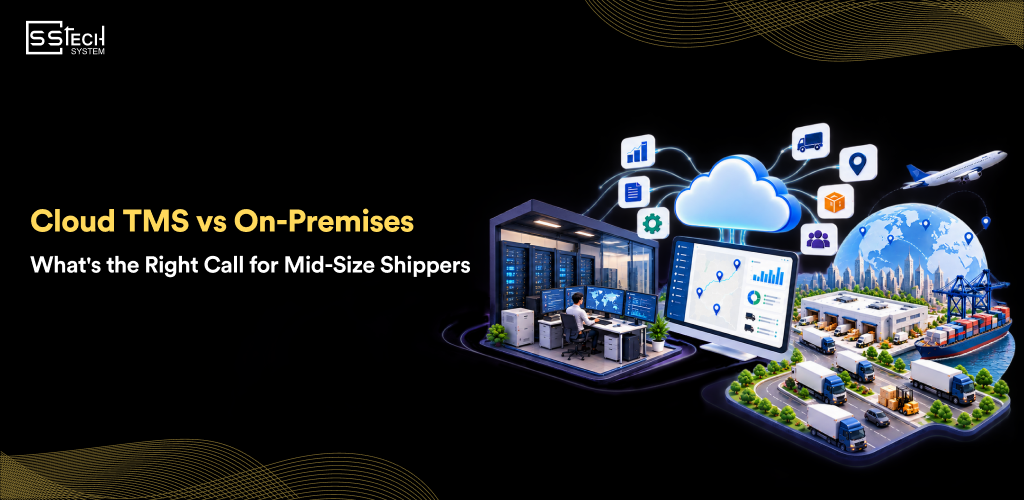
Transportation operations are becoming more connected and data-driven. Mid-size shippers now manage more carriers, orders, delivery expectations, and system integrations than before. This makes the Cloud TMS vs On-Premises TMS decision more important.
A Transportation Management System (TMS) can control transportation planning, carrier management, shipment tracking, dispatch, and freight data. However, how the system is deployed affects its cost, scalability, accessibility, security, and IT workload.
Cloud adoption is also accelerating. Gartner forecasts that public cloud spending in India will reach $17.5 billion in 2026, up 28.1% from 2025. So, should logistics companies move to cloud TMS? The answer depends on business size, infrastructure, integrations, control requirements, and future growth.
What Is Cloud TMS vs On-Premises TMS?
What Is a Cloud Transportation Management System?
A cloud transportation management system is hosted on cloud infrastructure and accessed through the internet. A cloud-based TMS does not require the shipper to maintain its own TMS servers. Most cloud platforms use subscription-based pricing. They can also support remote logistics management and faster cloud software integration.
What Is an On-Premises Transportation Management System?
An on-premises transportation management system is installed and maintained within a company’s own IT environment. An on-premises logistics software setup gives businesses direct control over infrastructure and data. A self-hosted TMS or private infrastructure TMS may suit companies with strict internal technology policies.
Cloud vs On-Premises TMS: The Basic Difference
The main difference is where the software and infrastructure are managed. A cloud TMS is managed through a hosted environment. An on-premises TMS depends on company-owned infrastructure, internal IT resources, and on-premises software deployment.
For a practical cloud TMS vs on-premise TMS comparison, consider these factors:
| Factors | Cloud TMS | On-Premises TMS |
|---|---|---|
| Cost | Subscription-based | Higher infrastructure investment |
| Scalability | Easier to scale | Requires additional infrastructure |
| Deployment | Faster | More complex |
| Updates | Usually provider-managed | Internally managed |
| Accessibility | Internet-based access | Usually controlled by internal network |
| IT Workload | Lower infrastructure workload | Higher internal responsibility |
| Control | Provider-managed infrastructure | Greater infrastructure control |
Cost and Total Cost of Ownership
Cloud TMS can reduce upfront hardware costs. However, subscription fees continue over time.
An on-premises TMS may require servers, licenses, maintenance, upgrades, security tools, and IT staff. Therefore, companies should compare the cloud vs. on-premises logistics software cost across several years.
Scalability and Business Growth
A scalable TMS solution can support changes in shipment volumes, users, locations, and carriers. Cloud platforms generally make this expansion easier.
On-premises systems may need additional infrastructure before they can support significant growth.
Implementation and Deployment
Transportation software deployment is usually simpler with cloud systems. The provider manages much of the infrastructure.
On-premises deployment often requires server configuration, network setup, security testing, and internal IT coordination.
Security and Data Control
Cloud platforms can offer security controls, backups, access management, and monitoring. Still, businesses must evaluate the provider’s security practices.
An on-premises setup gives companies greater direct control over infrastructure. That does not automatically make it more secure. Security depends on implementation, monitoring, access controls, and maintenance.
Maintenance, Updates, and IT Resources
Cloud providers generally manage infrastructure updates and system maintenance. This can reduce the IT workload.
Traditional TMS software requires more internal responsibility for updates, hardware, backups, and troubleshooting.
Benefits of Cloud Transportation Management Software
The benefits of cloud transportation management software extend beyond removing physical servers.
A cloud logistics platform can connect transportation data across locations. SaaS TMS software can also support subscription-based access without requiring businesses to maintain the underlying infrastructure.
Other key benefits include:
- Lower infrastructure costs: Businesses do not need to invest heavily in dedicated servers and related hardware.
- Better scalability: Scalable transportation software can adapt to changing shipment volumes and business requirements.
- Remote accessibility: Teams can manage transportation operations from different locations.
- Faster updates: Cloud providers can roll out system improvements without lengthy internal upgrade projects.
- Simpler integrations: Cloud logistics solutions can connect with ERP, WMS, carrier, accounting, and other business systems.
- Improved visibility: Centralized data can make it easier to monitor shipments, carriers, costs, and transportation performance.
- Reduced IT workload: Internal teams can spend less time managing infrastructure and routine system maintenance.
Read more: 12 Critical Logistics Challenges and How to Solve Them
Cloud platforms can also support digital freight management by connecting data from different transportation processes. This creates a more connected operating environment. For growing shippers, modern transportation software can therefore become more than a TMS.
$6.37 trillion in 2026 it can serve as a broader logistics technology platform that supports planning, execution, visibility, and collaboration. Gartner expects worldwide IT spending to reach $6.37 trillion in 2026, with IaaS spending projected to grow 29.3%.
When Does an On-Premises TMS Still Make Sense?
Is an on-premises TMS still relevant in 2026? Yes, in certain environments. Companies may consider an in-house transportation management software approach when infrastructure control is a major requirement. It can also fit organizations with established legacy transportation systems and large internal IT teams.
An enterprise-hosted logistics software environment may work where specific compliance, data, or infrastructure requirements make external hosting difficult. However, businesses should also consider the long-term cost of hardware, maintenance, upgrades, security, and internal support.
SaaS TMS vs Traditional TMS: What Changes for Mid-Size Shippers?
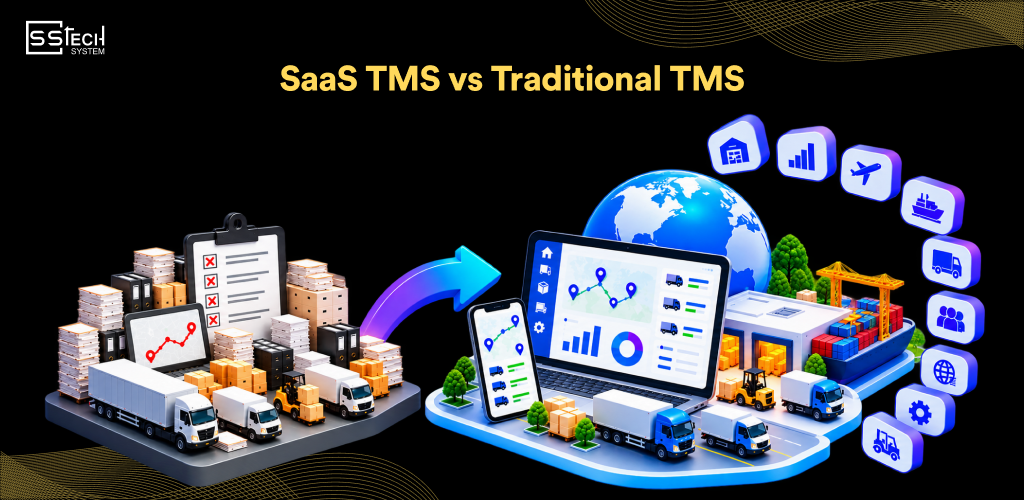
The SaaS TMS vs traditional TMS decision affects daily operations.
With SaaS transportation management software:
- Deployment: A cloud deployment for transportation can usually be completed without installing the entire system on company-owned servers.
- Infrastructure: The provider manages much of the cloud infrastructure for logistics. The shipper does not need to maintain dedicated TMS hardware.
- Updates: Cloud providers generally handle software updates, patches, and improvements. Traditional systems may require internal teams to plan and execute upgrades.
- Accessibility: A hosted transportation management system can support remote logistics management. Authorized users can access the platform from different locations.
- Scalability: A cloud-native transportation software platform can support changing users, shipment volumes, and locations without requiring the same level of infrastructure expansion.
- IT workload: SaaS can reduce responsibilities related to server maintenance, backups, and infrastructure monitoring.
- Customization: Traditional systems may allow deeper modifications. Modern SaaS platforms often focus on configuration, integrations, and scalable features instead.
A multi-tenant TMS can also allow multiple customers to use the same underlying cloud environment while keeping their data logically separated. This model supports efficient delivery of software updates and platform improvements.
For companies evaluating enterprise TMS software, the important question is not simply whether the system is SaaS or traditional. It is whether the deployment model supports current workflows and future requirements.
How Cloud TMS Fits Into a Connected Logistics Ecosystem
Transportation management systems (TMS) operate within an ecosystem and should allow customers to extend their functionality across the entire logistics system. TMS can act as a central system to provide connectivity and access to customer logistics systems. This allows customers to view and manage their logistics data.
A connected platform can include:
- Transportation Management Software for transportation planning.
- Freight Management Software for freight processes and costs.
- Carrier Integration Solutions for carrier connectivity.
- Shipment Visibility Solutions for real-time shipment information.
- Route Optimization Software for efficient planning.
- Fleet Management Software for vehicle operations.
- Last Mile Delivery Software for final-mile workflows.
- Driver Management Software for driver coordination.
- Proof of Delivery Software for delivery confirmation.
- Dispatch Management System for assigning and managing deliveries.
- Warehouse Management System (WMS) for warehouse operations.
- Inventory Management Software for inventory visibility.
- Warehouse Automation Solutions for automated warehouse workflows.
- Barcode Scanning Solutions for faster data capture.
Read more: What Is Carrier Integration? Complete Guide to Streamline Logistics Operations
These systems can also support ERP connectivity, WMS connectivity, carrier API integration, EDI integration, accounting software integration, and CRM integration. With API-enabled logistics software, businesses can enable freight data synchronization, shipment data automation, and logistics workflow integration.
Advanced businesses can also explore AI Software Development for predictive planning and IoT Application Development for connected vehicles, assets, and real-time operational data. The result is a more connected logistics environment where transportation, warehouse, inventory, carrier, and delivery systems can work together rather than operate as separate tools.
Cloud Transportation Software Implementation Guide
To implement a cloud-based transportation software solution, a business must first analyze their workflow. Identify the applications that integrate with their transportation operations (ERP, WMS, accounting, CRM, and others).
- Assess the implementation from the scope of security, data, and user management.
- Analyze the integration, reporting, and extension potential of the software.
- Cloud and other application integration services are utilized for implementation.
Which TMS Deployment Is Best for Mid-Size Shippers?
Mid-market shippers value flexibility. Therefore, they should select a transportation management system that is deployed via the cloud.
A useful decision framework is:
- Choose cloud when scalability and flexibility are priorities.
- Consider on-premises when infrastructure control is critical.
- Evaluate existing IT capabilities before choosing a deployment model.
- Compare total cost, rather than license price alone.
- Assess integrations with ERP, WMS, carriers, finance, and other systems.
Security, integration capability, implementation support, scalability, and total ownership cost also matter.
This approach works as a practical transportation software buying guide for TMS software for mid-size businesses.
Future of Cloud Transportation Management Systems
Using this guide to evaluating transportation management systems should be of particular help to large and small businesses in the US, Europe, and Australia. This includes logistics and transport management systems, cloud TMS, and related software.
The cloud has changed transportation management systems by integrating various functions and providing a single view of customer and product data. Gartner predicts that by 2026 public cloud spending will increase by over 20 percent. This will mainly be driven by cloud and AI software.
This direction also supports logistics SaaS platforms, scalable transportation software, and connected cloud logistics software for shippers operating across multiple regions. For businesses in different markets, this includes solutions such as cloud TMS software India, transportation management software India, cloud transportation management software Australia, logistics software Australia, cloud TMS software USA, and transportation management software USA.
Conclusion: Making the Right TMS Decision in 2026
Cloud TMS provides the benefits of remote access, greater scale, and reduced responsibility for infrastructure and administration. On the other hand, on-premises TMS provides more control and may be better aligned with existing organizational processes and systems.
For organizations with mid-size shipping operations, the best choice is typically driven by cost considerations, the maturity of the organization’s IT function, and the level of security required. Other considerations may include the degree of integration required, the level of customization anticipated, and expected organizational growth.

Frequently Asked Questions
What is a Cloud Transportation Management System (TMS)?
A cloud TMS is a system that helps a business manage various aspects of transport and logistics, including planning, Movement of Cargo, and Cargo Dispatch, using a cloud-based environment.
What is the difference between Cloud Based Transportation Management System (TMS) and On-Premises TMS?
From an implementation and deployment perspective, cloud-based TMS is more flexible. From a control and ownership perspective of the IT infrastructure, on-premises TMS is more favorable.
Is cloud-based TMS cost-effective?
Cloud-based TMS reduces the up-front cost of ownership of an IT infrastructure. Over the life of the IT solution, the cost may even out.
Is cloud-based TMS secure for Logistics?
Security of the solution depends on the solution provider, the controls available and provided, policies of the organization, access and usage controls, and compliance.
Why are mid-size shippers adopting cloud TMS?
Flexibility in access and the ability to deploy TMS quickly and update it remotally are benefits of using a cloud-based TMS. Additionally, cloud TMS allows users to integrate it with other logistics services and thus offer end-to-end logistics services.
Is it possible for cloud TMS to communicate with ERP and WMS?
It is possible for cloud TMS to communicate with either ERP or WMS. Most cloud TMS have APIs, EDI, or other techniques to enable integration with other systems.
How long will it take to implement a cloud TMS?
The length of time it will take to implement a cloud TMS will depend on how long it will take to migrate data to the new system, and the level of integration, customization, and testing the system will require. Cloud TMS typically offer faster implementation times compared to on-premises TMS.
Related Article