


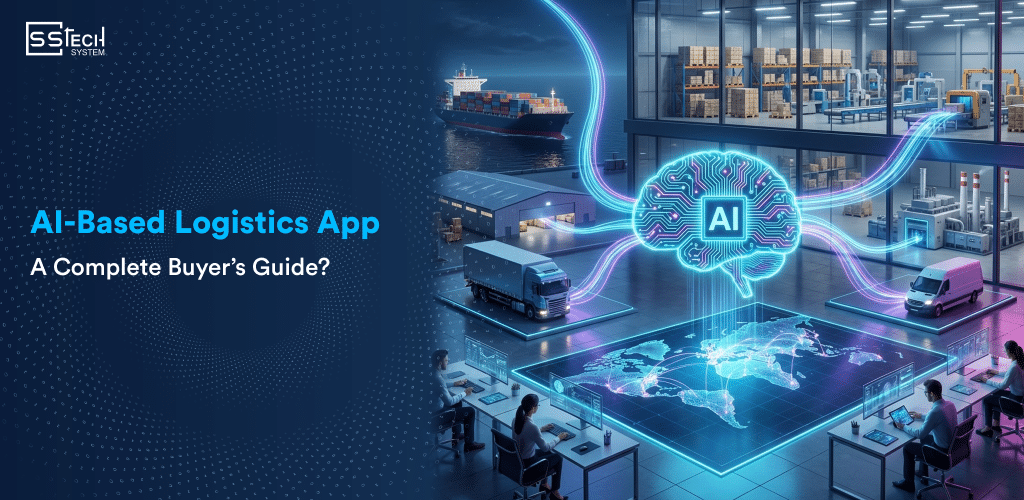
The logistics sector is experiencing one of the greatest revolutions of technology ever. A manual process with phone calls, spreadsheets, and reactive decision-making has now turned into an extremely data-driven ecosystem that operates based on AI-based logistics app development.
The question of whether businesses require AI is no longer being asked in the modern business. They are asking:
How to build an AI logistics app?
- What is the cost to develop AI logistics software?
- Is custom logistics software worth it?
How AI improve supply chain efficiency?
If you intend to develop AI-based logistics software, this guide outlines the entire development process: defining your business model, choosing your architecture, creating AI modules, estimating the logistics app development cost, and determining the ROI.
The guide is designed to be read by founders and CTOs, heads of logistics, and enterprises considering the option of partnering with AI logistics app development company.
Define the Problem & Business Model
The most important action to take before you can invest in development is defining the operational problem you are addressing.
Most of the businesses fail not due to ineffective technology but due to them trying to digitalize the broken logistics app development process rather than streamlining them.
Ask yourself:
- Are delivery delays hurting customer retention?
- Is fuel cost increasing operational expense?
- Is driver utilization inefficient?
- Are you losing visibility across supply chain operations?
- Are manual dispatch systems causing delays?
Your answers determine your approach to AI supply chain management and smart logistics app development.
The clearer your business objective, the stronger your long-term ROI.
Choose Your Logistics Focus
Choosing the right niche shapes your entire logistics app development lifecycle.
Decide your niche carefully:
- Last-mile delivery (like DoorDash)
- Ride & delivery hybrid (like Uber)
- Freight marketplace (like Uber Freight)
- E-commerce logistics (like Amazon)
- Fleet management (like Samsara)
- Warehouse automation
- B2B supply chain optimization
You may want to build:
- Logistics software for courier companies
- Logistics software for 3PL companies
- Logistics software for eCommerce
- Freight management software
- Fleet management app
- Warehouse management app
- Enterprise logistics software
Each model has a different operational complexity.
For example:
- The priorities of the last-mile delivery software include real-time shipment tracking, AI route optimization, and automated dispatch systems.
- The freight management software is in need of sophisticated load matching, dynamic prices calculators, and route optimization solution for long-haul transportation.
- Warehouse management system (WMS) intelligence and picking optimization algorithms could be crucial to the automation of warehouses.
- The optimization of B2B supply chain demands predictive analytics, demand forecasting using AI and complete supply chain automation.
- Early vertical application choice minimizes the time spent developing irrelevant features and controls the cost of developing logistics applications.
Core AI Use Cases
AI logistics solutions solve operational inefficiencies at scale.
Your AI layer can solve:
- AI route optimization
- Delivery time prediction (predictive delivery analytics)
- Demand forecasting using AI
- Driver allocation
- Fuel optimization
- Fraud detection
- Dynamic pricing
- Warehouse picking optimization
- Predictive maintenance
- Load matching (freight)
These modules transform traditional systems into intelligent, adaptive platforms.
For example:
- AI-based route planning reduces idle time and increases daily delivery volume.
- Demand forecasting using AI ensures drivers are positioned where orders are likely to appear.
- Predictive maintenance reduces fleet breakdowns and unplanned downtime.
- Dynamic pricing ensures supply-demand balance during peak hours.
This is how artificial intelligence in logistics delivers measurable business impact.
System Architecture Overview
Architecture determines whether your AI logistics app scales or crashes under growth.
A poorly designed backend will fail once daily orders increase.
A well-designed architecture supports:
- High transaction volumes
- Real-time shipment tracking
- Scalable AI computations
- Cloud-based logistics software deployment
- SaaS logistics platform monetization
High-Level Architecture
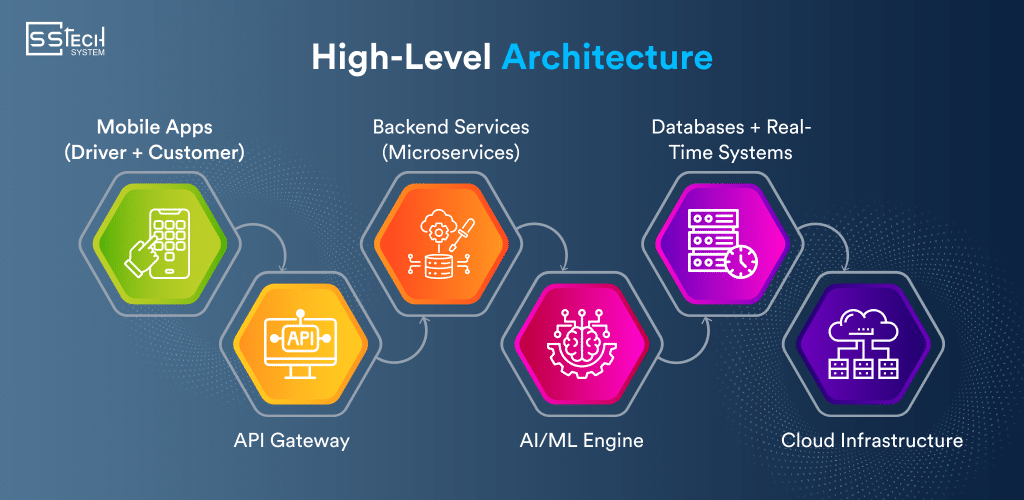
This modular architecture allows independent scaling of backend AI development services.
It also ensures smooth API integration for logistics partners.
Core Components
Frontend
Includes:
- Driver App (Android/iOS)
- Customer App
- Admin Dashboard (Web)
Technologies:
- Flutter / React Native for cross-platform efficiency
- React.js / Next.js for admin control panels
- Map integration (Google Maps, Mapbox)
A strong frontend ensures usability, driver adoption, and customer satisfaction.
Partnering with an experienced fleet management software development company improves UI performance and user retention.
Backend
Recommended Stack:
- Node.js (NestJS) or Python (FastAPI)
- PostgreSQL (transactions)
- MongoDB (flexible data)
- Redis (real-time tracking)
- Kafka (event streaming)
This stack supports logistics process automation and high-frequency operations.
AI/ML Layer
Built as a separate microservice using:
- Python (TensorFlow, PyTorch, Scikit-learn)
- OR-Tools for routing
- XGBoost for forecasting
- LSTM for demand prediction
- Reinforcement learning for dynamic routing
This enables deep AI and machine learning in supply chain systems.
AI Modules (Deep Breakdown)
Route Optimization Engine
Objective:
Minimize:
- Fuel
- Distance
- Delivery time
Techniques:
- Vehicle Routing Problem (VRP)
- Dijkstra’s Algorithm
- A*
- Google OR-Tools
- Reinforcement Learning
Advanced Capabilities:
- Real-time traffic integration
- Weather-based rerouting
- IoT in logistics sensor data integration
- API integration for logistics networks
AI route optimization directly reduces operating cost and improves last mile delivery optimization.
ETA Prediction Model
Inputs:
- Historical delivery time
- Traffic patterns
- Time of day
- Driver performance
- Weather
Models:
- Gradient Boosting (XGBoost)
- LSTM
- Random Forest
Accurate ETAs improve customer experience and reduce support tickets in shipment tracking software systems.
Demand Forecasting
Why it matters:
- Driver pre-positioning
- Inventory planning
- Resource allocation
- Warehouse scheduling
Models:
- ARIMA
- Prophet
- LSTM
Demand forecasting using AI improves operational stability and supports AI supply chain management goals.
Dynamic Pricing AI
Based on:
- Demand/supply ratio
- Weather
- Fuel cost
- Historical trends
Approach:
- Reinforcement Learning
- Multi-armed bandit models
Dynamic pricing allows intelligent adaptation, outperforming AI logistics app vs traditional logistics software systems.
Driver Allocation Engine
Goal: Assign best driver based on:
- Distance
- Rating
- Delivery history
- Fuel efficiency
- Current workload
Algorithms:
- Hungarian algorithm
- Linear optimization
- Reinforcement learning
This forms the heart of AI-powered transportation management (TMS) platforms.
Data Strategy (Critical for AI Success)
AI models are only as strong as the data they are trained on.
Data Collection
Collect:
- GPS coordinates
- Speed
- Route history
- Delivery timestamps
- Cancellation data
- Traffic API data
- Weather API data
- IoT in logistics device data
Without structured data, the logistics app development services cannot deliver results.
Data Pipeline
- Data ingestion (Kafka)
- Data storage (Data warehouse)
- Feature engineering
- Model training
- Model deployment
- Continuous monitoring
This enables big data analytics in logistics and real-time insights.
Data Storage
- OLTP: PostgreSQL
- Analytics: Snowflake / BigQuery
- Real-time: Redis
- Data Lake: S3
This structure supports enterprise logistics software performance.
Real-Time Tracking System
A high-quality real-time shipment tracking system is the backbone of any AI-based logistics platform. Customers today expect complete visibility, live updates, and accurate ETAs.
A strong real-time shipment tracking system requires:
- WebSockets
Enable instant bidirectional communication between server and client applications.
- Redis pub/sub
Supports high-speed message distribution across logistics software development services. Redis ensures location updates, order status changes, and event notifications are transmitted instantly across the system
- GPS polling every 5-10 seconds
Frequent polling ensures accurate tracking precision without overwhelming infrastructure resources.
- Event-driven architecture
Ensures every delivery status change (pickup, in transit, delivered, delayed) triggers automated workflows, notifications, and analytics updates.
Read more: Real-Time Tracking Solutions for Smarter Logistics Management
Cloud Infrastructure
Cloud Providers
- Amazon Web Services
Offers robust compute scalability, advanced AI tooling, and global infrastructure reach.
- Google Cloud
Strong in AI, data analytics, and Kubernetes-native deployment environments.
- Microsoft Azure
Enterprise-friendly ecosystem with strong compliance and hybrid cloud capabilities.
Choosing the right cloud provider depends on compliance needs, geographic coverage, budget, and AI tool integrations.
Recommended Architecture
- Kubernetes
Container orchestration for managing microservices efficiently across clusters.
- Docker
Containerization ensures consistent deployment environments and easier scalability.
- Auto-scaling groups
Automatically increase or decrease resources based on order volume and traffic spikes.
- CI/CD pipeline
Ensures continuous integration and automated deployments without service disruption.
- Load balancer
Distributes incoming traffic across servers to prevent overload.
- CDN
Improves global app performance and reduces latency.
Monitoring (Prometheus, Grafana)
Real-time observability dashboards for infrastructure health, AI model performance, and API response times.
Advanced Infrastructure Considerations:
- Disaster recovery planning
- Multi-region deployment
- Database replication
- Data backup automation
- High availability architecture
Cloud scalability ensures stable SaaS logistics platform growth while minimizing downtime and operational risks.
Security & Compliance
Security is critical in enterprise logistics software because sensitive data flows through the system continuously — including location data, customer information, payment details, and operational metrics.
Data Security
- TLS encryption
Encrypts data in transit to prevent interception and unauthorized access.
- JWT authentication
Secures APIs and ensures only verified users access system custom software development services.
- Role-based access control
Restricts data access based on user roles such as driver, admin, dispatcher, or manager.
- End-to-end encryption
Ensures secure communication between mobile apps and backend systems.
Additional Security Measures:
- Multi-factor authentication
- API rate limiting
- Intrusion detection systems
- Secure key management
- Data masking for sensitive fields
Compliance
- GDPR
Mandatory for handling European customer data responsibly.
- SOC 2
Demonstrates strong internal controls and enterprise security posture.
- PCI-DSS
Required if handling payment processing directly.
Compliance builds enterprise trust, prevents regulatory penalties, and strengthens your last-mile delivery software development investment.
Payments Integration
A reliable payment ecosystem ensures smooth transactions between customers, drivers, and the platform.
Integrate:
- Stripe
- PayPal
- Razorpay
Features of AI based logistics app:
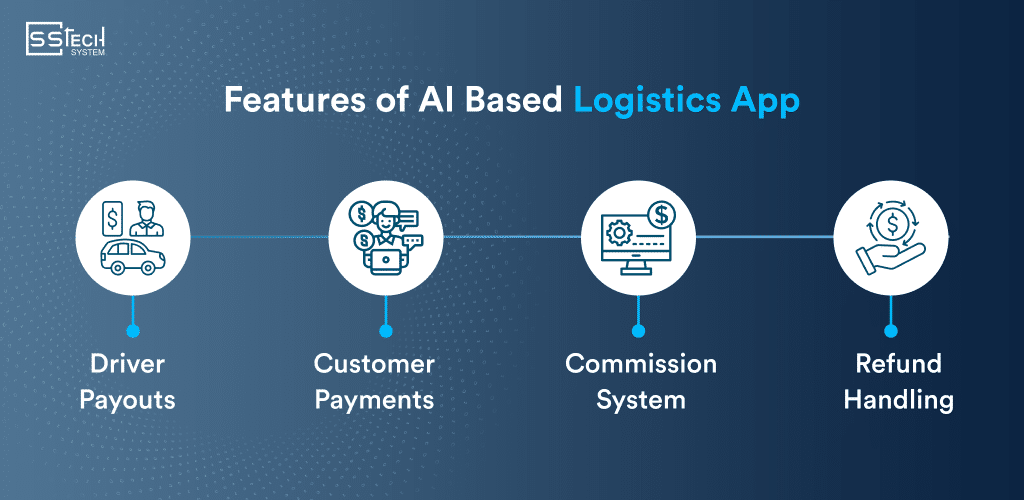
- Driver payouts
Automated weekly or instant payouts improve driver retention and satisfaction.
- Customer payments
Support for credit cards, wallets, and multi-currency payments.
- Commission system
Automated calculation and deduction of platform fees.
- Refund handling
Quick resolution for cancellations or failed deliveries.
Advanced Payment Capabilities:
- Escrow-based payments
- Surge pricing automation
- Split payments for multi-stop deliveries
- Tax calculation and invoicing
- Subscription billing for enterprise clients
A seamless payment system directly impacts monetization and cash flow management.
Admin Dashboard Features
The admin dashboard acts as the control center of your logistics platform.
Include:
- Fleet overview
Complete visibility into active drivers, vehicle status, and delivery counts.
- Live map tracking
Real-time map with route paths, traffic overlays, and delay detection.
- Revenue analytics
Track daily revenue, commissions, surge pricing impact, and profitability metrics.
- Driver performance analytics
Analyze ratings, delivery time averages, fuel efficiency, and reliability scores.
- Heatmaps
Visualize demand concentration by geography and time.
Demand prediction visualization
Show forecasted order volumes using AI models for operational planning.
Advanced Dashboard Additions:
- SLA breach alerts
- Delivery failure tracking
- Fleet utilization reports
- Carbon footprint reporting
- Operational cost breakdown analysis
A powerful dashboard enables strategic decision-making and operational optimization.
Scaling Strategy
Phase 1 – MVP
Basic routing, manual pricing, simple tracking, limited AI integration. Focus on validating product-market fit.
Phase 2 – Smart AI
Integrate AI route optimization, automated dispatch system, demand forecasting using AI, and predictive delivery analytics.
Phase 3 – Advanced AI
Deploy reinforcement learning models, predictive maintenance systems, self-optimizing fleet algorithms, and autonomous vehicle compatibility.
Dev Team Structure
A strong team determines execution speed and product quality.
Product Manager
Defines roadmap, aligns stakeholders, and prioritizes features.
Backend Engineers
Build scalable APIs, dispatch systems, and transaction engines.
Mobile Engineers
Develop driver and customer applications with real-time synchronization.
ML Engineer
Designs AI models for optimization, forecasting, and automation.
DevOps Engineer
Manages cloud infrastructure, CI/CD pipelines, and performance monitoring.
UI/UX Designer
Ensures usability, intuitive navigation, and adoption efficiency.
You may hire logistics app developers internally for long-term control or partner with a logistics software development company for faster time-to-market and reduced hiring complexity.
Estimated Cost
MVP: $40k–$120k
Advanced Platform: $250k–$1M+
Factors affecting Logistics AI app development cost:
AI complexity
Advanced reinforcement learning increases the cost of custom AI logistics app development.
Real-time infrastructure
High-frequency tracking increases cloud usage.
Compliance requirements
Enterprise certifications require additional security investment.
Cloud scalability
Global deployment increases hosting costs.
Additional Cost Drivers:
- API integration for logistics partners
- Payment gateway integrations
- Custom dashboard features
- Blockchain integration
- AI experimentation cycles
Understanding logistics software development cost vs ROI is critical before making capital investment decisions.
Monetization Models
Commission per delivery
Primary revenue stream for marketplaces.
Subscription model
Monthly SaaS model for enterprise clients.
Enterprise contracts
Long-term B2B agreements with logistics companies.
Fleet SaaS licensing
White-label platform licensing for regional operators.
Dynamic surge pricing
AI-powered pricing during peak demand.
Diversified monetization improves revenue stability and long-term platform valuation.
Competitive Moat Strategy
To compete effectively, focus on:
Hyperlocal niche
Dominate smaller regions before expanding nationally.
Industry-specific optimization
Tailor AI for pharmaceuticals, food delivery, freight, or eCommerce.
AI superiority
Continuous optimization improves margins over time.
Lower commission
Attract drivers and merchants with better economics.
Better analytics
Provide actionable insights competitors lack.
Custom vs off-the-shelf logistics software decisions significantly impact your long-term technological edge and scalability.
Future Trends in AI Logistics
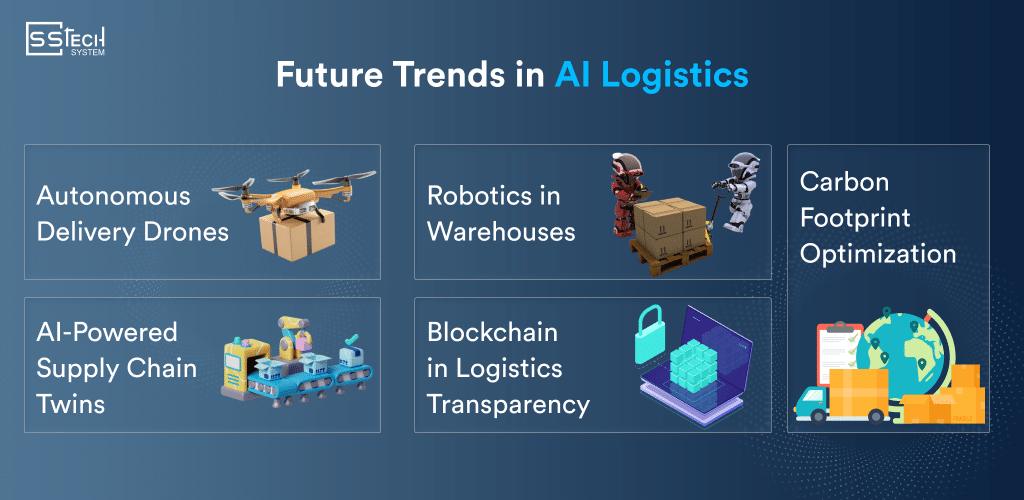
Autonomous delivery drones
Reduce last-mile cost and improve rural coverage.
Robotics in warehouses
Increase picking speed and accuracy.
AI-powered supply chain twins
Simulate entire logistics networks for optimization.
Carbon footprint optimization
Meet ESG compliance and sustainability goals.
Blockchain in logistics transparency
Enable tamper-proof shipment records and smart contracts.
Forward-thinking platforms integrate emerging technologies gradually without disrupting core operations.
Conclusion
Building an AI logistics platform is not just about adding machine learning features or integrating a few automation tools. True success comes from developing a sustainable data advantage, ensuring the highest optimization engine quality, maintaining rapid execution speed, leveraging strong network effects, and committing to long-term operational excellence.
The fact that the companies controlling this space are not just working with AI, but they are constantly developing their algorithms, enhancing the accuracy of the data, and optimizing each level of their logistical processes. To create a competitive and scalable logistics platform that will work, you will need to invest in intelligent system architecture, structured and effectively controlled data pipelines, resilient cloud infrastructure, and ongoing AI innovation.

Frequently Asked Questions
How much does it cost to build an AI-based logistics app?
An AI-based logistics app typically costs between $40,000 and $1M+, depending on AI complexity, real-time infrastructure, integrations, compliance requirements, cloud scalability, and customization depth.
How long does it take to develop AI-based logistics software?
Development usually takes 4–6 months for an MVP and 8–14 months for a full AI-powered platform, depending on feature complexity, integrations, testing, and AI model training.
Is custom logistics software better than off-the-shelf solutions?
Custom logistics software offers scalability, flexibility, and competitive advantage, while off-the-shelf solutions provide faster deployment and lower upfront costs but limited customization and AI capabilities.
How does AI improve supply chain efficiency?
AI improves supply chain efficiency through route optimization, demand forecasting, automated dispatch, predictive analytics, and real-time tracking, reducing costs, delays, inefficiencies, and operational uncertainties significantly.
Related Article