


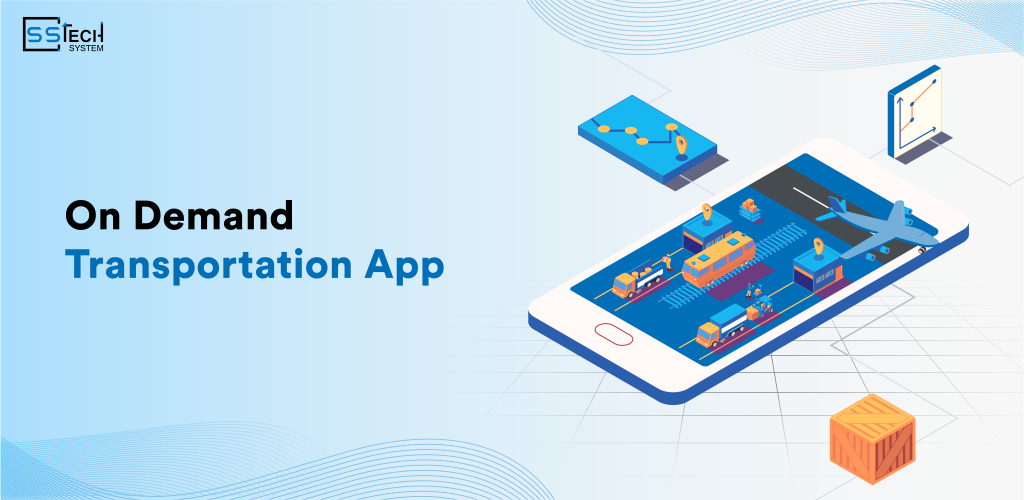
The transportation and logistics sector has seen a big transformation to real-time, intelligent, and highly customer-centric digital platforms as opposed to traditional operations. The main element of the transformation is the on-demand transportation app, which allows users to book services, track vehicles in real time, plan deliveries, pay safely, and receive trustworthy updates, all via smartphones.
These applications not only improve user convenience and transparency; they also assist businesses with route and fuel consumption optimization, efficient fleet management, automated dispatching, and the overall reliability of services.
Since taxi services, courier services, medicine delivery, heavy vehicle transport, packers and movers, and last-mile logistics, on-demand apps are now needed across various industries. As e-commerce expands, urban mobility requirements intensify, together with a growing demand and demands to have fast, flexible and trackable services, the conventional logistics approach is becoming insufficient.
Companies have become competitive by having digitally first, scalable, and data-driven solutions. That is why the on-demand transportation app development has turned into a strategic need of startups and established logistics providers.
What Is On-Demand Transportation?
On-demand transportation is service where services are rendered when the customer demands them, at the time and location of his or her desire as opposed to the set timelines. This includes:
- Ride-hailing services (passenger taxi, bike taxi, auto-rickshaw, heavy-vehicle transport)
- Courier and delivery services (packages, groceries, medicines)
- Movers/porter services for shifting goods or furniture
- Freight transport for heavier cargo or specialized logistics
- Any fleet-based or driver-based service triggered by a user request via app
Just in a nutshell, on-demand transportation applications are a mediator – they connect demand (customers who need transport or delivery) with supply (drivers, vehicles, or couriers), arrange bookings, tracking, payments and management, usually by using real-time data, GPS, and artificial intelligence.
Market Size & Growth: Why On-Demand Logistics Matters Now
Market analysts often say, “If logistics is the heart of commerce, on-demand delivery is now its pulse.” And the numbers prove it:
- The global on-demand logistics market is projected to grow from USD 23.3 billion in 2025 to USD 138.2 billion by 2035, registering a CAGR of 19.5%.
- The global last-mile delivery transportation market was estimated at USD 169.95 billion in 2024, with forecasts expecting growth to USD 446.29 billion by 2034.
- In India, the last-mile delivery market was valued at around USD 6.50 billion in 2024, and is projected to reach USD 24.00 billion by 2033 , a CAGR of 13.70%. Overall, the global logistics market (across all segments) was estimated at USD 9.98 trillion in 2024, with forecasts to reach roughly USD 23.14 trillion by 2034.
The increasing e-commerce penetration, urbanization, and consumer behavior are all contributing to the growth and this is the best opportunity to invest in on-demand transport/logistics solutions. These figures represent a huge and growing demand – which is a good business case to initiate or improve logistics services through online platforms.
What’s Driving the On-Demand Economy?
“Convenience has become a habit, not a luxury.” This shift in consumer mindset is fueling the on-demand economy. Here are the major driving forces:
E-commerce and Instant Delivery Explosion
Customers are growing more demanding in terms of timely delivery of merchandise- same-day or hourly. This increases the agile logistics and last-mile delivery requirements.
Urbanization, Increasing Demand of Mobility and Alteration of Lifestyles
With an increased number of people residing in urban or semi-urban cities, the necessity to have convenient on-demand transport, not only of people, but also of goods, has increased substantially.
Improvements in Technology
Smartphones, GPS, mapping, real-time data, IoT, backend infrastructure – allow matching supply and demand in the most efficient way, tracking in real time, route optimization, and digital payments.
Business Flexibility and Scalability
Companies desire adaptable logistics to meet demand spikes, seasonal demand, or erratic demands. Elasticity is provided by on-demand solutions.
Need of On-Demand Logistics and Transportation App

Provided you have a logistics company (or you are starting a company) that supplies on-demand services or is based on the idea of transport/delivery, an on-demand app can fulfill a variety of requirements and provide considerable benefits:
Growing Demand for Real-Time Delivery Solutions
Customers have now become demanding in terms of real time tracking, shorter deliveries and the ability to schedule at their convenience. On-demand apps can match these expectations, as they make it possible to book, track live and dispatch quickly.
Importance of Digitized Fleet Management
Use of manual management of a fleet of vehicles is not efficient and is subject to errors. An app provides digital fleet management – vehicle tracking, availability management, task designation, and time management.
Enhanced Customer Experience Through On-Demand Services
Customers have the advantage of enhanced visibility and control with such features as live tracking, estimated arrival times, automated notifications, and flexible scheduling.
Optimization of Delivery Routes and Fuel Consumption
Routing optimization, real-time analytics, GPS, and other applications can assist with finding the most efficient path, evading congestion, fuel savings, and time savings.
Warehouse & Inventory Coordination
In the case of firms that have warehousing requirements (e.g., e-commerce, groceries, or medicines), on-demand logistics applications can coordinate inventory, pickups and deliveries – seamlessly matching the function of the warehouse-management with the last-mile delivery.
Scalability for Logistics Companies
An on-demand app ensures that the volume of orders can be scaled up or down, which means that more vehicles/couriers can also be brought on board when necessary but without significant delays.
Real-Time Data Analytics for Logistics Decisions
Using the information gathered during deliveries, routes, behavior of customers, you will be able to make informed decisions on how to optimize the size of the fleet, the time of peak demand, when to deliver in a specific area and performance metrics.
Enhanced Safety & Compliance Management
It can combine the safety check, driver authentication, compliance policies, documentation, digital record-keeping, and increasing safety, preventing fraud, and maintaining regulatory compliance.
Therefore, transport app development services are not only a benefit but also a business strategy that will enable organizations to achieve operational efficiency, scalability, customer satisfaction, and cost optimization.

Cost to Build a Transportation / Logistics App
It is important to have an estimation of development cost prior to commencement. Prices depend on the complexity, features, platform/s, location of development, and integrations. The following is a realistic breakdown of these based on recent industry statistics and reports by the vendors.
- A basic on-demand taxi-style app (MVP) can cost between US $25,000–$40,000.
- A mid-level app, with more features and customizations, may cost US $50,000–$90,000.
- A full-featured, enterprise-grade transportation/logistics app (with all bells and whistles: real-time tracking, admin dashboards, multiple integrations, scalability, possibly multi-platform) can go beyond US $100,000–$250,000+.
- Some providers suggest much lower starting costs for modest features and minimal viable product e.g., as low as US $5,000 to $10,000 for very basic ride-hailing or white-label taxi apps.
The real price will be based on different variables: features (booking, real-time tracking, payment, driver side and customer side, admin dashboard), complexity UI/UX design, integrations with third parties (maps, payment gateways, notifications), back-end infrastructure, maintenance, location (hourly rate of developers widely different).
How Can On-Demand Logistics Help You Improve Customer Experience?
The use of on-demand logistics mobile app can significantly increase customer experience in the following ways:
Convenience & Flexibility
Customers can book rides or deliveries instantly via app, at any time, without calling or waiting for hours.
Real-time Tracking & Transparency
Users can track their delivery or ride in real time, get ETA updates, live location, and notifications, building trust and transparency.
Speed & Reliability
On-demand dispatch often reduces waiting time; efficient route optimization ensures faster deliveries or pickups.
Choice & Customization
Customers can choose vehicle type (bike, car, van, heavy-vehicle), delivery speeds (express, standard), payment method, and scheduling , giving more control and flexibility.
Better Customer Communication
Automated messages, live support, and feedback systems ensure smooth communication, complaint resolution, and improved satisfaction.
Scalable Service Availability
During peak demand (festivals, sales, holidays), app-based logistic services can scale up , ensuring consistent experiences without overloading staff or vehicles.
Use Cases of On-Demand Logistics Apps
On-demand transportation and logistics apps are available not only to taxi services. The following are some of the most important applications of such apps:
Medicine Delivery and Healthcare
Particularly, in emergencies or with older/chronic patients – users have the opportunity to order the delivery of medicines, medical supplies, arrange transportation of patients to medical institutions.
Food Delivery App
Food delivery (restaurants, grocery, quick-commerce) are very dependent on on-demand logistics in order to provide pickup and delivery on time with a narrow time window – and often under strong time constraints.
Transport App (Heavy-Vehicle / Specialized Cargo , “Wheel-eye” style)
To deliver heavy items, construction materials, equipment, furniture, on-demand transportation app can find the appropriate heavy-vehicle delivery service, plan deliveries, and control routes.
Movers App, Porter / Shifting Service
To individuals moving houses or offices – users can request a mover or porter, arrange the packing/ unpacking, transportation and monitor the process using an application which makes the whole process easier.
Taxi App
Conventional ride-hailing (bike-taxi, cabs, auto-rickshaws, intercity/intra-city transportation) remains a fundamental on-demand platform, commonly utilized in daily travel or commuting.
In addition to these, there exist hybrid models e.g. e-commerce logistics, warehouse to door delivery, B2B freight services, hyperlocal deliveries, etc.
How to Get Started With Transportation App Development
If you are convinced of the opportunity and ready to build, here’s a detailed approach:
Get Clarity on Your Objective
- Niche: ride-hailing, courier, heavy cargo, movers, food/grocery, B2B, freight, etc.
- Target market: B2C consumers, small businesses, large companies, retailers, pharmacies, etc.
- Choose business model: commission based, subscription based, pay-per-use or hybrid.
Market Research & Planning
- Carry out research: local demand in your target market, competitors, legal conditions, price, customer culture.
- Predict demand and supply: orders/month estimated, high times, fleet size needed, availability of drivers.
- Arrange business plan, revenue model, budget, marketing and growth strategy.
UI/UX Design
- Provide customers with simplified and easy-to-follow user flows: booking, service type selection, scheduling, payments, tracking and notifications.
- Develop individual driver/courier interfaces: acceptance of jobs, navigation, payments board, performance.
- Admin panel: fleet management and order dashboard, driver dashboard, billing dashboard, analytics dashboard, reporting dashboard, customer support.
App Development
- Choose technology stack: native (iOS, Android) or cross-platform (React Native, Flutter) depending on your budget, time-to-market, and long-term plans.
- Build backend infrastructure: server, database, real-time messaging, authentication, APIs for mapping, payment gateways, notifications, tracking.
- Implement core features: user registration, booking, scheduling, real-time tracking, payments, notifications, reviews/feedback, admin functionalities.
Integration of Technologies & Tools
- Map and GPS services for accurate location tracking and route planning (e.g. Google Maps, other mapping SDKs).
- Payment gateway integration for seamless payments.
- Real-time notifications (push, SMS, in-app).
- Fleet management tools/driver, apps/dispatch logic.
- Analytics and reporting tools to monitor KPIs, performance metrics, delivery times, driver utilization.
- Optional: IoT integration (for heavy cargo tracking, vehicle telemetry), telematics, smart lockers, scheduling and warehouse integration.
Testing & Optimization
- Perform rigorous testing: functional testing, performance & load testing, security testing, user acceptance testing.
- Optimize performance: ensure fast loading times, smooth UI/UX, robust backend under heavy load, error handling, offline support (if needed).
- Collect feedback from beta users (initial customers, drivers) and refine.
Deployment & Maintenance
- Deploy to app stores / web (if web version).
- Monitor app performance, server uptime, bug reports.
- Provide customer support, driver support, and regular updates.
- Add new features over time: dynamic pricing, advanced analytics, machine learning for route optimization, demand forecasting, etc.
With these steps, you can systematically build a viable on-demand transportation or logistics app starting with a minimum viable product (MVP), then scaling up as demand grows.
Business Challenges in On-Demand Logistics Apps – And Their Solutions

While the opportunity is huge, there are real challenges. Below are common hurdles, and possible ways to mitigate them:
Scalability and Demand Fluctuations
- Challenge: Changeable demand, peak hours, holidays, surges per season; overutilization during low seasons.
- Solution: Flexible (gig drivers/ couriers) workforce, dynamic pricing, surge pricing, predictive analytics to predict demand and scale resources.
Operational Costs
- Challenge: Fuel, maintenance, vehicle acquisitions, wages of drivers, overheads may become high.
- Solution: Route optimization, less idle time, fuel-efficiency or electric vehicles, efficient fleet management, better rates, incentive on efficient drivers.
Regulatory Compliance
- Challenge: Local legislation, permits (and heavy vehicles in particular), safety standards, and transport regulations differ depending on the location.
- Solution: Establish compliance checks within the app (check on drivers/vehicles, uploading of documents, expiration notifications), follow the local regulations, collaborate with local transportation officials, keep digital records.
Customer Expectations and Service Reliability
- Challenge: The customers demand to be served on time, to be transparent, to be able to track their items as well as there to minimize delays or it damages your brand.
- Solution: Tracking in real time, correct ETAs, proper driver assignment, notification, customer service, backup delay or vehicle-based solutions.
Technology Integration
- Challenge: The combination of various technologies, maps, payments, tracking, backend, analytics, can be complicated and painful.
- Solution: Tested framework, modular architecture, strong QA/testing, and incremental rollout (MVP first).
Security and Data Privacy
- Challenge: Work with user information (personal data, payment data), GPS position information data, threat of compromise, and abuse.
- Solution: Strong encryption, secure authentication, adherence to the laws of data protection (depending on the region), anonymization where feasible, periodic security checks.
Last-Mile Delivery Challenges
- Challenge: Traffic jam, wrong addresses, unsuccessful deliveries, unreachable customers, and repeated, all make it more expensive and difficult.
- Solution: Address validation, geolocation, delivery time windows, customer notifications, retry policies, optimized routing, alternative delivery options, etc.
Workforce Management
- Challenge: Recruitment, screening, retaining of drivers/couriers; their availability, quality and performance control.
- Solution: Implement driver onboarding within the application, perform verification, keep performance indicators, offer incentives, rely on ratings and feedback systems, offer training/support.
All these obstacles are manageable provided you think, design, and develop a strong system that will bring you an agile, hardy, and scalable logistics business.
Conclusion
The race isn’t about who moves products, it’s about who moves them smarter. On-demand transportation and logistics applications are not a new thing anymore, they have become an expectation of customers, businesses, and markets around the world.
As the world of e-commerce is growing at an alarming pace, the expectation of consumers in terms of convenience and speed, the enhancement of technology, and the modernization of business requirements make the present time a timely moment to invest in these solutions.
An on-demand logistics app can be highly beneficial to operational efficiency, customer satisfaction, scalability, and cost-effectiveness regardless of whether the application has been developed to support a ride-hailing application, a food or medicine delivery system, a movers/porter medium, or a heavy-cargo transport application.
Nevertheless, the construction of such an app takes a lot of planning, both in terms of defining goals and researching the market as well as design, development, integrations, testing, deployment, and maintenance. The price may be very differentiated by complexity and features.
With a strategic approach, proactive response to problems, and customer experience as the core, your on-demand bus app development may become a competitive advantage, fulfill the changing needs of the market, and provide new business opportunities. Are you ready to embark on this journey?

Frequently Asked Questions
On-demand transportation applications are best applied in taxi services, courier and delivery services, food and medicine delivery, movers and packers, heavy-vehicle transportation services, eCommerce logistics, and last-mile delivery services.
The main elements are to enable users to book their delivery, GPS tracking, driver and customer applications, route optimisation, secure payments, notifications, an administrative dashboard, fleet management, analytics, and customer support integration.
The cost typically ranges from $25,000–$40,000 for a basic MVP, $50,000–$90,000 for mid-level apps, and $100,000–$250,000+ for advanced enterprise-grade logistics and transportation solutions.
It is convenient, tracked in real-time, provides accurate ETAs, accelerated service, a variety of vehicles, flexible scheduling, transparent prices, and enhanced communication, which results in increased customer trust and satisfaction.
Common challenges include scalability, fluctuating demand, regulatory compliance, operational costs, technology integration, data security, and driver management, which can be addressed through smart architecture, automation, and AI-driven optimisation.
Related Article