


The world of global logistics is going through the most radical change in decades. Due to skyrocketing e-commerce demand, shortened delivery schedules, supply chain disruptions, and other logistical problems, logistics companies are no longer able to rely on old-fashioned, manual, or semi-digital models. Nowadays, technology of logistics has become the foundation of resilient, agile, and scalable supply chains.
To get a clearer picture of which logistics tech trends are likely to lead a list of what is most important in 2026, this blog will provide you with practical information, real-life scenarios, and a general overview of the way logistics companies are modernizing their activities.
You will also learn how the future of logistics technology is being shaped by AI Logistics Development, cloud logistics management, supply chain automation, blockchain logistics solutions, and warehouse robotics companies.
The US freight and logistics market size is expected to reach 1.62 trillion US dollars by 2029. The growth in e-commerce has put a strain on the logistics providers to provide faster service still in a transparent manner, at low costs and with the removal of the bottlenecks. Nevertheless, the conventional work processes, manual records, obsolete ERPs, ineffective tracking, and isolated communications are no longer sufficient.
The benefits of modern logistics technology are not complicated- lower operational costs, greater accuracy, higher delivery success rates, higher customer satisfaction, and improved risk management. This blog disaggregates the most significant logistics tech trends 2026 to be able to define the future of logistics industry across the globe.
Challenges in the Current Logistics Landscape
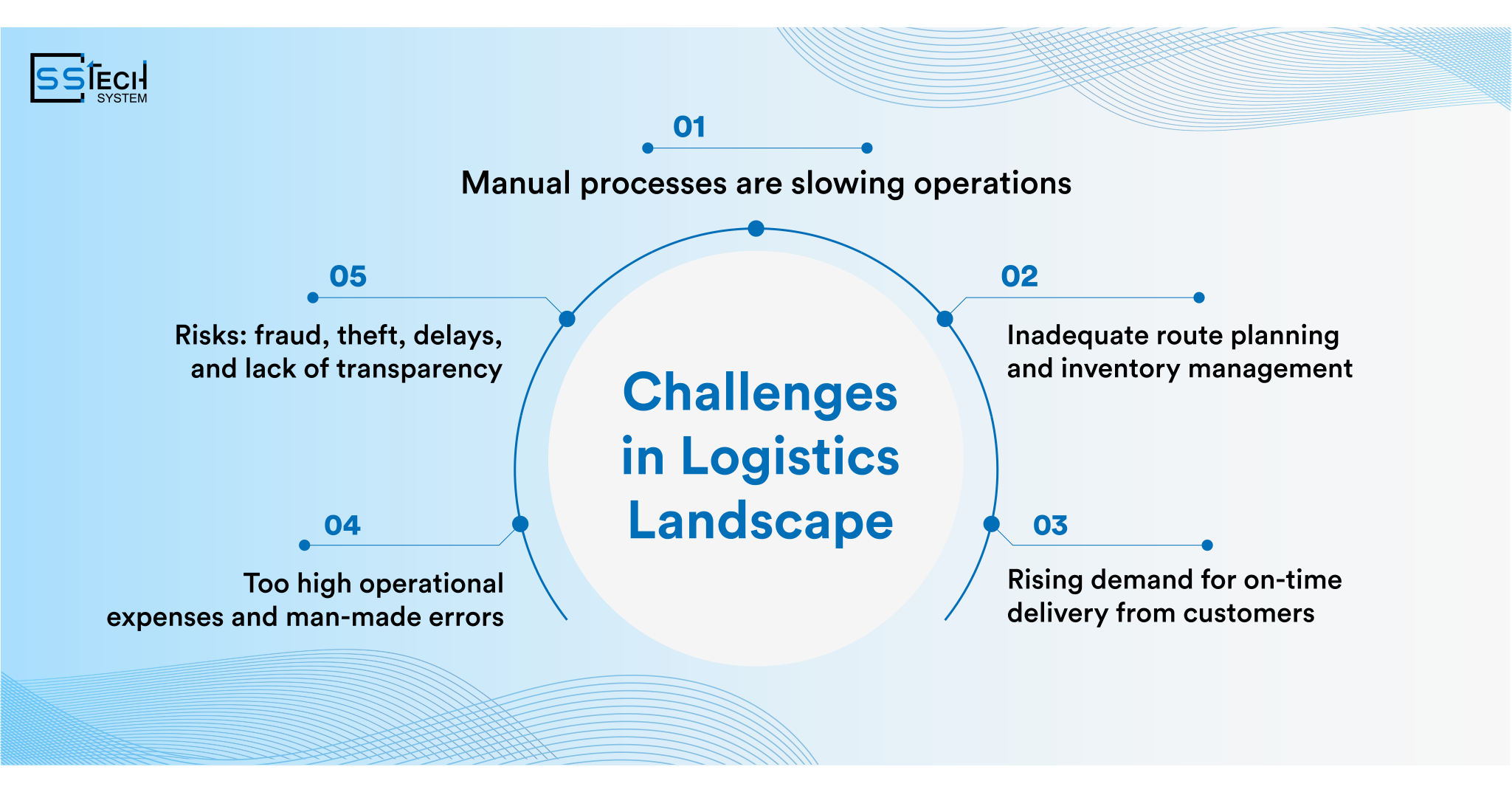
The logistics sector is changing at a high rate, but the majority of businesses still grapple with operational issues that have existed over time and that inhibit business productivity, transparency and profitability. These problems become especially clear when the volume of deliveries increases, customers become more demanding, and supply chain networks become more complex. The list of the most critical barriers that influence logistics performance in the modern society includes the following challenges:
Manual processes are slowing operations
Most of logistics remains reliant on physical reports, manual data entry, phone communications and simple spreadsheets. Such obsolete work processes result in slower order processing, increased error rates, and slow decision-making. As shipment volumes grow, there is no way to scale operations manually, leading to bottlenecks that affect the entire supply chain.
Inadequate route planning and inventory management
The process of managing fleets effectively is not possible when logistics teams do not have intelligent route optimization or real-time inventory visibility. Ineffective routing leads to fuel usage, delays in the delivery of last-mile, and decreased delivery precision.
Equally, manual or old inventory systems cause misplaced stock, incorrect counts, overstocking, or stockout all of which interfere with the operations of the warehouse. Business Wire reports that more than 80% of warehouses today have no automation at all.
Rising demand for on-time delivery from customers
Customers have new demands for quick trackable and reliable deliveries. The legacy systems are unable to give real-time updates and correct ETAs and as such, missed delivery windows and reduced customer satisfaction.
Too high operational expenses and man-made errors
Unproductivity in terms of fuel, overtime labor, vehicle maintenance, repetitive manual labor and human error are the contributing factors to high operational costs. These costs compound and decrease the margin of profits.
Risks: fraud, theft, delays, and lack of transparency
Logistics is increasingly vulnerable worldwide within the supply chain that includes theft of shipments, forged paperwork, route delays and lack of real-time tracking. In the absence of the digital tracing and safe programs, companies cannot promptly identify problems or eliminate abuse.
| Area | Traditional | Tech-Driven (2026) |
|---|---|---|
| Visibility | Limited tracking | Real-time IoT updates |
| Routing | Manual planning | AI route optimization |
| Warehouse | Labor-heavy | Robotics & automation |
| Costs | High operations cost | Reduced via automation |
| Security | High fraud/theft risks | Blockchain + GPS safety |
Why Upgrading Technology Is Essential
The need to modernize logistics technology is no longer an option; it is a strategic necessity for enterprises seeking efficiency, cost reduction, and competitiveness. Such advanced technologies as AI, IoT, automation, cloud logistics management, and blockchain logistics solutions can assist the logistics enterprises in overcoming the existing issues and creating more resilient supply chains.
Technology is very instrumental in addressing operational inefficiencies. Workflows are automated to increase speed in warehouses and minimize human error, and decrease documentation. AI-controlled route planning enhances fleet efficiency, reduces fuel consumption, and ensures on-time deliveries. Smart inventory systems boost precision and eliminate stock outs or excessive stock.

The use of modern logistics devices improves the accuracy and visibility of tracking required by current customers. The IoT sensors, telematics, GPS positioning and cloud-based dashboard give real-time data of the location of shipment, temperature, the state of the vehicle and the progress of delivery. Managers are able to identify problems immediately and the customers also have full transparency.
Modernization of technology also provides good long term ROI. Automation saves on labor, AI saves on fuel, cloud eliminates hardware, and blockchain reduces fraud-related losses. These savings are very useful in enhancing profitability in the long run.
Scalability is also aided by technology as businesses expand. Cloud computing, built-in software, and automation enable logistics firms to process greater quantities without operational hiccups.
Finally, modern technology adoption provides a competitive advantage to the logistics businesses that allows them to operate faster, more accurately, provide their customers with greater satisfaction, and more robustly in the future of logistics industry.
| Technology | Primary Impact | Business Benefit |
|---|---|---|
| AI Logistics Development | Smarter forecasting & routing | Faster deliveries, fewer delays |
| Cloud Logistics Management | Centralized real-time data | Better coordination & scalability |
| Warehouse Robotics | Automated picking & sorting | Reduced labor cost, higher accuracy |
| IoT Tracking Solutions | Live location & condition monitoring | Stronger visibility & fewer losses |
| Blockchain Logistics | Tamper-proof documentation | Fraud prevention & secure transactions |
Top Logistics Tech Trends 2026
Below are the most impactful logistics technology trends transforming operations across industries. These insights are crafted for businesses aiming to build smart logistics systems that are scalable, automated, and future-ready.
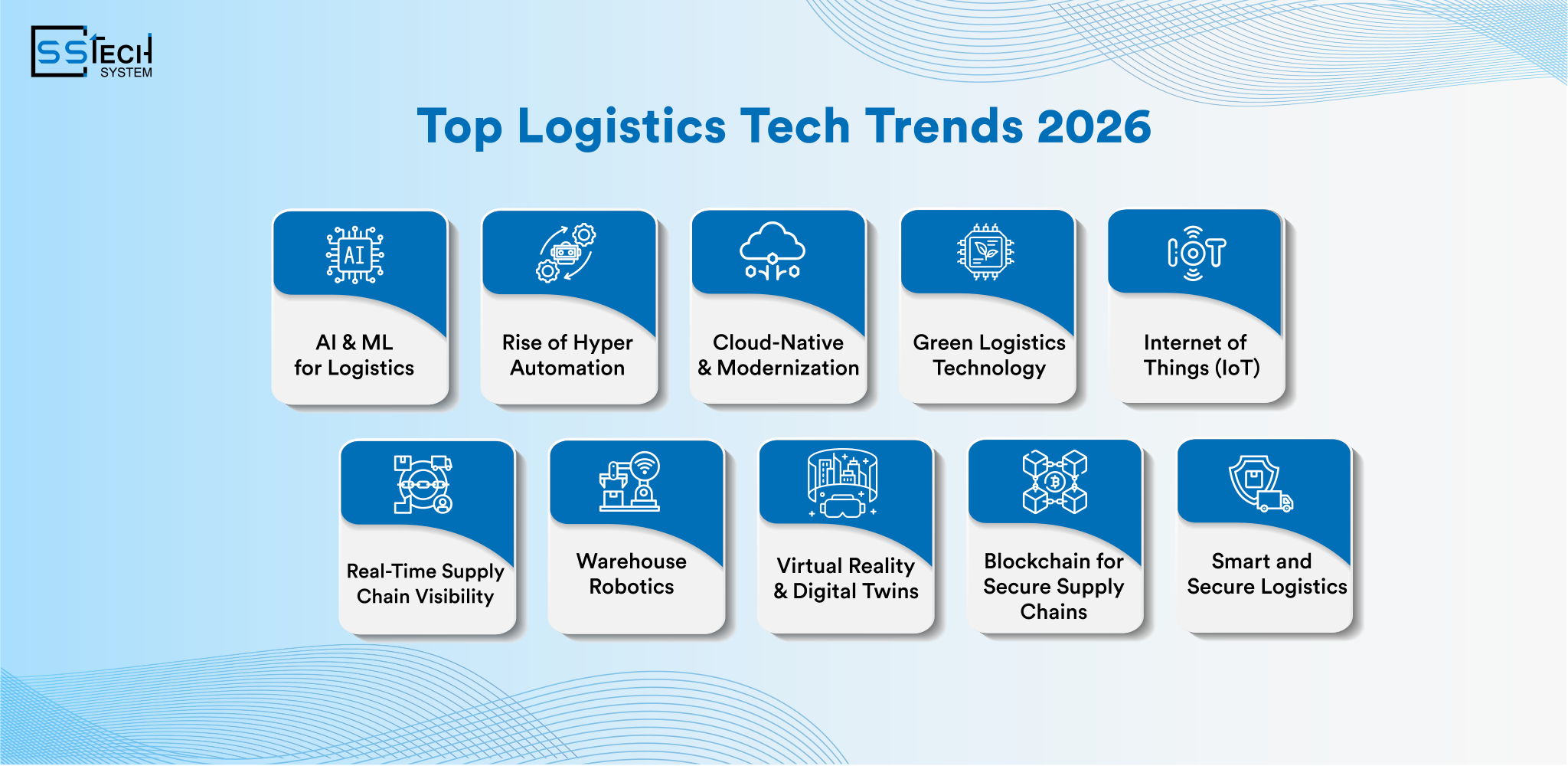
AI & Machine Learning for Logistics
AI has become a tool of mission-critical to a contemporary logistics operation. It is the cornerstone of smart logistics because of its capability to analyze big volumes of data and provide precise predictions.
AI increases predictive analytics, demand predictions, and performance management. The AI-enhanced route optimization applies the past data, weather conditions, traffic information, and cargo data to suggest the most efficient and quickest routes. AI is also at the center of warehouse automation, including the picking, packing, and inventory forecasting.
The AI systems are already utilized by many of the major logistics firms in the world to minimize operational delays, enhance fuel efficiency and decrease the number of unneeded delivery trips. This will increase in the future as companies adopt AI Logistics Development to enhance their customer experience and efficiency in their back-end.
Rise of Hyper-Automation in Warehouses
Repetitive manual processes are being replaced by hyper-automation that leverages smart machine networks. This encompasses autonomous vehicles, conveyors, robots, and all-digital WMS platforms that collaborate to speed up the processes in the warehouse.
The usage of robots in the workplace is growing in collaboration with human workers lowering the risks of injuries and enhancing the accuracy of the work. Yard management systems have now sensors, cameras and AI to automate tasks such as truck docking, positions of cargo and temperature settings.
Automation in warehouse logistics offers advantages such as shorter cycle times, reduced errors, lower labor costs, and enhanced safety. Warehouse automation and AI development services will deliver significant cost savings through hyper-automation in 2026 and beyond.
Green Logistics Technology
Green logistics solutions constitute one of the largest trends in logistics technology since sustainability has become a strategic necessity. Environmentally friendly packs, a carbon-monitoring dashboard, and a low-energy-consuming warehouse are the norm.
Electric fleets, hydrogen fuel technologies, and storage facilities that run on renewable energy are becoming the norm. Green logistics technologies assist the business in decreasing emissions, adhere to the governmental requirements, and enhance the corporate sustainability index. With the global transition to the low-carbon supply chains, the technology of green logistics will be on the center stage in transportation.
Cloud-Native Platforms & Software Modernization
Cloud logistics management has become a disruptive solution to international supply chains. Cloud-native systems are able to consolidate data silos which facilitate real-time communication as well as synchronized operations.
The cloud-based ERP, TMS, and WMS systems enable collaboration among logistics teams that serve warehouses, locations, and distribution centers. These services enhance scalability, enable multi-party integration and secure storage of data.
The smart business logistics digital transformation systems enable the real-time order updates, predictive maintenance, automated billing and easy fleet monitoring. As the development of logistics websites becomes increasingly significant, cloud-native modernization helps logistics providers deliver better UI experiences, integrate AI modules, and provide cross-platform accessibility.
Internet of Things (IoT)
Smart logistics have become based on IoT. Sensors with IoT have end-to-end visibility due to shipment health, temperature, location, and movement.
IoT enables logistics departments to get real-time fleet management notifications, deliveries, safety notifications and maintenance feedback. This decreases delays, increases security as well as customer satisfaction. IoT sensors are also useful in assisting businesses to be effective in handling perishable and high-value goods.
Artificial intelligence and the Internet of Things join forces in the field of logistics to develop self-optimization systems that eliminate delays and enhance precision in deliveries.

Real-Time Supply Chain Visibility
One of the customer expectations is now real-time visibility. Logistics providers use advanced GPS, telematics, middleware, edge sensors, and 5G-powered tracking systems to monitor every movement of a shipment in real time.
Live supply chain visibility supports dynamic routing, automated SLA alerts as well as real-time exception management. It assists firms to react to situations in which a disaster occurs swiftly such as weather delays or delays in handling of cargo.
For deeper insights into tracking innovation, you can explore real time tracking solutions.
Warehouse Robotics
The future of the logistics operations is being transformed by the companies of warehouse robotics. Modern warehouses have become common with autonomous guided vehicles (AGVs), robotic arms and automated sorting systems.
Robots are able to identify inventory, box packages, sort products based on size or destination, and do menial jobs much faster and more efficiently. Warehouse teams reduce operational costs, improve warehouse efficiency, and increase inventory accuracy by implementing optimized management processes.
In 2026, the warehouse robots will be even smarter with AI upgrades that will give the smart logistics the ability to make decisions and to reduce mistakes and work 24 hours in a cycle.
Virtual Reality & Digital Twins
Digital twins give logistics companies the opportunity to design virtual warehouses, supply chains, and distribution paths. The models are used to simulate, reduce risks, and plan the layout optimally.
Digital twins, available on VR and AR platforms, enable managers to identify bottlenecks, observe equipment behavior, and experiment with new processes without committing real resources. They assist in improving the accuracy of forecasting and curbing operational failures.
This is among the strongest technology trends in logistics that will be influencing innovation in 2026 by enhancing decision-making and minimizing risks.
Blockchain for Transparent and Secure Supply Chains
The rapidly growing market for blockchain logistics solutions is driven by the industry’s demand for secure data, tamper-proof records, and transparency. Blockchain provides end-to-end traceability and supports verification of shipment authenticity, documentation accuracy, and payments.
Smart contracts detect fraud by automation of approvals and diminishing human errors in documents. The application of blockchain in logistics management is growing in cross-border logistics, multimodal logistics, and customs. By 2026, the use of blockchain will be a normal practice because of its security and transparency qualities.
Securing Logistics with Smart Technology
Contemporary logistics is challenged by problems such as theft, fraud, delays, and limited visibility. Technology has now offered defense mechanisms that are robust.
The IoT and GPS tracking will guarantee the real-time tracking of fleets, eliminating theft and illegal movement of cargo. Smart warehouses have AI-powered surveillance that detects abnormal activities.
Blockchain will eliminate document tampering and maintain data integrity. To stop fraud, AI analytics identify inconsistencies in delivery times, invoices, and routing patterns.
Cloud supply chain systems eliminate delays because of improved coordination and smart scheduling. IoT sensors and dashboards offer full transparency, enabling businesses to control all logistics processes in real time.
Key Benefits of Proactive Tech Adoption in Logistics
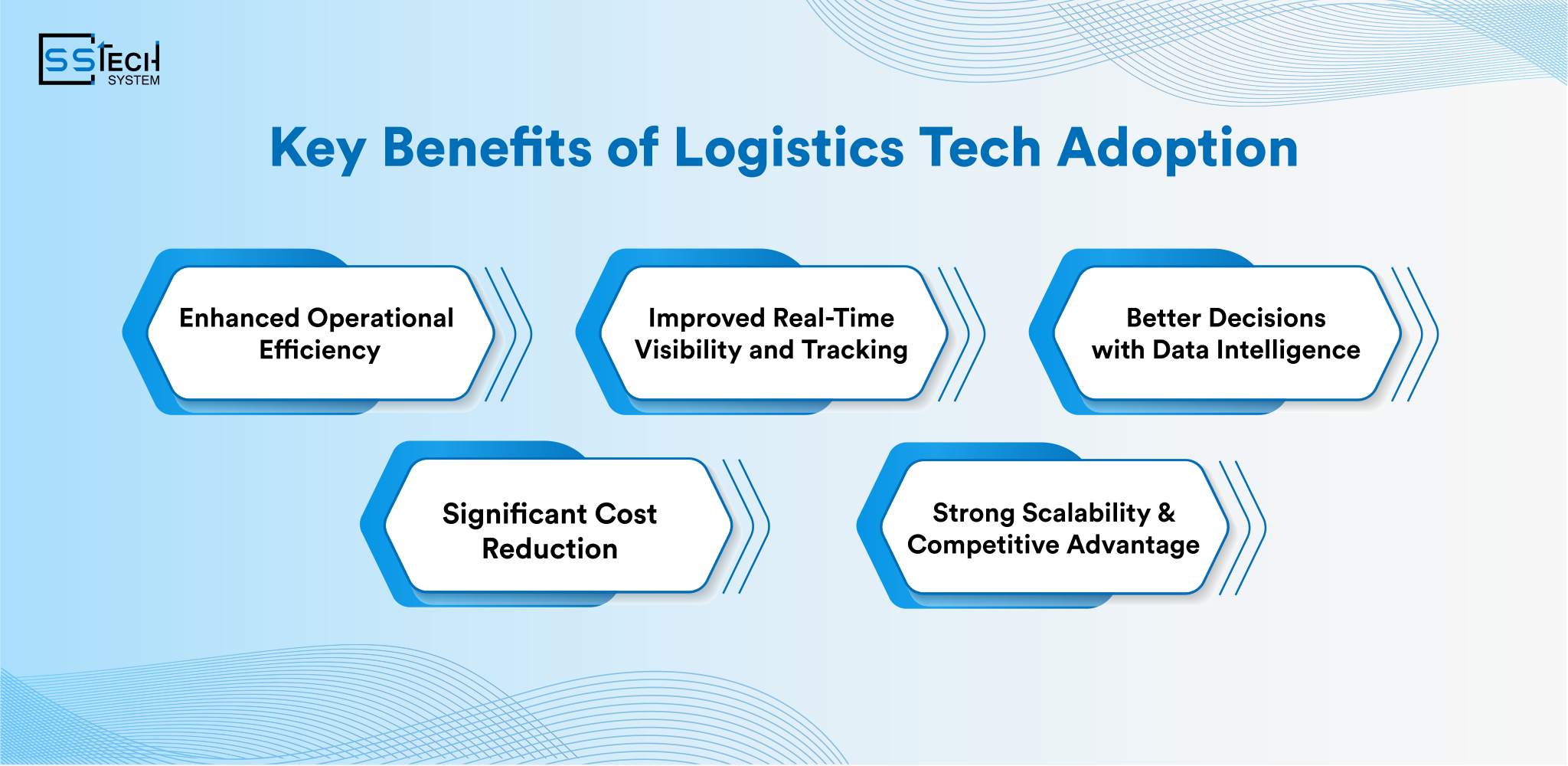
The contemporary logistics processes are based on automation and AI, IoT, and cloud systems that minimize delays, avoid mistakes, and enhance overall efficiency. From $700 billion in 2023, the reverse logistics market is forecasted to grow to $954.5 billion by 2029. The benefits of automation in warehouse logistics are far-reaching and profound in all spheres of the supply chain:
Enhanced Operational Efficiency
The level of efficiency is enhanced dramatically because technology eliminates tedious manual processes in favor of an automated workflow. Robotic picking, artificial intelligence-based optimized routes, and digital records eradicate manual bottlenecks associated with slow procedures previously.
Hyper-automation in warehouses enables them to operate more quickly, achieve shorter cycle times, and achieve higher daily output. Drivers and dispatch teams spend less time on uncertain routes, and dispatch teams receive instant updates to deploy resources more efficiently. Generally, this makes the operations of best logistics companies in India smoother, faster, and accurate.
Improved Real-Time Visibility and Tracking
Live tracking has become an essential requirement in the new logistics. GPS trackers, IoT sensors and telematics systems keep track of cargo condition, vehicle performance and delivery condition at all times. These lessons assist the teams to act as they are being affected by a delay or deviation.
The customer receives real-time tracking updates that are accurate, leading to increased satisfaction and trust. The visibility also enhances identification of lost shipments and also reduces uncertainty in the supply chain.
Significant Cost Reduction
Technology gets rid of a lot of hidden costs that make profits low. Automation helps decrease labor expenses because it reduces manual labor, and AI route optimization decreases unwarranted fuel usage.
Cloud computing eliminates the costly hardware previously used and enables companies to store and retrieve information safely without incurring excessive maintenance costs. Predictive maintenance tools prevent vehicle breakdowns and reduce repair costs. Technological investments incur long-term and quantifiable cost savings altogether.
Better Decision-Making Through Data Intelligence
Machine learning and predictive analytics can give the logistics teams deeper insights that would not be feasible to have manually. These tools predict demand surges, forecast future needs, analyze market trends, and help businesses allocate resources efficiently.
The real-time dashboards allow the managers to keep track of performance and make better decisions as the data is correct and updated. Technology is changing logistics from a reactive to a proactive industry.
Strong Scalability and Competitive Advantage
Transportation Technology guarantees that businesses can expand at ease with regards to shipment volume without recruiting more labor and hence no reduction in quality.
Client logistics management, automation, API integrations, and logistics route optimization solutions enable companies to grow comfortably across regions and the customers they serve. Early adopters have a well-defined competitive edge of providing quicker, more precise, and more transparent than their competitors who are yet to switch to the outdated system.
Conclusion
The logistics sector is entering a new age imposed by smartness, automation, and sustainability. With the ever-increasing integration of global supply chains and the ever-increasing demands of customers, the imperative of having a superior logistics technology has never been more evident.
The most influential ones are AI in Logistics, Digital Twin simulations, hyper-automation, real-time visibility, cloud logistics platforms for smart businesses, blockchain for securely handling data, and next-generation IoT, which are fundamentally changing the way business is conducted.
Such innovations not only simplify routine operations but also make logistics more resilient, reduce operational risk, and allow logistics providers to anticipate challenges before they disrupt the supply chain.
The role of blockchain in logistics management is especially radical through route optimization, demand forecasting, warehouse enhancement, and better customer communication. Digital Twins also provide additional support to strategic planning since it enables organizations to model warehouse layouts, transportation networks and the possible disruptions in a virtual environment.
Meanwhile, automation is critical to ensure efficient scaling, minimize reliance on human labor, and maintain precision during periods of high demand. These technologies together with real-time tracking devices, logistics solutions that are environmentally friendly and cloud-based platforms form the basis of supply chains of the future.

Frequently Asked Questions
The most significant beneficiaries of the new logistics technology in courier services, eCommerce logistics companies, 3PL companies, freight operators, and warehouse-centric businesses are an increased delivery speed, visibility, scalability, and cost efficiency.
AI can enhance logistics by facilitating predictive demand forecasting ability, smart route optimization, digitalization of warehouses, identifying fraud, and decision-making processes in real-time, assisting companies in lowering expenses and enhancing accuracy of deliveries.
Real-time visibility enables logistics companies to trace their shipments, monitor vehicle activity, react immediately to delays, enhance customer communication, and minimize risks like theft, damage, and missed delivery schedules.
IoT devices will offer real-time data on shipment position, temperature, movement, and health of vehicle. This allows preventive maintenance, more effective management of perishable products, increased security, and more operational efficiency.
Modernization of the old systems, integration of AI and automation, investment into IoT tracking solutions, and teaming with the long-term logistics software development companies can prepare the logistics business.
Related Article