

Enterprise AI Agents help businesses automate workflows and make better business decisions. Additionally, they enhance employee productivity. Adding Custom AI Agents to your business helps you automate workflows further and improve business processes. We have detailed the various steps to implement Custom AI Agents in your business.
We provide various examples to help you better understand Custom AI Agents. Additionally, we outline some of the security risks associated with custom software development and ways to determine the return on investment (ROI) for implementing Custom AI Agents.
What Are Custom AI Agents in Enterprise Workflows?
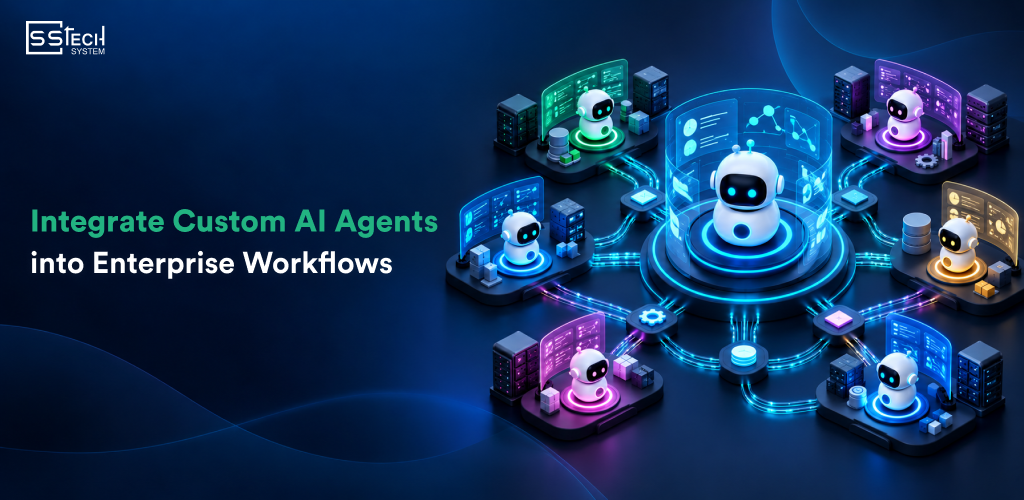
Custom AI solutions USA are systems designed to accomplish business tasks, make business decisions, and communicate with other organizational units and employees using a combination of business rules, other AIs, and other business software. Unlike traditional business automation, Enterprise AI Agents are designed to operate with some degree of business flexibility.
Key Capabilities of Enterprise AI Agents
- Task planning and execution: Break down large business goals and the set of tasks required to achieve the goals.
- Context-aware decision-making: Use their understanding of business rules to make decisions and act.
- API and application interaction: Use APIs to integrate with other enterprise applications.
- Employee and agent collaboration: Work with employees. Work through agents when abilities are unavailable in employees.
- Continuous monitoring and feedback: Monitor outcomes. Determine the causes of errors occurring during SaaS application development and improve performance.
- Tool use and function calling: Request help from other agents to perform complex tasks or access other systems. Using the Model Context Protocol (MCP) with other agents provides standard ways to connect with other agents.
- Knowledge Retrieval: Use RAG to understand a question and find information to answer it from company records.
- Multi-agent System: Communicate with other agents through the Agent2Agent (A2A) protocol to distribute tasks.
Read more: Custom Software Development Services
Why Should Enterprises Integrate AI Agents into Their Workflows?
This is the wave of the future. Organizations can move beyond their first few isolated AI projects and begin enhancing overall business operations. Among other uses, a reliable AI agent development company India helps achieve enhanced productivity and better staffing alignment with company processes.
Key Business Benefits
Automate repetitive tasks and reduce operational costs
Agents can handle routine activities such as data extraction, ticket classification, document processing, report preparation, and record updates. This reduces manual effort and frees employees to focus on higher-value responsibilities.
Increase employee productivity by reducing routine workloads
Want to know how AI agents improve business productivity? Agents that automate business processes, compile information, and assist in making work-related decisions support employees better. Agents reduce the time staff spend searching for information and lessen the staff’s application-switching load.
Improve decision-making with AI-assisted insights
AI agents help spot abnormalities, recognize business patterns and trends, and generate ideas to assist employees in making business decisions.
Faster time-to-value, 24/7 operations, and scalability without proportional headcount
Routinely monitor the health of the business, spot issues, and proactively assist customers. Note that actual increased work capacity of a business can be achieved, and service can be offered continuously, at a cost, with the associated load still resting on staff.
Real enterprise results / mini case examples
Let’s say there’s a customer support team that receives thousands of routine questions. An agent can independently classify support tickets, seek out the relevant company policy, compose an answer, and route more difficult cases to the appropriate person. Likewise, an agent can help a member of the finance team find the details of a particular invoice and help identify potential errors.
Results will vary based on workflow complexity, how well the agent integrates with other enterprise AI solutions India and how the workforce accepts and uses the agent.
How to Integrate Custom AI Agents into Enterprise Workflows
A methodology to implement an enterprise software development solution in a controlled and systematic manner helps gain comfort and confidence with the predictive analytics solutions and realize the expected business benefits. Here is a description of such a methodology.
Step 1 – Identify Workflow Bottlenecks and Business Goals
Look for workflows with well-defined inputs and outputs. Identify repetitive tasks and activities, and delays and inconsistencies.
Step 2 – Choose the Right AI Agent Architecture
Depending on how many workflows you want to address, develop a multi-agent solution or a single-agent solution. Based on your agent architecture framework (Lang, Crew, Microsoft, OpenAI, Google), decide on orchestration and governance.
Evaluate the expected business results, consider the trade-offs between solution accuracy and latency, and determine the solution cost. Strategize your agent solution based on company policy and the machine learning solutions offered by integration partners.
Step 3 – Build Agents with Foundation Models, RAG, Prompting, and Tool Use
Use foundation models. Evaluate if RAG and other tool calling would suffice. Consider fine-tuning only if performance is not meeting goals.
Step 4 – Integrate Agents with Existing Enterprise Systems
Integrate AI agents seamlessly into your enterprise systems and software using APIs, MCP servers, and modern integration platforms. To protect sensitive business data, deploy identity and access management (IAM) solutions that enforce single sign-on (SSO) and role-based, least-privilege access controls.
Step 5 – Automate Workflows and Define Human Oversight
Configure AI workflow automation for large businesses to include exception handling and define approval processes. Low-risk workflow tasks can be automated. Configurable controls allow the system to define which tasks require approval and by whom.
Step 6 – Test Security, Accuracy, and Performance
Automated scripts quickly evaluate your AI agent’s performance and measure its impact across your entire system. By running targeted red team exercises, security teams verify that agents never compromise network security, leak sensitive business data, or execute unauthorized tasks.
Step 7 – Deploy, Monitor, and Improve
Prioritize the agent’s use across different processes, use agent management practices to track the agent and evaluate the agent’s impact on the process, and use management practices to ensure the system remains within resource constraints. Maintain configurability.
What Are the Best Use Cases of AI Agents in Enterprises?
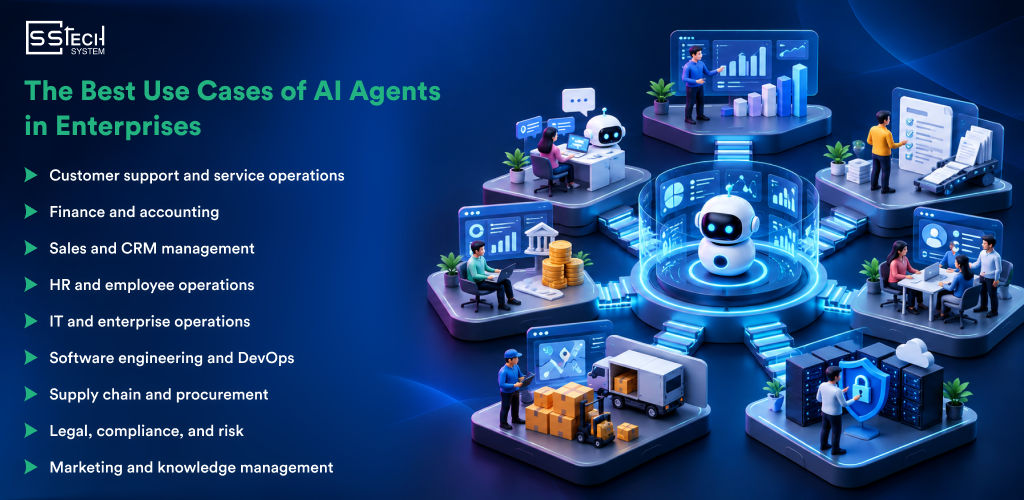
Use cases for AgentWorks span several business functions based on the nature of business process workflow, data, and risk.
- Customer support and service operations: Agents can route customers to the right support personnel, analyze support tickets, and answer customer questions.
- Finance and accounting: Agents can review finances and ticketing systems to recognize exceptions.
- Sales and CRM management: Agents can research leads and assist in entering customer engagement and tissue documentation.
- HR and employee operations: Agents can retrieve HR policy information, answers to common HR benefits and support requests, and assist in employee benefit enrollment.
- IT and enterprise operations: Agents can support service desk functions and other IT and AEC activities by capturing incidents and ticketing and suggesting potential solutions to support tickets.
- Software engineering and DevOps: Agents can create, review, and test code and assist in answering support tickets.
- Supply chain and procurement: Agents can assist in supporting procure-to-pay processes by analyzing and monitoring inventory and supplier ticketing.
- Legal, compliance, and risk: Agents can assist in contract review, organize and summarize supporting evidence and documents, and assist legal auditing functions.
- Marketing and knowledge management: Agents can support marketing functions by answering and directing internal customer requests and questions. Agents can help analyze data and reports.
Read more: How AI Route Optimization Reduces Delivery Delays
What Challenges Should Businesses Consider Before Implementation?
Before adopting Enterprise AI Agents, businesses should address the following challenges:
- Data quality: The quality of data used by Enterprise AI Agents is crucial. AI Agents should not be implemented until enterprise data has been cleansed and normalized.
- Legacy systems: Many organizations’ legacy systems are old and do not have APIs. When building integration layers, tools and services to enable communication among systems should be used.
- Security and privacy: The AI Agents should be programmed to protect sensitive data.
- Unreliable outputs: Validate responses and actions, and set rules to govern output.
- Implementation costs: The ROI should be assessed for each use case.
Addressing these challenges early makes enterprise AI automation solutions more reliable and easier to scale.
How Do You Secure and Govern Enterprise AI Agents?
When creating Enterprise AI Agents, security and governance should be integrated from the start. If Enterprise AI Agents are given broad access to enterprise data and systems, there is the potential for a significant data and security breach. Limit the access of Enterprise AI Agents to enterprise data and systems to that which is necessary. Agents should use encrypted and scoped access credentials.
To minimize risk, Agents should be programmed to perform actions only after input validations and policy checks. Agents should be periodically audited, and an emergency shutdown feature should be available. The extent of human oversight should be based on the sensitivity of the data, action, and the risk of the web application development outcomes. Human oversight should be integrated for financial approvals, regulated decisions, and actions.
Some governance frameworks that organizations can consider include the NIST AI Risk Management Framework and the ISO/IEC 42001 standard. Additionally, organizations must consider relevant provisions of the EU AI Act, GDPR, India’s DPDP Act, SOC 2, and HIPAA. Relevance will be determined based on the nature of the organization’s activities, location, and the data processed by the organization.
What Are the Best Practices for Enterprise AI Integration?
Follow these practices to build reliable, scalable AI-powered workflows:
- Start with a focused pilot: Choose a high-value workflow with measurable outcomes.
- Use trusted data: Enforce data quality, access permissions, and retrieval controls.
- Define autonomy limits: Specify which actions agents can perform and when approval is required.
- Evaluate continuously: Combine automated testing, performance evaluations, and human feedback.
- Assign ownership: Designate a responsible owner for every production agent.
- Maintain an agent registry: Track agent versions, tools, permissions, owners, and deployment status.
- Scale gradually: Expand only after validating performance, security, and ROI.
These practices support sustainable enterprise AI integration and help align intelligent automation solutions with business objectives.
How Can SSTech System Help with Enterprise AI Agent Development?
SSTech System helps in AI workflow automation in Australia, artificial intelligence, and software solutions to help organizations achieve their operational goals. These solutions cover the analysis and design of automated solutions, integrated systems, and software. They also include AI software development, testing, and deployment.
Choose the option that fits best in your current IT environment and security model and supports your company’s growth. To begin to reap the benefits of custom AI agents for enterprises, mobile application development, identify a high-value, low-effort use case and build a proof of concept to demonstrate the value to the rest of the organization. Once value has been demonstrated, you can scale your deployment across the enterprise.
Conclusion
Using Enterprise AI Agents requires strategy, integrity, and evaluation. Selecting and monitoring product engineering services, and making integration and automation part of your enterprise AI automation strategy, helps improve employee productivity and business operations.
Using AI Agents for repetitive business tasks frees employees for more strategic business activities. Using Custom AI Agents for specific processes gives an enterprise an advantage and can play a significant role during an enterprise’s digital business transformation.
Frequently Asked Questions
What is MCP, and why is it important for Enterprise AI Agents?
MCP establishes a uniform method for communication between enterprise AI agents and other business tools, applications, and corporate data.
Can AI agents be used in the enterprise?
Yes, AI agents for business can be used for enterprises with appropriate controls and Integrations.
Should a company build, buy, or both?
In the majority of cases, purchasing and/or subscribing is the best course. For unique or differentiated business processes, build may be the best course.
How long will it take to implement enterprise AI agents fully?
Complete implementation may take 6 to 9 months. Shorter-term implementations may take a few months or less.
What are the major threats of using AI agents?
Some of the more common risks may include, but are not limited to, prompt injection, unauthorized agent behavior, and/or data leaks.
What is the difference between single-agent and multi-agent systems?
In a single-agent system, one software agent performs tasks. In contrast, a multi-agent system involves a collection of collaborating software agents that are responsible for executing components of a given task.
What skills are required for managing enterprise AI agents?
The skills vary and are usually a combination of generative AI development, artificial intelligence engineering, data, AI chatbot development, and business skills.
What is the difference between AI agents and automation in workflow?
Traditionally, automation in workflow has been dominated by rules and thus quite rigid. AI agents, on the other hand, can interpret contexts and make decisions within the limits of options available to them to achieve a goal.
What is the cost of building custom AI agents?
Custom AI agent development Australia cost varies based on factors such as the level of complexity, the systems it will be integrated with, the infrastructure, the type of security required, and the level of support and maintenance desired.
Related Article