


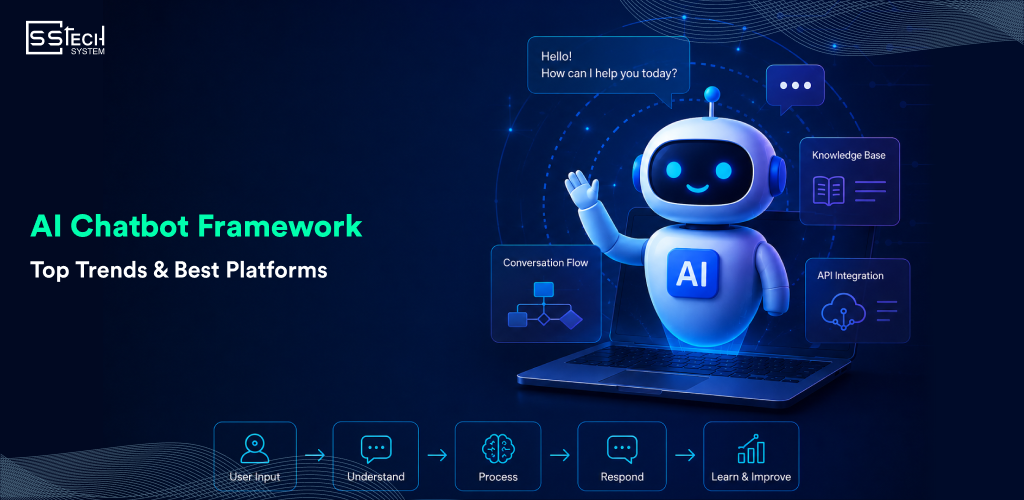
Artificial intelligence is rapidly transforming how businesses communicate with customers, automate operations, and deliver personalized digital experiences. As organizations continue to embrace digital transformation, implementing an AI Chatbot Framework has become one of the most effective ways to improve customer engagement, especially for businesses investing in Mobile Application Development, streamline internal processes, and provide instant support around the clock. Modern AI chatbots are no longer limited to answering simple questions. They can understand context, retrieve information from multiple data sources, integrate with business applications, and even perform complex tasks with minimal human intervention.
What is an AI Chatbot Framework?
An AI Chatbot Framework is a comprehensive software platform or development environment that provides developers with the tools, libraries, APIs, and infrastructure needed to create intelligent conversational applications. Unlike traditional rule-based chatbots that rely on predefined scripts and decision trees, modern AI chatbot frameworks utilize Natural Language Processing (NLP), Machine Learning (ML), Large Language Models (LLMs), and Generative AI to understand user intent, interpret context, and generate meaningful responses in real time.
These frameworks serve as the foundation for building conversational systems capable of interacting naturally with users across websites, mobile applications, messaging platforms, voice assistants, and enterprise applications. By integrating with cloud services, databases, CRMs, ERPs, and third-party APIs, AI chatbot frameworks enable businesses to automate repetitive tasks, provide personalized customer support, and improve operational efficiency.
Why Businesses Need AI Chatbot Frameworks in 2026
Customer expectations have changed dramatically over the past few years. Consumers now expect immediate responses, personalized interactions, and seamless digital experiences regardless of the communication channel they choose. Businesses that fail to meet these expectations risk losing customers to competitors who offer faster and more intelligent support.
An advanced AI Chatbot Framework empowers organizations to provide 24/7 customer assistance without increasing operational costs. Instead of relying solely on human agents, businesses can automate routine inquiries, appointment scheduling, order tracking, technical support, lead qualification, and countless other repetitive tasks. This allows employees to focus on more strategic responsibilities while improving response times and customer satisfaction.
Top AI Chatbot Framework Trends in 2026
Artificial intelligence continues to evolve at an extraordinary pace, and 2026 marks a significant shift in how businesses build and deploy conversational AI solutions. Modern organizations are no longer looking for chatbots that simply answer frequently asked questions. Instead, they expect intelligent AI assistants capable of understanding context, reasoning through complex requests, automating workflows, and integrating seamlessly with enterprise systems. As a result, every leading AI Chatbot Framework now focuses on delivering greater intelligence, flexibility, and business value.
Agentic AI
One of the biggest innovations shaping the future of conversational AI is Agentic AI. Unlike traditional chatbots that respond only when users ask questions, AI agents can independently plan, reason, and execute tasks to achieve specific goals. This evolution transforms chatbots from simple conversational interfaces into intelligent digital assistants capable of making decisions within predefined business rules.
Multi-Agent Collaboration
Another major trend redefining enterprise AI is Multi-Agent Collaboration. Instead of relying on a single chatbot to perform every task, organizations are building systems where multiple AI agents work together, each specializing in a particular function.
A modern AI Chatbot Framework enables organizations to design collaborative AI ecosystems where multiple intelligent agents share information, coordinate workflows, and solve business challenges collectively. This architecture significantly improves scalability and allows businesses to expand AI capabilities without redesigning their entire system.
Voice AI Chatbots
Voice technology has become an essential component of digital customer experiences, especially for businesses focused on Android Development and iOS Development. Consumers increasingly prefer speaking naturally rather than typing long messages, making Voice AI one of the fastest-growing areas of conversational technology.
Multimodal AI
Modern users interact with businesses through much more than text alone. They upload images, share documents, speak through voice messages, and expect AI systems to understand multiple forms of communication simultaneously. This demand has accelerated the adoption of Multimodal AI.
Retrieval-Augmented Generation (RAG)
One of the most important innovations in enterprise AI is Retrieval-Augmented Generation (RAG). Traditional language models generate responses based primarily on their training data, which may become outdated or lack organization-specific knowledge. RAG solves this limitation by allowing AI chatbots to retrieve relevant information from trusted business data sources before generating responses.
AI Memory & Personalization
Personalization has become a defining factor in exceptional customer experiences. Users expect businesses to remember previous interactions, understand preferences, and continue conversations naturally across multiple sessions.
MCP & Enterprise Integrations
Enterprise AI systems rarely operate in isolation. Modern organizations rely on dozens of software applications, including Customer Relationship Management (CRM) systems, Enterprise Resource Planning (ERP) platforms, accounting software, project management tools, communication platforms, and cloud services. To maximize business value, AI chatbots must integrate seamlessly with these systems.
Security & Compliance
As AI adoption accelerates across industries, protecting sensitive business and customer information has become more important than ever. Organizations require chatbot frameworks that prioritize security, privacy, and regulatory compliance without compromising performance or usability.
Best AI Chatbot Frameworks & Platforms in 2026
Choosing the right AI Chatbot Framework is one of the most important decisions for organizations planning to implement conversational AI. Every business has unique goals, technical requirements, security standards, and integration needs, so there is no single framework that fits every scenario. Some platforms are designed for enterprise automation, while others focus on rapid development, no-code deployment, or advanced AI agent orchestration.
LangChain
LangChain has become one of the most widely adopted open-source frameworks for building intelligent AI applications. It simplifies the development of conversational AI by providing components for prompt management, memory, tool integration, document retrieval, and workflow orchestration. Developers can connect multiple AI models, vector databases, APIs, and enterprise applications to create highly customized chatbot solutions.
LangGraph
As organizations increasingly adopt AI agents, LangGraph has emerged as a preferred framework for creating complex multi-agent workflows. Unlike traditional chatbot architectures, LangGraph enables developers to design intelligent systems where multiple AI agents collaborate, share information, and complete sophisticated business processes.
OpenAI Agents SDK
The OpenAI Agents SDK has gained significant attention in 2026 as businesses seek to build intelligent AI assistants capable of using tools, retrieving information, and completing real-world tasks. The framework simplifies the development of AI-powered applications that interact with external APIs, business software, databases, and cloud services.
Microsoft Copilot Studio
Microsoft Copilot Studio is an enterprise-focused platform designed for organizations operating within the Microsoft ecosystem. Businesses already using Microsoft 365, Dynamics 365, Azure, Teams, and Power Platform can rapidly develop intelligent chatbots without extensive coding.
Google Dialogflow CX
Google Dialogflow CX remains one of the leading conversational AI platforms for businesses requiring scalable customer engagement solutions. Its advanced Natural Language Understanding capabilities enable organizations to build intelligent virtual assistants capable of managing complex conversations across websites, mobile applications, contact centers, and messaging platforms, making it an excellent choice for modern Application Development projects.
Rasa
Rasa continues to be one of the most trusted open-source AI chatbot frameworks for enterprises that require complete control over their conversational AI systems. Unlike cloud-only solutions, Rasa allows organizations to deploy AI assistants within private infrastructure, ensuring greater control over sensitive business and customer data.
Botpress
Botpress has evolved into a powerful AI chatbot platform that combines no-code simplicity with advanced AI capabilities. It enables businesses to create conversational applications through visual interfaces while still offering extensive customization for developers.
CrewAI
CrewAI represents the growing trend of collaborative AI systems. Instead of building a single intelligent assistant, developers create multiple AI agents that specialize in different business functions and work together to achieve shared objectives.
IBM watsonx Assistant
IBM watsonx Assistant continues to serve enterprises requiring secure, scalable, and highly customizable conversational AI solutions. The platform supports customer service automation, employee assistance, and industry-specific AI applications while maintaining strong governance, compliance, and security capabilities.
Essential Features of a Modern AI Chatbot Framework
The capabilities of chatbot technology have expanded dramatically over the past few years. Businesses are no longer satisfied with simple question-and-answer systems. Instead, they require intelligent conversational platforms capable of understanding context, accessing business information, automating workflows, and continuously improving through machine learning.
Industries Using AI Chatbot Frameworks
The adoption of AI Chatbot Framework technology has expanded far beyond customer service. Organizations across virtually every industry now leverage conversational AI to automate operations, improve customer experiences, and increase productivity.
Logistics and supply chain companies benefit significantly from AI chatbot frameworks by automating shipment tracking, warehouse inquiries, inventory visibility, delivery scheduling, transportation updates, and customer communication. Intelligent AI assistants help streamline logistics operations while improving transparency throughout the supply chain.
Educational institutions deploy AI chatbots to support student admissions, answer academic questions, manage course information, provide learning assistance, and improve communication between students and faculty members. These solutions enhance accessibility while reducing administrative burdens.
Real estate companies leverage chatbot frameworks to qualify buyers, schedule property visits, answer listing inquiries, recommend suitable properties, and simplify communication throughout the purchasing process. AI-powered automation helps agents focus on high-value client interactions.
Hospitality businesses including hotels, restaurants, and travel agencies use AI assistants to manage reservations, recommend services, answer guest inquiries, and provide multilingual support throughout the customer journey.
Human Resources departments increasingly depend on AI chatbot frameworks to automate recruitment, employee onboarding, leave management, policy inquiries, benefits administration, and internal knowledge sharing. These intelligent assistants improve employee experiences while reducing administrative workloads.
Software companies and SaaS providers use conversational AI for customer onboarding, product guidance, technical support, subscription management, and knowledge base assistance. AI chatbots accelerate customer success while reducing support costs.
How to Choose the Best AI Chatbot Framework
Selecting the right AI Chatbot Framework is a strategic decision that directly impacts the success of your AI initiatives. While many frameworks offer similar core capabilities, the best choice depends on your business objectives, technical requirements, scalability needs, and long-term digital transformation strategy. Investing time in evaluating available platforms helps organizations build AI solutions that remain effective as business requirements evolve.
Scalability is another critical consideration. As your business grows, the chatbot should be capable of handling increasing numbers of users, conversations, and data without compromising performance. A scalable AI Chatbot Framework allows businesses to expand AI capabilities across multiple departments, regions, and communication channels while maintaining consistent user experiences.
Common Challenges & Solutions
Although AI chatbot technology has advanced significantly, organizations still face several challenges during implementation. Understanding these obstacles and adopting the right strategies can help businesses maximize the effectiveness of their conversational AI solutions.
One common challenge is AI hallucination, where a chatbot generates responses that sound convincing but are inaccurate or unsupported. This issue can be minimized by implementing Retrieval-Augmented Generation (RAG), connecting the chatbot to trusted business knowledge bases, and regularly updating enterprise data sources.
Future of AI Chatbot Frameworks
The future of the AI Chatbot Framework extends far beyond conversational interfaces. Over the next several years, AI assistants will evolve into intelligent digital coworkers capable of reasoning, planning, learning, and executing complex business operations with minimal human intervention.
Agentic AI will continue driving this transformation by enabling autonomous systems that can complete multi-step tasks, collaborate with other AI agents, and make context-aware decisions within defined business rules. These intelligent agents will become valuable members of customer service, sales, finance, logistics, and operations teams.
Why Choose SSTech System for AI Chatbot Development
Implementing a successful AI chatbot requires more than selecting the right framework. It demands technical expertise, industry knowledge, strategic planning, and seamless integration with existing business systems. At SSTech System, we help organizations transform ideas into intelligent AI solutions that deliver measurable business value through expert Mobile Application Development, AI integration, and enterprise software solutions.
Conclusion
Choosing the right AI Chatbot Framework can help businesses automate processes, improve customer engagement, and deliver smarter digital experiences. Whether you’re investing in Mobile Application Development, Application Development, Android Development, or iOS Development, AI-powered chatbots can enhance efficiency and support long-term business growth.
At SSTech System, we build secure, scalable, and customized AI chatbot solutions that align with your business goals. Ready to transform your digital experience? Connect with our experts and build an AI-powered solution for the future.
Frequently Asked Questions
What is an AI chatbot framework?
An AI chatbot framework is a software platform that helps developers build, train, deploy, and manage intelligent chatbots with features like NLP, LLM integration, APIs, and workflow automation.
How do AI chatbot frameworks improve customer support?
Modern chatbot frameworks automate customer interactions, provide instant responses, support multilingual conversations, integrate with CRMs, and deliver personalized experiences using generative AI.
Are AI chatbot frameworks suitable for small businesses?
Yes. Cloud-based chatbot frameworks are affordable, scalable, and easy to implement, making them suitable for startups, SMEs, and enterprises alike.
Why should businesses partner with SSTech System for AI chatbot development?
SSTech System delivers custom AI chatbot solutions that combine advanced technologies, enterprise integrations, scalable architecture, and industry best practices. Our expertise in AI, software development, cloud solutions, and digital transformation enables businesses to build intelligent applications that improve efficiency, enhance customer experiences, and support long-term growth.
Related Article