


The mobile app industry is evolving faster than ever, and businesses are constantly searching for smarter ways to build high-quality applications without increasing development costs. As smartphones continue to shape how customers shop, communicate, and interact with brands, investing in Mobile Application Development has become a strategic necessity rather than an option. Whether you are a startup launching your first product or an established enterprise expanding your digital presence, having a reliable mobile application can improve customer engagement, streamline business operations, and create new revenue opportunities.
One of the biggest challenges organizations face is choosing the right development approach. Building separate applications for Android and iOS often requires larger budgets, longer development cycles, and dedicated teams for each platform. In today’s competitive business environment, companies need solutions that deliver exceptional user experiences while reducing both development time and maintenance costs.
The growing demand for faster product launches, scalable applications, and simplified maintenance has made hybrid development one of the leading Mobile App Development Trends. From startups and SMEs to global enterprises, organizations across industries are embracing hybrid technology to accelerate digital transformation while maximizing return on investment.
What is Hybrid Mobile App Development?
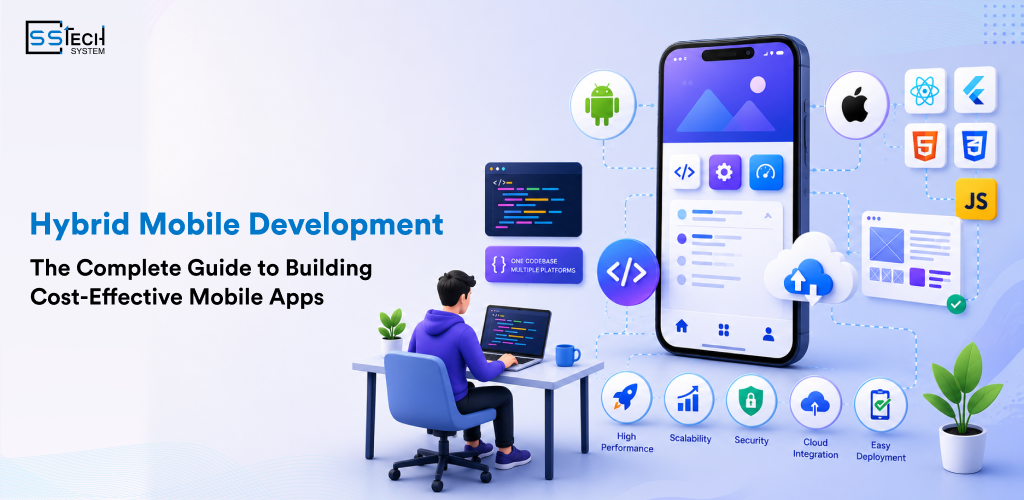
Hybrid Mobile App Development is a modern approach to Mobile Application Development that enables developers to build a single application capable of running on both Android and iOS devices using one shared codebase. Instead of creating separate applications for each platform, developers write the code once and deploy it across multiple operating systems, significantly reducing development time, project costs, and ongoing maintenance efforts.
Over the past few years, hybrid development has evolved significantly. Modern frameworks such as Flutter and React Native now offer faster rendering, responsive user interfaces, smooth animations, and seamless integration with native device capabilities. As a result, hybrid applications can provide experiences that closely match native apps while offering the flexibility and efficiency businesses need in today’s competitive digital landscape.
Hybrid applications are widely used across industries, including eCommerce, healthcare, education, logistics, finance, real estate, travel, and enterprise solutions. Whether the goal is improving customer engagement, automating internal operations, or expanding digital services, hybrid development provides a scalable foundation for long-term success.
Why Businesses Are Choosing Hybrid Mobile App Development
As digital transformation accelerates across industries, businesses are looking for development strategies that deliver faster results without compromising quality. Hybrid Mobile App Development has become a preferred choice because it enables organizations to develop feature-rich applications for multiple platforms using a single codebase. This approach reduces overall development costs while helping businesses launch products more quickly and efficiently.
One of the primary reasons companies choose hybrid development is faster time-to-market. Instead of building and managing separate Android and iOS applications development teams can create one application that works across both platforms. This significantly shortens project timelines, allowing businesses to introduce new products, gather customer feedback earlier, and respond quickly to changing market demands.
Cost efficiency is another major advantage. Maintaining separate development teams for Android Development and iOS development can increase project expenses considerably. Hybrid development eliminates much of this complexity by allowing developers to maintain one codebase, reducing development, testing, and maintenance costs throughout the application’s lifecycle.
The rise of Mobile App Development Trends such as AI-powered automation, cloud-native architecture, real-time analytics, and personalized user experiences has further strengthened the adoption of hybrid applications. Businesses can leverage these technologies to deliver smarter, more engaging mobile experiences while maintaining development efficiency and controlling operational costs.
Hybrid Mobile App Development vs Native Mobile App Development
Choosing between Hybrid Mobile App Development and native mobile development is one of the most important decisions businesses make before starting a mobile application project. The right approach depends on factors such as business objectives, target audience, project budget, required features, development timeline, and long-term scalability.
Native mobile applications are developed separately for Android and iOS using platform-specific programming languages such as Kotlin for Android and Swift for iOS. Because these applications are built specifically for each operating system, they provide maximum performance, faster processing, smoother animations, and complete access to device hardware. Native development is often recommended for high-performance gaming applications, augmented reality (AR), virtual reality (VR), and other graphics-intensive solutions where every millisecond of performance matters.
Popular Hybrid Mobile App Development Frameworks
The success of any Hybrid Mobile App Development project depends heavily on selecting the right development framework. Today’s leading frameworks provide exceptional performance, reusable code, faster development cycles, and seamless integration with native device capabilities. As businesses continue to embrace digital transformation, these frameworks have become the foundation of modern cross-platform application development.
Flutter
Flutter, developed by Google, is one of the most popular frameworks for Hybrid Mobile App Development. It enables developers to build visually appealing applications for Android, iOS, web, and desktop using a single codebase. Flutter is known for its high-performance rendering engine, customizable widgets, and consistent user experience across multiple platforms.
One of Flutter’s biggest advantages is its Hot Reload feature, which allows developers to instantly view code changes without restarting the application. This significantly improves development speed while reducing testing time. Flutter also provides smooth animations, responsive layouts, and excellent scalability, making it an ideal choice for startups, enterprises, and businesses looking to build modern digital products.
React Native
React Native, developed and maintained by Meta, is another leading framework for Mobile Application Development. Built using JavaScript and React, it enables developers to create cross-platform applications with native-like performance while sharing most of the code between Android and iOS.
React Native offers reusable components, strong community support, extensive third-party libraries, and excellent integration with native modules. Businesses appreciate React Native because it accelerates development while maintaining a high-quality user experience. It is widely used for social networking platforms, eCommerce applications, healthcare systems, financial services, and enterprise mobility solutions.
Ionic
Ionic is another powerful hybrid development framework designed primarily for businesses that require enterprise-grade or content-driven applications. Built using modern web technologies such as HTML, CSS, and JavaScript, Ionic enables developers to create interactive applications that work seamlessly across Android, iOS, and web platforms.
Ionic offers an extensive library of pre-built UI components, rapid development capabilities, and easy integration with existing web applications. Organizations looking to extend their web platforms into mobile environments often choose Ionic because it provides a cost-effective solution while maintaining excellent cross-platform compatibility.
Key Features of Hybrid Mobile App Development
Modern Hybrid Mobile App Development delivers far more than simple cross-platform compatibility. Today’s hybrid applications provide advanced features that enable businesses to create engaging, secure, and scalable digital experiences while meeting evolving customer expectations.
As the Future of Mobile App Development continues to evolve, Artificial Intelligence has become an essential part of modern hybrid applications. Businesses can integrate AI-powered chatbots, intelligent search, personalized product recommendations, predictive analytics, voice assistants, and workflow automation to deliver smarter and more personalized customer experiences.
Benefits of Hybrid Mobile App Development for Businesses
Businesses today need mobile applications that are fast, scalable, and cost-effective. Hybrid Mobile App Development has become a preferred choice because it helps organizations reduce development expenses while delivering high-quality applications across multiple platforms. By leveraging a single codebase, businesses can simplify development, accelerate product launches, and provide consistent user experiences on both Android and iOS devices.
Security is equally important in modern Mobile Application Development. Hybrid frameworks support secure authentication, encrypted data transmission, role-based access control, biometric verification, and compliance with modern security standards. These features help businesses protect sensitive customer information while building trust and credibility.
Industries That Benefit from Hybrid Mobile App Development
The flexibility and scalability of Hybrid Mobile App Development make it a smart choice for businesses across various industries. It enables organizations to build cost-effective, customized mobile applications that improve customer engagement, streamline operations, and support long-term digital growth.
The eCommerce industry uses hybrid applications to deliver seamless shopping experiences with features like secure payments, product recommendations, order tracking, loyalty programs, and push notifications, helping businesses boost customer satisfaction and sales.
In healthcare, hybrid mobile apps support appointment scheduling, telemedicine, patient management, fitness tracking, and electronic health records, making healthcare services more accessible and efficient.
For the logistics and transportation industry, hybrid applications simplify fleet management, warehouse operations, shipment tracking, inventory management, and route optimization, improving operational efficiency and real-time supply chain visibility.
Educational institutions use hybrid apps for online learning, virtual classrooms, student management, and digital assessments, enabling flexible and interactive learning experiences.
In the travel and hospitality industry, hybrid mobile applications streamline hotel bookings, travel planning, online check-ins, and customer support, enhancing convenience and improving guest experiences.
Real estate businesses benefit from hybrid apps by offering property listings, virtual tours, site visit scheduling, and client management, making the buying and selling process more efficient.
Enterprise organizations rely on hybrid applications for project management, workflow automation, CRM, ERP, business analytics, and employee collaboration, helping improve productivity and business performance.
Challenges of Hybrid Mobile App Development
Although Hybrid Mobile App Development offers numerous advantages, businesses should also understand the potential challenges before selecting the right development approach. Every mobile application has unique technical requirements, and choosing the appropriate technology depends on business objectives, target users, and expected functionality.
Third-party plugin compatibility may occasionally create development challenges. Some external libraries or plugins may not immediately support the latest operating system updates, requiring developers to implement custom solutions or alternative integrations. Selecting mature frameworks and experienced development teams helps minimize these risks.
Performance optimization also remains an ongoing responsibility. Developers should continuously optimize API calls, database queries, image compression, application size, caching strategies, and background processes to ensure fast loading speeds and smooth user interactions across all supported devices.
Best Practices for Successful Hybrid Mobile App Development
A successful Hybrid Mobile App Development project requires careful planning, the right technology stack, and a clear understanding of business goals. Following industry best practices helps organizations build scalable applications that deliver exceptional user experiences while supporting future growth.
The first step is defining clear business objectives and understanding the target audience. Organizations should identify user needs, application functionality, performance expectations, and long-term scalability before beginning development. A well-planned strategy reduces project risks and improves development efficiency.
Choosing the right framework is equally important. Businesses should evaluate factors such as application complexity, expected user traffic, required integrations, security requirements, and future expansion plans before selecting Flutter, React Native, Ionic, or another cross-platform framework.
Future Trends in Hybrid Mobile App Development
The Future of Mobile App Development is being driven by rapid technological innovation and changing customer expectations. Businesses are no longer looking for mobile applications that simply function, they expect intelligent, scalable, secure, and highly personalized digital experiences. As a result, Hybrid Mobile App Development continues to evolve as one of the most influential Mobile App Development Trends.
Artificial Intelligence (AI) is transforming how hybrid applications interact with users. AI-powered chatbots, personalized recommendations, predictive analytics, voice assistants, and intelligent automation are becoming standard features in modern mobile applications. These capabilities help businesses improve customer engagement, automate routine tasks, and deliver more personalized user experiences.
Cloud-native architecture is another major trend shaping hybrid application development. Cloud integration enables applications to scale effortlessly, synchronize data in real time, and provide seamless experiences across multiple devices. Businesses benefit from improved reliability, enhanced security, lower infrastructure costs, and simplified application management.
The Internet of Things (IoT) is expanding the role of hybrid applications by connecting smartphones with wearable devices, smart homes, industrial equipment, healthcare devices, and logistics systems. Real-time monitoring, remote device management, and automated workflows are creating new opportunities for businesses across industries.
Progressive Web Apps (PWAs) continue to complement hybrid development by offering fast, responsive, and app-like experiences directly through web browsers. Many businesses are combining PWAs with hybrid mobile applications to maximize user reach while minimizing development costs.
5G technology is also accelerating the growth of hybrid applications. Faster internet speeds, reduced latency, and improved connectivity enable developers to build more interactive applications featuring HD video streaming, augmented reality, virtual collaboration, and real-time communication without compromising performance.
Why Choose SSTech System for Hybrid Mobile App Development?
Choosing the right development partner is just as important as selecting the right technology. A successful mobile application requires strategic planning, technical expertise, user-focused design, and ongoing support to deliver long-term business value.
At SSTech System, we specialize in delivering innovative Hybrid Mobile App Development solutions that help businesses accelerate digital transformation while reducing development costs. Our experienced team combines industry best practices with modern frameworks such as Flutter and React Native to build secure, scalable, and high-performing mobile applications tailored to unique business requirements.
Conclusion
Hybrid Mobile App Development has transformed the way businesses build and deploy mobile applications by making cross-platform development faster, more affordable, and highly scalable. Instead of maintaining separate Android and iOS applications, organizations can leverage a single codebase to reduce development costs, simplify maintenance, and accelerate time-to-market without compromising quality.
Modern frameworks such as Flutter and React Native have significantly improved the performance of hybrid applications, enabling businesses to deliver near-native experiences while benefiting from greater flexibility and faster development cycles. As the Future of Mobile App Development continues to evolve, hybrid technology will remain a key driver of digital innovation across industries.
Frequently Asked Questions
What is Hybrid Mobile App Development?
Hybrid Mobile App Development is a cross-platform approach that enables developers to build a single application that works on both Android and iOS using one shared codebase.
Is Hybrid Mobile App Development better than Native App Development?
It depends on your business goals. Hybrid development is ideal for businesses seeking faster development, lower costs, and easier maintenance, while native development is better suited for graphics-intensive and hardware-dependent applications.
Which framework is best for Hybrid Mobile App Development?
Flutter and React Native are currently the two most popular frameworks because they offer excellent performance, strong community support, and faster cross-platform development.
Is Hybrid Mobile App Development suitable for startups?
Yes. Hybrid development helps startups reduce development costs, launch products faster, validate business ideas quickly, and scale applications as the business grows.
Can Hybrid Mobile Apps integrate AI and Cloud technologies?
Absolutely. Modern hybrid applications can integrate Artificial Intelligence, cloud computing, IoT, machine learning, payment gateways, CRM systems, ERP platforms, and various third-party APIs.
Related Article