


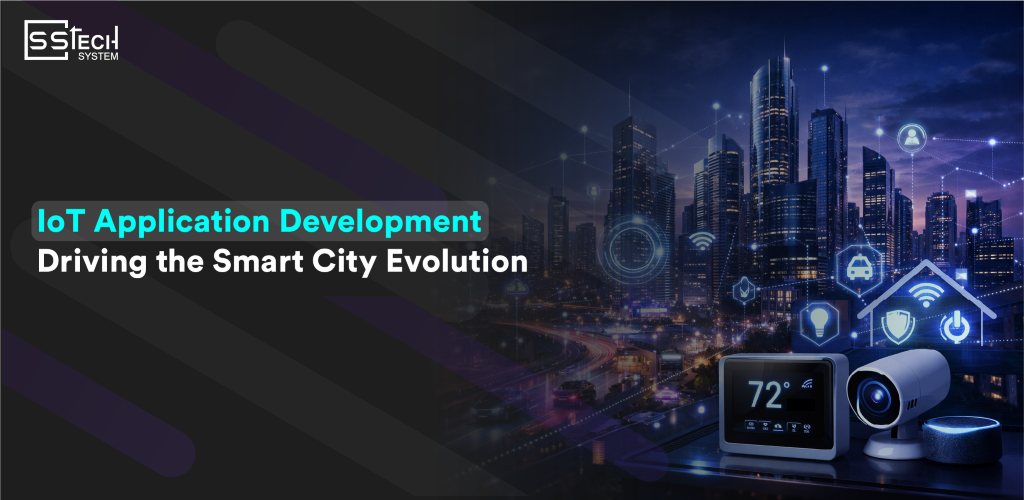
IoT Application Development is becoming a major actor in transforming residential and commercial environments in the current society. The development of IoT technology has made it possible for smart homes and smart cities—where IoT-enabled smart devices cooperate to offer an improved living environment.
This change addresses sustainability, efficiency, safety, and convenience as well as others. Companies like SSTech System are setting the standard for IoT development and are causing a major change in our interaction with our surroundings.
Introduction: The Rise of IoT-Powered Living
You are living in an age where technology gently chugs along in the background, automating daily life for convenience. From there, an experimental concept morphed into a central digital foundation for all things modern. From simple connectivity of passive devices, the Internet of Things (IoT) has transformed into an ecosystem that provides support for smarter homes and more efficient cities. Essentially, what we are looking at today in this evolution is IoT Application Development which allows connected devices to work seamlessly and provide you with the desired value.
IoT is not just about devices, it’s about how applications make those devices useful. IoT software development extracts data from devices and sensors, analyses it, and turns it into an automated response. This is also the reason why organizations are investing more in IoT app development services and partnering with a reliable IoT application development company to create solutions that are dependable and scalable.
Nowadays, you would be looking for living spaces which are:
- Smarter and more responsive
- Safer and more secure
- Energy-efficient and sustainable
Because they are largely siloed, rely on manual control, and lack visibility, traditional systems often fail. On the other hand, the typical IoT-enabled systems offer a lot more through the custom IoT application development, such as:
- Real-time monitoring and control
- Seamless automation across devices
- Better decision-making using live data
This is another blog about two vast transformation areas:
- Smart homes, where IoT enhances comfort, safety, and convenience
- Smart cities, where IoT solutions development improves traffic, utilities, and public services
These environments weave into each other creating an organic ecosystem of homes, cities and citizens, demonstrating how IoT application development transforms smart cities, interaction and experience with our surroundings.
Understanding IoT Application Development
Connected devices are a part of your daily life, but it is, in fact, IoT Application Development that brings intelligence, responsiveness, and value to those devices. This acts as a digital brain that can connect hardware, data, and user experiences into one system.
Definition of IoT application development
IoT Application Development is the process of designing and building software using tools, languages, frameworks, and technologies to enable connected devices to collect data, communicate, and act without manual intervention. It emphasizes on making the device raw data flow into insights that matter and make a difference in the real world for you.
Core Components
The core components of IoT Application Development work together to connect devices, transmit data, process information, and deliver intelligent, user-friendly experiences that you can rely on at scale.
IoT sensors and devices
IoT sensors and devices collect real-time data from the physical environment like temperature, motion, energy consumption, or traffic density. Having these devices is only the tip of the iceberg, without IoT software development, their data lie stagnant.
Connectivity Protocols (Wi-Fi, LPWAN, 5G, NB-IoT)
Connectivity protocols provide a way for devices to send data to each other reliably and securely over a network, depending on range, speed, and power requirements. Selecting an appropriate protocol makes certain that your IoT ecosystem runs smoothly at both home level and city level.
Cloud platforms and edge computing
Cloud platforms act as managers for any data produced from IoT devices, storing and processing massive amounts of it, while edge computing takes care of immediate, time-sensitive tasks (those that need to be close to the device). Combined with those key features, they allow for quicker responses, enhanced scalability and seamless IoT innovation.
Data analytics and dashboards
Using analytics tools and dashboards, complex IoT data is broken down, rendering data into actionable insights that will make sense to you. This real-time vision allows to track performance, troubleshoot problems and improve decision-making process.
Role of custom IoT software vs off-the-shelf platforms
While off-the-shelf platforms come with the advantage of speed, custom IoT application development provides you flexibility, control and allows for business or city-specific needs. Tailored solutions evolve with your needs.
Importance of scalability, security, and interoperability
An IoT ecosystem grows rapidly, and your applications have to ramp scaling without performance or security slides. Robust security and interoperability work seamlessly across your devices, platforms and integrations without compromising security.
Why application-layer development matters more than hardware alone
Data is collected by hardware, but it is the application layer that determines what is done with the data. Even the best visualized smart devices will not bring any value to you without having an effective IoT Application Development practice in place.
Challenges in IoT Application Development
You will need to address these technical and operational challenges from the start when you are scaling connected ecosystems across homes and cities that IoT Application Development. Tackling these issues isn’t possible without Custom Software Development, excellently running integrations, and a stable cloud infrastructure underneath.
Data security and privacy concerns
As IoT applications are requested to process continuous streams of sensitive data, security becomes of high priority for you. Cloud Application Development without secure architectures can quickly turn into data breaches and compliance risks hurting the trust and stability of any system.
Scalability challenges in large deployments
As your IoT ecosystem grows, applications must support thousands of devices without performance loss. Thus, the solutions designed using custom IoT application development are scalable which means that the platform scales seamlessly along with the growing demand.
Integration with legacy systems
Many organizations remain on legacy systems of systems that was not designed for connectivity to IoT. API Integration Services help you to connect up-to-date IoT platform with existing infrastructure, without affecting ongoing operations.
Network reliability and latency issues
Multiple connectivity protocols are required for consistent performance for IoT applications but they all need to run on the same network. In large scale urban deployments network instability or latency can directly impact real-time features.
Regulatory and compliance considerations
Willing to adhere the provisions of data protection regulations and different industry standards that vary by region. By incorporating compliance into the IoT software development process, you can minimize both long-term legal and operational risks.
Importance of choosing the right development partner
An experienced IoT application development company will help you tackle these challenges effectively. A trusted partner will make sure that your solution is compliant with IoT Application Development Services, swiftly integrates with the current systems and is adaptable in the future as the technologies would evolve.
The role of IoT application development in smart cities
The progress of smart cities depends much on IoT application development in Australia. IoT technology’s inclusion into urban infrastructure is enabling cities to grow more environmentally friendly, effective, and resident-responsive. Globally, smart city IoT solutions are being used since they offer real-time data and insights that help managers and municipal planners to make wise decisions.
Smart city traffic management is one of the main areas IoT application development is transforming. IoT-enabled smart devices let cities track traffic, ease congestion, and maximize public transit systems. This lowers carbon emissions, thereby helping to create sustainable smart cities, and enhancing the daily commute for residents.
IoT environmental monitoring is another quite important factor. Among other environmental elements, IoT development has made it possible to install sensors tracking air quality, noise levels, and water quality all around. This information is priceless in guaranteeing that city stays habitable and in enabling fast reactions to environmental hazards.
Management of Energy Another field where IoT application development is changing metropolitan environments is IoT. IoT technology lets cities maximize public building energy use, street lighting, and other infrastructure. In addition to saving money, this greatly helps a city’s total energy impact to be lessened.
What Makes a City “Smart”?
A smart city employs connected technologies (or IoT Application Development) in order to coordinate and manage infrastructure, resources, and services more effectively for you. The use of sensors and connected systems provides real-time data, which enhances decision-making speed, facilitates better service delivery and supports improved urban planning. Citizens also are active data participants, providing information through mobile apps and connected platforms which allow cities to respond more intelligently to real world demands.
Points to Consider:
- Integration of Internet of things in urban areas depends on IoT application development.
- Smart city traffic management and IoT environmental monitoring are key areas benefiting from IoT development.
- Energy management IoT solutions contribute to the creation of sustainable smart cities.
How IoT Applications Support City Administrations
You rely on efficient city services, and IoT Application Development allows administrations to observe, organize and control urban functions from a common virtual platform. Integrating this real-time data with automation, city leaders achieve better visibility, rapid responses, and more intelligent resource management.
- Centralized dashboards for decision-making: City admins can view everything in one place with centralized dashboards that enable real-time decision making, using live data to inform more effective decision-making.
- Real-time alerts and predictive analytics: IoT Applications provide the city with instant alerts surrounding predictive insights that help mitigate issues before they snowball and service the city.
- Better delivery of services and cost containment: Using data driven automation in cities reduces operational costs while also enabling better quality and dependable public services.
- Engagement of citizens through mobile and web platforms: IoT mobile app development enables citizens to engage with city systems, report problems, and get real-time responses, enhancing transparency and engagement.
Transforming Residential Spaces with IoT
IoT application development is changing homes as well as cities. Smart home technology is now a reality, with IoT development making homes more efficient, secure, and comfortable.
Among the most important developments in home IoT are home automation using IoT. From their smartphones or tablets, homeowners may manage lighting, heating, cooling, and even kitchen appliances by IoT-enabled smart devices. This not only adds convenience but also contributes to energy efficiency with IoT by ensuring that energy is not wasted when it is not needed.
Another area IoT technology that is significantly changing is security. IoT-powered smart home security systems let homeowners remotely operate locks and cameras, monitor their houses in real time, and get alarms about suspicious behavior. This level of security was unimaginable just a few years ago and is now becoming a standard feature in IoT applications for residential spaces.
The AI and IoT integration is improving the features of smart homes even further. IoT application development is letting homes learn from the behavior patterns of its occupants and automatically modify settings by integrating the power of artificial intelligence with IoT technology. This produces a more individualized and responsive living space.
Points to consider:
- Home automation with IoT is making homes more convenient and energy-efficient.
- Smart home security systems provide real-time monitoring and control for enhanced security.
- The integration of AI and IoT is creating smarter, more responsive homes.
Key Areas of Residential Transformation
The true effect of IoT Application Development becomes apparent within the home, as connected technologies make life easier. Through the application of automation, data, and IoT mobile app development, residential spaces can be made more efficient, secure, and customizable.
Smart energy management
With IoT applications, you can monitor and control energy usage, reducing waste and optimizing household costs in real-time.
- Accurate consumption data and optimized usage patterns are provided by the connected meters and appliances.
- This data-driven insight helps you reduce electricity bills while also contributing to the sustainable living objectives.
Home security and surveillance
Security systems powered by IoT provide enhanced security by allowing you to have complete control of your home environment.
- Combined security devices detect movement and help prevent unauthorized access in real time.
- By using IoT mobile app development, you can manage home security monitoring even from a distance via mobile.
Comfort and convenience
With IoT applications that automate lighting, temperature, and anything that needs to communicate within itself, our daily routines are modified.
- Integrated systems automatically determine setting or responds to voice commands for streamlined control.
- IoT is learning user behaviour and setting the home environment according to the lifestyle of a user.
Healthcare and assisted living
Connected health solutions make it more convenient and safer to live alone in your home.
- Health data is constantly monitored with the help of IoT devices and results are shared with caregivers or the medical community.
- Wearables and smart sensors monitor the elderly residents and help caregivers respond in real-time.
Transforming smart cities and smart homes: a unified vision
Beyond personal inventions, IoT application development offers a consistent future vision by transforming smart cities and smart homes. IoT technology guarantees that cities become more sensitive and flexible to the requirements of their citizens as they expand therefore ensure their adaptation.
This change involves creating interconnected infrastructure where IoT-enabled smart devices work together to enhance environmental monitoring, energy management, and public safety. At the same time, it personalizes smart homes for homeowners by providing automation, improved security, and energy efficiency.
Smart homes and smart cities working together produce a whole ecosystem where technology enhances macro and micro-level quality of living. Driven by IoT Application Development, this twofold shift is creating the foundation for a time when urban life and personal spaces will be linked, intelligent, and very efficient.
Examples of Cross-Domain Integration
Real intelligence then starts to show up when systems interact between homes and cities instead of remaining disjointed. Data moves between residential and municipal platforms effortlessly through API Integration Services and Cloud Application Development.
How home energy systems interact with the smart grid: Smart city grids sync with home energy data to reduce outages, balance demand, and support renewable energy distribution.
Residential EV chargers integrated with city mobility platforms: EV charging system usage data will be shared with citizens mobility systems (if the city has them), which will allow charging availability to be shaped (or at least the best could be done), as well as optimizing traffic planning.
Connected smart water management to municipal supply systems: Connected water supplies allow cities to track where and how much people use water and monitor for leaks in homes.
Benefits of a Unified IoT Ecosystem
By integrating home and cities as one ecosystem, you can enjoy enhanced decision-making and seamless journeys for your everyday needs. The confluence of Custom Software Development, Mobile App Development, and essential role of AI and Automation in IoT drive this convergence.
Better urban planning: Instead of assumptions about how infrastructure is used, planners can use unified data to better understand what happens on their roads.
Improved sustainability outcomes: With increasing IoT Technology Trends focused on sustainability, integrated systems minimize the waste of resources.
Seamless citizen experiences: You love seamless, integrated experiences across home and city platforms, without headaches and heavy lifting.
Importance of standardization and interoperability
Standardization and interoperability ensure that you have a platform where all the gadgets and everything else used can work without complications arising from compatibility issues. Following common standards means you avoid vendor lock-in and you also have the ability to scale over time or swap systems if needed. It also eases integration between residential and city infrastructures and provides both sustainability and user experience in the longer term.
The future of IoT application development
IoT application development has high future prospects since ongoing technological developments will help to change smart homes and cities. Leading innovators in this transformation, organizations like SSTech system solutions should provide ever more complex solutions as IoT development advances.
One area of interest is the ongoing IoT smart city infrastructure integration. The possibilities for IoT for public safety, intelligent building management, and real-time IoT monitoring will just increase as more cities embrace IoT technologies. Safer, more efficient cities able to instantly meet the demands of their residents will result from this.
IoT app development will probably concentrate in residential environments on improving the features of IoT-enabled smart devices. We can expect more sophisticated and intuitive home automation using IoT systems. As more devices connect, the focus on IoT data privacy and security will become increasingly important.
Future IoT application development will be significantly influenced by SSTech System’s IoT solutions combined with emerging technologies like 5G and edge computing. These advancements will create faster and more reliable IoT networks, essential for the growth of smart homes and cities.
Points to consider:
- The future of IoT Application Development will see continued advancements in IoT smart city infrastructure and home automation with IoT.
- IoT data privacy and security will become increasingly important as the number of connected devices grows.
- The integration of SSTech System IoT solutions with technologies like 5G will drive the next wave of IoT innovation.
Read more: The Top Web Application Trends Businesses Can’t Ignore in 2026
How IoT Application Development Transforms Smart Cities
Instantaneously, with connected environments transitioning away from pilot programs and into daily operations, you start to observe quantifiable value. Smart environments powered by IoT can offer economic, operational, and competitive advantages for end-users including homeowners and the city administration.
- Cost savings for homeowners and city administrations: Homes and public infrastructure realize lowered costs of energy, water, and maintenance through automated monitoring and optimization.
- New revenue models for service providers: Such practices are paving way for innovation for technology providers and utility providers and generating new revenue streams such as data-driven services, subscription, and usage-based pricing.
- Job creation in IoT development and data analytics: The increased demand for interconnected devices leads to the creation of jobs in software development, data analysis, security, and other associated systems.
- Long-term ROI of IoT investments: Dynamic data visibility and automation for returns that grow in impact over time, rather than plateau after deployment.
- Competitive advantage for early adopters: Early adopters of IoT are experiencing operational efficiencies, leadership in innovation and positioning in the market.
How Organizations Can Get Started with IoT Application Development
You can adopt IoT in a more thoughtful manner than simply aligning IoT technology developments with true business and community demands. Long-term success needs structure to decrease the risk.
- Importance of pilot projects and MVPs: Pilot deployments allow you to validate assumptions, test performance, and refine solutions before scaling.
- Choosing the right IoT architecture: Choosing the appropriate architecture allows for the flexibility, performance, and interoperability that individual systems require as they expand.
- Selecting a reliable IoT application development partner: Having an experienced partner to help you design, build and deliver solutions that meet technical and operational objectives.
- Ensuring long-term scalability and support: Invest in peace of mind as the technology and the requirements change, through continued support and a scalable design.
Conclusion:
The transformation of smart homes and smart cities is mostly dependent on IoT application development. From IoT smart city infrastructure to home automation with IoT, IoT technology is clearly seen in any sphere of our daily life.
If you’re ready to turn connected ideas into real-world impact, now is the time to partner with a trusted software development company that understands smart environments end to end. Choose a team that can help you plan, build, and scale intelligent solutions that deliver long-term value for your homes, cities, and customers.
Leading the charge in this change are companies like SSTech System, which offers creative IoT solutions making our homes more safe, our cities more sustainable, and our life more convenient.
Frequently Asked Questions
IoT (Internet of Things) acts as the nervous system of a smart city. By integrating sensors, cameras, and data analytics into urban infrastructure, IoT helps municipalities monitor traffic flow, manage waste collection efficiently, reduce energy consumption through smart lighting, and improve public safety with real-time surveillance.
IoT development transforms traditional houses into "Smart Homes" by allowing devices like thermostats, lights, security cameras, and locks to communicate. This provides homeowners with remote control via mobile apps, enhanced security, automated energy saving, and a more convenient lifestyle.
A modern IoT-enabled security system includes smart locks, video doorbells with motion detection, facial recognition, and real-time mobile alerts. These systems allow users to monitor their property from anywhere in the world and grant access to visitors remotely.
IoT sensors and smart cameras collect real-time data on vehicle density and congestion. This information is used to adjust traffic signal timings automatically, suggest alternative routes to drivers, and even manage "Smart Parking" systems that guide drivers to available spots, reducing idle time and emissions.
Beyond smart homes and cities, IoT offers businesses enhanced operational efficiency, reduced costs through predictive maintenance, and the ability to collect valuable consumer data. It allows for more informed decision-making and provides a competitive edge in an increasingly connected market.
Related Article