


You are operating in a world where eCommerce grows every quarter.
- Customers expect same-day delivery
- Businesses want real-time order visibility
- Your drivers must move faster, and
- Your operations team must resolve issues before they become escalations
But there is one big obstacle.
Many courier businesses still rely on paper-based processes like manual delivery slips, handwritten delivery notes, phone-based tracking updates, and spreadsheets that only tell part of the story. These methods worked a decade ago. But they do not work anymore.
Moreover, manual systems create blind spots. They slow your team down, make dispatch unpredictable, increase disputes, and hurt your margins. Plus, they also hold you back when demand spikes.
But 2026 is the turning point. And digital transformation is no longer optional because courier and parcel delivery companies are shifting to delivery visibility platforms, automated dispatch tools, ePOD systems, and AI-powered route optimization.
In this guide, you will learn:
- Why paper-based courier operations are breaking down
- The hidden costs you may not notice today
- A practical roadmap to modernize courier operations
- Core technologies that transform delivery performance, and more
Let’s explore!
Why Paper-Based Courier Operations Are Breaking Down
Manual systems feel familiar, seem cheap, and look easy to run. But they create invisible risk every single day.
Paper delivery logs get lost, static route sheets cause delays, dispatchers must guess where drivers are, and support teams depend on phone calls to track parcels. As a result, your customers become frustrated, and your brand suffers.
The key reasons for this include:
Limited Visibility Across the Delivery Lifecycle
Manual updates stop you from knowing what is happening in real time. And you rely on driver calls, paper notes, and on guesswork.
There is no real-time parcel status. Plus, the drivers cannot update deliveries instantly. Even support teams cannot answer customer queries quickly.
Due to this, your visibility gap becomes your biggest operational risk.
Dispatch Errors and Inefficient Route Planning
Human-driven dispatching sounds logical, but it is limited. Plus, the routes remain static, traffic is unpredictable, and urgent deliveries receive delays.
Additionally, manual decision-making often causes:
- Wasted fuel
- Unnecessary detours
- Missed delivery slots
This way, your fleet works harder, but not smarter.
Proof of Delivery Disputes and Delayed Closures
Paper slips get torn, damaged, or misplaced. And even the signatures on it can fade, and records can disappear.
Without digital proof of delivery:
- Customers question deliveries
- Billing disputes increase
- Payments get delayed
And in turn, your cash flow suffers, and your team spends time chasing documents instead of managing operations.
Here’s the basic difference between the paper-based and digital delivery operations:
| Area | Paper-Based | Digital |
|---|---|---|
| Tracking | Manual calls | Real-time dashboard |
| POD | Physical slips | Secure ePOD |
| Dispatch | Manual guesswork | Automated and optimized |
| Reporting | End-of-day consolidation | Instant analytics |
| Customer Updates | Call support | Live notifications |
Bottom line: Digital courier operations reduce errors, improve speed, and give you predictability.
The Hidden Costs of Paper-Based Delivery Operations
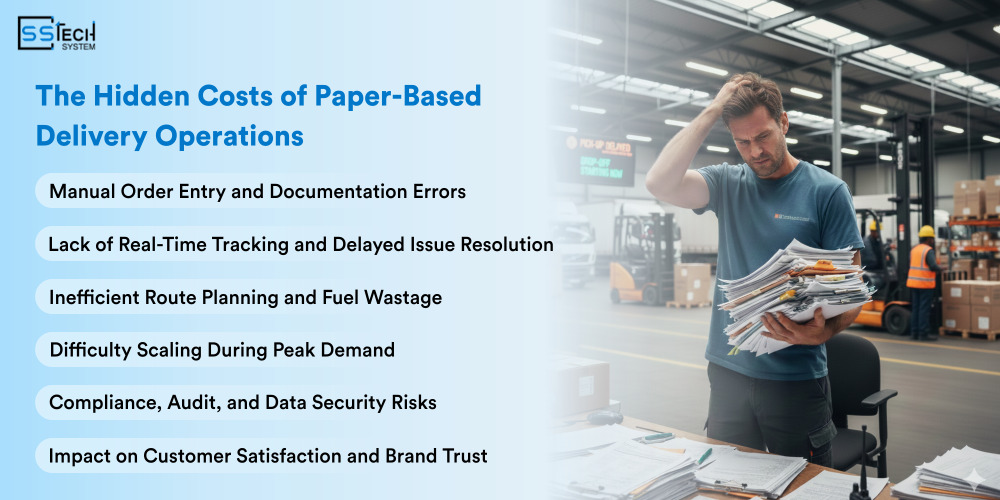
The paper looks cheap. But the real costs hide behind the scenes. The key hidden costs of paper-based delivery operations include:
Manual Order Entry and Documentation Errors
When orders are written or re-entered by hand, mistakes creep in. A wrong digit, a misspelled address, or missing delivery notes create failed attempts and re-deliveries. Every correction consumes time and labor.
These small oversights quietly increase operational expenses without you noticing.
Lack of Real-Time Tracking and Delayed Issue Resolution
Your team depends on calls and messages to find parcel status. By the time an issue surfaces, the delivery has already gone wrong. And support teams react instead of preventing problems.
This reactive approach turns minor delays into costly service failures.
Inefficient Route Planning and Fuel Wastage
Paper-based routing forces drivers to follow static plans. And when the traffic conditions change, or priorities shift, your routes can’t adapt. Due to this, your drivers travel longer distances and burn more fuel than necessary.
Hence, fuel and time become recurring hidden costs that never show on paper, but hit your margins.
Difficulty Scaling During Peak Demand
When shipment volumes spike, manual processes collapse. This leads to more paperwork, more phone calls, and more confusion.
On top of that, your team struggles to keep up, and customer complaints rise. So, scaling becomes expensive because your system is not built to grow.
Compliance, Audit, and Data Security Risks
Regulators expect clear records, time stamps, and digital trails. But paper logs get lost, damaged, or accidentally altered. Due to this, audits take longer and expose your business to penalties or mistrust.
Plus, the cost of non-compliance often appears only when it’s too late.
Impact on Customer Satisfaction and Brand Trust
Customers expect instant updates and proof of delivery. When they can’t track shipments, frustration grows, support queues increase, and repeat business declines.
Revenue loss from unhappy customers is one of the biggest hidden costs in courier operations.
Key Drivers Pushing Courier Companies Toward Digital Transformation in 2026
Several forces are reshaping your industry and pushing your courier business towards digital transformation in 2026. They are:
Rising Customer Expectations for Real-Time Delivery Updates
Customers don’t want vague delivery windows anymore. They want live tracking, accurate ETAs, and instant notifications. And companies that cannot provide this transparency feel outdated fast.
Whereas digital platforms make visibility the default, and customers now expect nothing less.
Increased Competition from Tech-Enabled Logistics Providers
New-age logistics players operate with automation, AI routing, and smart dashboards. They deliver faster and with fewer errors. Traditional courier companies struggle to match this performance when they rely on paper.
Hence, digital transformation becomes a competitive necessity, not an optional upgrade.
Growing Focus on Sustainability and Paperless Operations
Businesses and governments are prioritizing environmental responsibility. Paper-heavy workflows create waste and increase operational overhead.
So, moving to digital records and ePOD supports sustainability goals while reducing administrative work.
Moreover, paperless operations help you save costs and strengthen your brand reputation.
Workforce Productivity and Driver Experience Improvements
Drivers spend less time dealing with paperwork and more time completing deliveries. Plus, operations teams receive structured data, quick insights, and fewer manual interventions.
And the entire delivery chain becomes smoother.
This way, digital tools empower your team instead of slowing them down.
Regulatory Compliance and Digital Record-Keeping Mandates
Authorities are increasingly pushing for traceable, digital proof of deliveries. And audits require accurate logs, timestamps, and documentation trails. In addition to that, paper records cannot provide this reliability at scale.
On the contrary, digital systems make compliance easier, faster, and far more secure.
Step-by-Step Roadmap to Move From Paper to Digital
Transforming courier operations does not need to be overwhelming. You modernize step by step. You remove the friction layer by layer. And you focus on impact.
Digital transformation is not about replacing everything at once. It is about building capability, one phase at a time.
Let’s look at these phases in brief:
Phase 1: Audit Current Delivery Processes
Plus, you evaluate:
- Manual order capture
- Dispatch workflows
- Driver communication
- POD collection
- Reporting flow
And you identify friction instead of guessing. For that, you need to identify bottlenecks and failure points:
- You look for repeated delivery delays
- You analyze support complaints, and
- You track routes where drivers lose time
These patterns reveal where modernization matters first.
Phase 2: Clean and Standardize Operational Data
Your transformation depends on clean data. So, addresses, contact numbers, parcel entries, everything must be structured.
You must standardize formats, reduce duplication, and ensure every parcel travels with correct information. This improves automation success from day one.
For that, you need to do address accuracy and contact validation. Because incorrect addresses cause route failures. Plus, wrong phone numbers cause escalations.
Data validation tools eliminate those gaps.
Phase 3 – Digitize Proof of Delivery First
Digitizing POD creates immediate value.
- Drivers capture signatures digitally.
- Photos verify drop-offs.
- Time stamps prove accuracy.
This also makes billing faster and reduces disputes dramatically. You get early internal wins too, as your team starts trusting digital tools.
Why ePOD Delivers the Fastest ROI?
ePOD reduces administrative work, strengthens accountability, and accelerates invoice cycles.
In turn, you see profit improvement quickly.
Phase 4: Introduce Real-Time Tracking and Routing
Next, you enable GPS-based tracking and AI-driven route optimization.
Through this:
- Drivers get optimized routes.
- Operations teams see live parcel movement.
- Customers receive instant updates.
- And Efficiency becomes measurable.
Phase 5: Measure, Optimize, and Scale
At this stage, you analyze metrics, fix gaps, and expand digital tools across regions.
Remember the idiom: Rome was not built in a day?
Similarly, digital courier transformation improves progressively. You modernize, you refine, and you scale gradually plus confidently.
Core Digital Technologies Transforming Parcel & Courier Operations
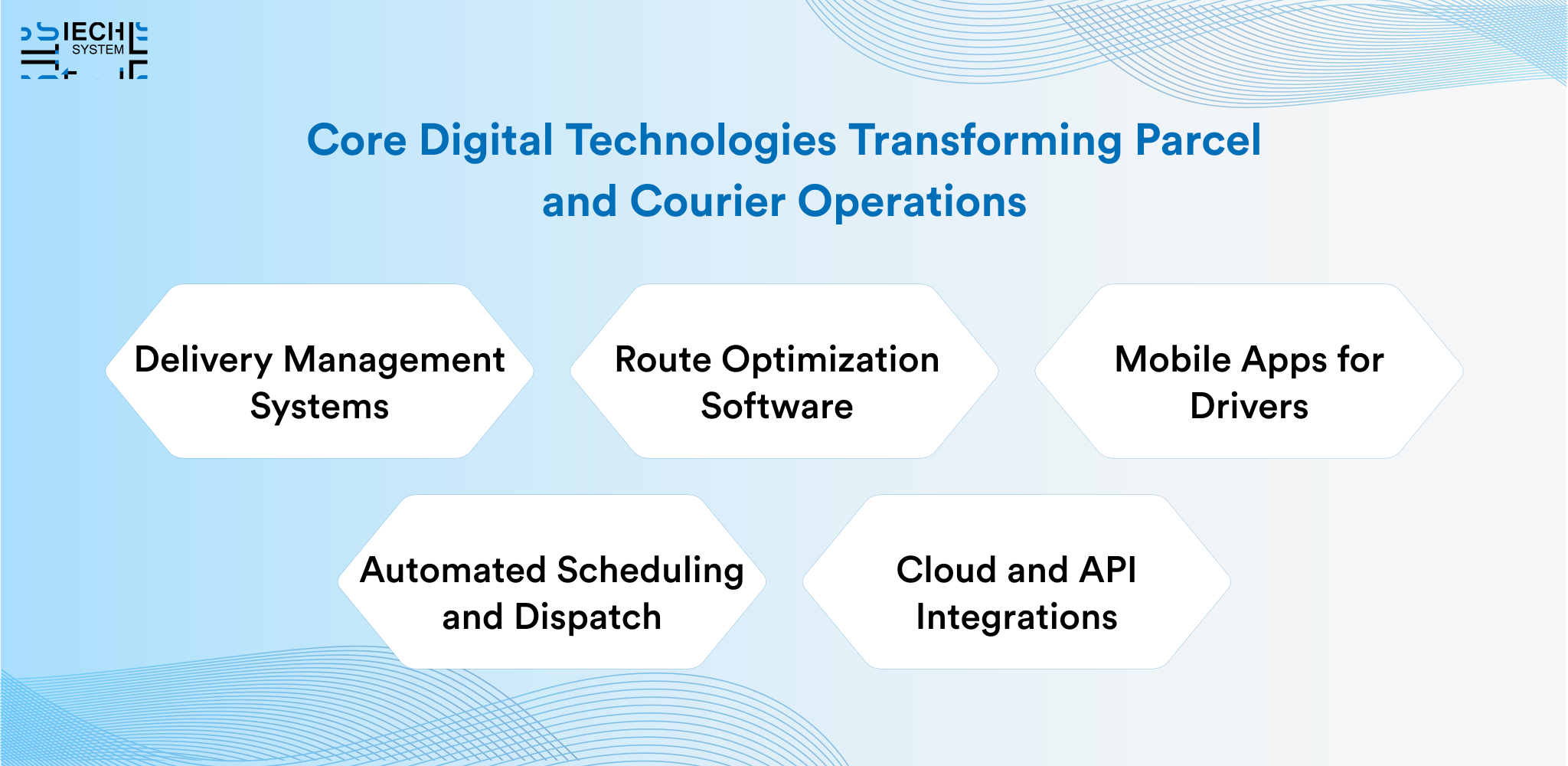
Digital transformation depends on the right tools. Each technology removes one major bottleneck from your operations.
The core technologies transforming parcel and courier operations are:
Delivery Management Systems (DMS)
A Delivery Management System acts as your single command center. All orders, dispatch statuses, and delivery workflows stay in one place. You see who is delivering what, where delays occur, and which routes are performing best.
With one platform controlling operations, you remove guesswork and improve decision-making.
Route Optimization Software
Manual routing depends on assumptions. Whereas, AI route optimization uses traffic patterns, delivery windows, load capacity, and distance data to find faster routes automatically.
Due to this, even the drivers have to spend less time idling and more time completing deliveries.
Plus, you reduce fuel costs and improve on-time performance without increasing fleet size.
Mobile Apps for Drivers
Driver apps replace paper manifests and constant phone calls. So, drivers receive tasks digitally, capture signatures, upload images, and update delivery status instantly.
Plus, navigation support and in-app messaging keep everything smooth. This way, your drivers stay connected, confident, and accountable throughout each delivery.
Automated Scheduling and Dispatch
Automated dispatching assigns jobs based on proximity, capacity, priority, and SLA commitments. Hence, the urgent orders get the right attention. And recurring deliveries follow optimized patterns instead of manual planning.
This creates balance across your fleet and removes bottlenecks during busy hours.
Cloud and API Integrations
Courier systems must talk to ERPs, CRMs, marketplaces, and warehouse tools. Cloud-based APIs integrate everything, so data flows automatically instead of being re-entered.
This way updates sync across platforms in seconds. And you gain real-time visibility across your ecosystem and eliminate duplicate work.
Read more: How to Develop an On-Demand Delivery App for Your Business
AI & Data Analytics: Enabling Smarter Delivery Decisions
AI is transforming logistics intelligence. Here’s how it’s enabling smarter delivery decisions:
AI-Powered Decision Intelligence in Logistics
AI analyzes millions of delivery patterns and makes recommendations faster than any manual process. It highlights risks, bottlenecks, and opportunities in real time. Plus, you get proactive insights instead of reactive firefighting.
Predictive Delivery Time Estimation
Machine learning uses historical trips, traffic trends, and driver performance to calculate accurate ETAs. With it, your customers receive realistic timelines and fewer unexpected delays. And your support team handles fewer complaints.
Demand Forecasting and Resource Allocation
AI predicts busy periods, seasonal peaks, and delivery hotspots. You allocate drivers, vehicles, and capacity before demand spikes hit your network. This helps you avoid last-minute chaos and high overtime costs.
Performance Dashboards and KPI Tracking
Data dashboards convert raw numbers into visual insights. This way, you can track on-time rates, failed deliveries, idle time, and driver productivity at a glance. And patterns become visible and easier to manage.
Data-Driven Continuous Optimization
Analytics do not stop after one improvement. The system keeps learning from every delivery and suggests new optimizations over time. And your operations become smarter, leaner, and more predictable with every cycle.
Security, Compliance, and Reliability in Digital Courier Systems
Digital courier tools must protect sensitive data. Hence, they must follow security, compliance, and reliability factors like:
Data security and access control
Your delivery platform holds sensitive customer, shipment, and billing data. Hence, you need encryption across every layer and strict authentication to keep unauthorized users out.
Strong access control stops internal leaks before they start.
Role-based permissions
Not every stakeholder should see everything in your system. Drivers, dispatchers, finance teams, and admins all need different levels of access.
And role-based permissions ensure people only view the data required to do their job, thereby reducing mistakes and preventing misuse.
Compliance with regional logistics regulations
Couriers today operate across borders, industries, and regulatory frameworks. Digital systems help you meet rules around data retention, privacy, e-invoicing, and transport records automatically. Plus, fewer manual records mean fewer compliance risks.
Audit trails and digital documentation
Every order, update, and delivery attempt should leave a timestamped trail. Audit logs protect your business when disputes arise and make investigations faster. Clear digital records also simplify partner audits and internal reviews.
Business continuity and uptime assurance
Your delivery operation cannot afford downtime. Cloud-based courier systems provide redundancy, automated backups, and disaster recovery.
If something breaks, operations fail over automatically so your drivers keep moving and customers stay informed.
Business Benefits of Going Paperless by 2026
Paperless operations reshape your business performance in 2026. The key benefits include:
Faster delivery cycles: Digital workflows remove manual paperwork, so orders move from booking to dispatch instantly. Your teams act in real time instead of waiting on forms, signatures, or manual updates.
Reduced operational costs: Paper-based tasks consume time, storage, fuel, and rework. Automation cuts repetitive processes and eliminates expensive mistakes across billing, dispatching, and reconciliation.
Improved delivery accuracy: Drivers get clear digital instructions, optimized routes, and ePOD validation at every stop. And fewer manual entries mean fewer wrong addresses, failed deliveries, and reverse trips.
Enhanced customer satisfaction and retention: Customers track parcels live, receive proactive alerts, and get faster resolutions when issues occur. And a transparent delivery experience keeps them coming back, instead of switching providers.
Scalability for multi-city and cross-border operations: Once processes are digital, adding new hubs, drivers, or regions becomes simpler. And you scale through configuration instead of hiring more admin staff or printing more paperwork.
Environmental and sustainability benefits: Removing paper reduces waste and supports eco-friendly operations. Many enterprise clients now prefer courier partners who show measurable sustainability progress.
Real-World Use Cases: How Courier Companies Are Modernizing
The real-world examples are making the real world buzz about the courier companies going paperless:
- Urban couriers use digital routing to manage dense city zones. They complete more deliveries in fewer hours.
- Inter-city parcel services automate POD. They accelerate billing and ensure transparent documentation.
- B2B couriers rely on dashboards. Enterprise clients receive real-time shipment tracking.
- E-commerce delivery networks integrate warehouses, marketplaces, and courier systems into one unified visibility layer.
Challenges in Digital Transformation & How to Overcome Them
The process of digital transformation can be tricky. However, it’s solvable. Let’s see how!
Resistance to change from drivers and staff
People worry new systems will slow them down or replace their roles.
You overcome this with training, clear communication, and quick wins that prove technology makes their day easier, not harder.
Integration with legacy systems
Older TMS, billing, or warehouse tools may not “talk” to modern platforms.
API-first software and phased integrations help you connect systems gradually without disrupting operations.
Data migration concerns
Years of historical data often live in spreadsheets, paper records, or disconnected tools.
A structured migration plan cleans, validates, and imports only useful data so your new system launches clean.
Budget and ROI justification
Leaders hesitate when they don’t see near-term payback.
Build a business case around reduced fuel, fewer failed deliveries, faster billing cycles, and lower support costs. Plus, numbers speak louder than opinions.
Selecting the right technology partner
The wrong vendor leaves you with rigid software and slow support. Look for partners with logistics expertise, configurable platforms, and a proactive roadmap so your investment grows with your business.
Read more: Challenges and Solutions in Logistics Digital Transformation
What to Look for in a Digital Delivery Software Partner
Choosing the right partner shapes how smoothly your transformation runs, and how future-proof it becomes.
Here’s what matters most when you evaluate vendors.
Logistics domain expertise
You don’t want a generic software vendor. You need a team that understands courier workflows, exceptions, SLAs, and real delivery pressure. When they “get” your world, implementation moves faster and solutions fit better.
Customization and scalability
Your operation will evolve: new services, new cities, new clients. Look for a platform that adapts to your processes instead of forcing you to adapt to it. Plus, configurable modules help you scale without rebuilding systems later.
API-first architecture
Your software must connect easily with ERPs, CRMs, eCommerce platforms, and warehouse tools. An API-first platform keeps integrations clean, reduces manual entry, and supports future partnerships without technical headaches.
Security and compliance readiness
Your partner should treat data like an asset, not an afterthought. Ask about encryption, role-based permissions, audits, and certifications. Because strong compliance practices protect you from fines, breaches, and reputation damage.
Long-term support and innovation roadmap
Digital transformation is not a one-time project. You want a partner who trains your teams, responds quickly, ships upgrades regularly, and invests in new features like AI and automation.
The Future of Parcel & Courier Operations Beyond 2026
The shift from paper to digital is only the beginning. What comes next will redefine how you plan, move, and manage every parcel on the road.
Here’s what the future looks like:
Autonomous routing and predictive logistics: Routing systems will anticipate delays before they happen and reroute automatically. Your teams move from reacting to issues to managing a network that largely runs itself.
AI-driven demand shaping: Instead of guessing capacity, AI will predict order surges by region, time, and customer type. You’ll align drivers, fleets, and hubs proactively, not in crisis mode.
Smart cities and connected delivery ecosystems: Traffic signals, parking systems, city logistics hubs, and courier platforms will share data. That means smoother last-mile delivery, fewer bottlenecks, and safer urban roads.
Sustainability-focused logistics innovation: Electric fleets, consolidated routes, and paperless workflows will become the norm. Environmental responsibility won’t just be a PR message; it will be a competitive advantage.
Read more: How Technology Is Transforming Supply Chains industry
Conclusion
Paper-based delivery processes worked when volumes were predictable and customers were patient. Today, courier operations move faster, involve more touchpoints, and demand real-time clarity.
When workflows stay on paper, problems linger longer, drivers wait longer, and customers feel the impact. And going digital is not about chasing trends. It’s about removing friction from everyday operations and giving your teams reliable tools that actually help them do their jobs.
The path forward is practical. Start with visibility, digitize proof of delivery, introduce smarter routing, then expand across routes, hubs, and partners. Step by step, you create a delivery operation that feels organized, transparent, and easier to scale.
The good news is: At SSTech System, we help courier and logistics businesses make this shift without disruption or confusion. Our approach focuses on real-world implementation, not buzzwords.
If you want clearer processes, fewer disputes, and happier customers, connect with our expert team. We’ll walk through your goals and guide you toward a confident, paperless future.
Frequently Asked Questions
It depends on your scope. If you start with ePOD and tracking, you can see results in weeks. A full rollout across hubs typically happens in phases, so you modernize without disrupting daily deliveries.
Begin with proof of delivery and real-time visibility. These two areas reduce disputes, speed up billing, and build trust inside your team. Once they stabilize, you move into routing, automation, and integrations.
Yes. Smaller courier businesses often benefit the fastest because they remove paperwork early. You gain control over costs, deliveries, and customer communication without adding extra admin staff.
Keep it simple. Provide short app training, clear SOPs, and hands-on support during the first week. When drivers see fewer calls, less paperwork, and faster trips, adoption happens naturally.
Track failed deliveries, route time, billing cycle time, customer complaints, and driver productivity. When these numbers improve, you know your digital transformation is working and worth expanding.
Related Article