



Warehouse efficiency in contemporary supply chains is a direct factor in the success of your business in serving its customers. As customers demand faster delivery of goods and orders with no mistakes, even the smallest inefficiencies in warehouse processes can result in significant losses.
Order picking, RFID warehouse management, and fulfilment are among the most critical areas where businesses do not excel. Picking mistakes, slow deliveries and ineffective inventory visibility have the potential to interfere with the whole supply chain.
Conventional warehouse operations like real-time inventory tracking, IoT in warehouse management tend to rely heavily on manual labor, document-based systems, or non-integrated tools, increasing the risk of errors.
This is where a Warehouse Management System (WMS) would be needed. The WMS automation software introduces automation, real-time visibility and smart workflows to the warehouse. It is made sure that all the products are properly traced, each order is picked correctly and each shipment arrives on time.
What Is a Warehouse Management System (WMS) & How It Works?
A Warehouse Management System (WFS) is a specialized software platform that assists you in managing, controlling, and optimizing all warehouse operations in real time. It is the very heart and the key that links inventory, workforce, and order tracks into one smooth workflow.
Also, it helps with different modules such as inventory management system, warehouse operations management, smart warehouse software, supply chain warehouse management, distribution center management system, cloud warehouse management system, warehouse picking system, and barcode picking system.
Warehouse management system market is projected to grow from USD 4.57 billion in 2025 to USD 10.04 billion by 2030, registering a CAGR of 17.1%. In contrast to simple inventory-related tools, a warehouse management system software is more comprehensive, as it controls the movement of goods within the warehouse to make processes such as receiving inventory and loading orders efficient and error-free.

How To Reduce Warehouse Fulfillment Time?
Upon receiving inventory at your warehouse, the warehouse management software will record it and automatically place it in the best locations based on predetermined rules, such as product type, frequency of use, and available space.
Once orders are received, the system automatically takes them and gives picking instructions. The warehouse workers are given direct instructions on what and where to pick and in which order and very often through handheld devices.
Here’s how its core functions work together:
Inventory Tracking:
WMS continuously tracks stock levels, locations, and movements. This eliminates stock discrepancies and ensures accurate inventory records.
Order Management:
Orders are automatically captured, prioritized, and assigned. Urgent or high-value orders can be processed faster.
Picking Optimization:
The system calculates the most efficient picking routes, reducing travel time and improving productivity.
Barcode / RFID Scanning:
Each item is verified using scanning technology, ensuring the right product is picked every time.
Real-Time Reporting:
Managers gain instant visibility into warehouse performance, helping them make data-driven decisions.
Challenges in Manual Picking and Order Fulfillment
Lack of 3PL warehouse management software means that warehouses most of the time are relying on manual processes that are easily susceptible to inefficiency and error. These obstacles not only drag the processes but pose long-term business risks.
Cost Impact
Picking by hand makes labor more dependent and less efficient. Employees waste time in locating items, rectifying errors and responding to returns.
Misplaced products, wrong quantities, and choosing the wrong product are just a few examples of errors that result in extra expenses of re-shipping, reverse logistics and customer support.
Customer Dissatisfaction
Poor deliveries or delayed deliveries have a direct impact on customer experience. Customers who are getting products that are not correct or there is a delay in the delivery of the product mean less trust in your business.
Returns & Rework
There are higher rates of returns, which are caused by manual errors. Inventory that has been returned should be checked, replenished, or substituted, which puts additional pressure on your workforce.
How WMS Improves Picking Accuracy
Improving picking accuracy is one of the biggest advantages of implementing a WMS. The system uses automation, picking optimization in warehouse and real-time data to minimize human errors. But, all these features can be achieved only if you hire logistics software development services from expert companies.
Real-Time Inventory
Under WMS, you will have no doubt about the place and the quantity of each product in your warehouse. This makes it very easy to understand and pickers do not spend resources searching for products.
Barcode and RFID Scanning
The technology of scanning makes sure that any item is checked at different points of picking, packing and shipping.
Guided Picking Processes
WMS offers electronic pick lists and instructions. This eliminates reliance on the worker memory or experience.
Automated Order Validation
WMS always verifies the presence and correctness of all items before an order is completed. This will eliminate manual verification and ensure customers see what they ordered.
Smart Slotting and Location Management
WMS is used to organize products strategically in accordance with demand patterns. Most of the frequent products are located in spots that are easily reachable.
How WMS Reduces Fulfillment Time
In addition to accuracy, WMS significantly speeds up order fulfillment by optimizing every step of the process.
Optimized Picking Routes
WMS calculates efficient and shortest routes of pickers. The workers do not move randomly, but in an organized direction that saves them time.
Automated Order Processing
There is a collection and processing of orders automatically without any human intervention. Assigning tasks to the system is instant and minimizes delays and orders flow in the fulfillment pipeline very fast.

Wave Picking and Batch Picking
WMS enables picking multiple orders at the same time in batch picking, or collecting into waves based on priorities.
Faster Packing and Shipping
On-point picking eliminates re-checking items during packing. The simplified workflow enables packing teams to take shorter time to process orders and be ready to dispatch them without wasting time.
Reduced Operational Delays
On-the-fly reporting and automation are useful in determining and removing bottlenecks. It can be a lack of stock or workflow issues, but WMS ensures efficient system operation as issues are addressed immediately.
Advanced WMS Capabilities
Contemporary WMS systems are much more sophisticated than simple inventory management tools and order processing mechanisms. These functions assist you in shifting away the reactive decision-making of your business to being predictive and strategic.
AI-Based Demand Forecasting
The AI-driven WMS solutions process high volumes of past sales records, seasonal patterns, consumer patterns and market dynamics to make sound predictions of future demand.
This allows you to:
- Maintain optimal inventory levels across different SKUs
- Reduce excess stock that ties up working capital
- Avoid stockouts that can disrupt order fulfillment
- Improve procurement planning and supplier coordination
Predictive Analytics
Warehouse analytics software tools constantly observe the workings of the warehouse and pinpoint trends that can be used to reveal the presence of inefficiencies of possible disruption in the future.
For example, the system can detect:
- Slow-moving inventory that may need repositioning
- Bottlenecks in picking or packing workflows
- Repeated errors in specific warehouse zones
- Labor inefficiencies or underutilized resources
Top WMS Software Solutions in the Market
Selecting an appropriate WMS from a custom software development services provider is a very important choice that directly affects your warehouse performance and scalability.
Here are some of the leading WMS platforms:
SSTech WMS:
A robust and scalable warehouse management solution designed to optimize end-to-end warehouse operations. SSTech WMS focuses on improving picking accuracy, inventory visibility, and order fulfillment speed through automation and real-time data tracking.
SAP Extended Warehouse Management (EWM):
A highly robust WMS for retail warehouses designed for large-scale and complex warehouse environments. It offers advanced automation, real-time visibility, and deep integration with SAP ERP systems.
Oracle WMS Cloud:
A scalable, cloud-based platform that provides strong automation capabilities, real-time tracking, and easy deployment, making it suitable for growing businesses.
Manhattan Associates WMS:
Known for its advanced supply chain optimization features, this platform supports complex distribution networks and high-volume operations.
Infor WMS:
Offers industry-specific configurations and flexible deployment options, making it suitable for diverse industries such as manufacturing and retail.
Microsoft Dynamics 365 WMS:
Seamlessly integrates with Microsoft’s ERP ecosystem, providing a unified platform for managing warehouse and business operations.
Softeon WMS:
A highly configurable solution that adapts to unique warehouse workflows and supports both simple and complex operations.
Fishbowl Inventory:
Ideal for small to mid-sized businesses, offering essential features of warehouse management software at a lower cost.
NetSuite WMS:
A cloud-based solution integrated with NetSuite ERP, providing end-to-end visibility and control over warehouse operations.
Blue Yonder WMS:
Leverages AI and machine learning to deliver predictive insights and advanced automation for large-scale operations.
Zoho Inventory:
A user-friendly and cost-effective option for small businesses, offering basic inventory and order management capabilities.
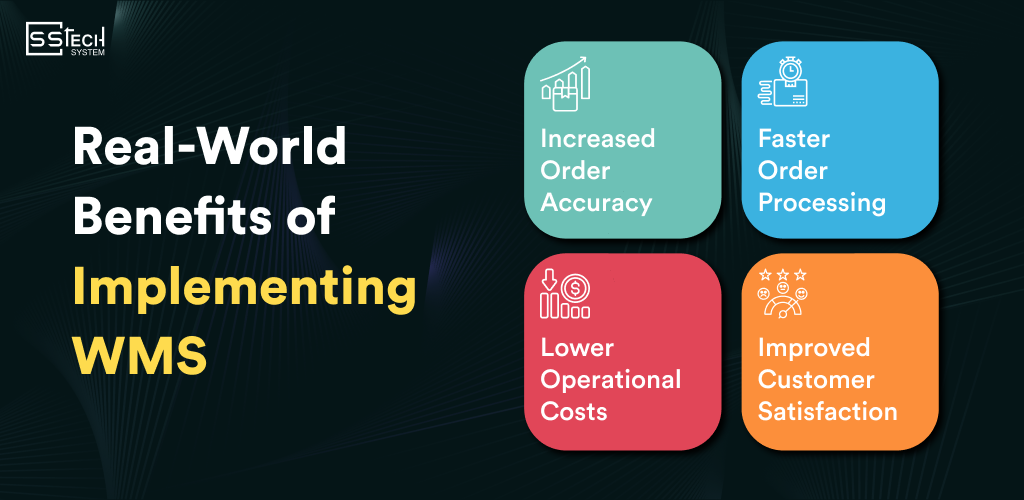
Real-World Benefits of Implementing WMS
The deployment of a WMS provides quantifiable benefits in various areas of warehouse activities. These not only improve efficiency but also improve long-term business growth.
Let’s check how WMS improves warehouse efficiency:
Increased Order Accuracy
WMS minimizes human errors through automation, barcode scanning, and system-driven validation.
As a result:
- Incorrect shipments are significantly reduced
- Order discrepancies are minimized
- Quality control processes become more reliable
This leads to higher accuracy rates and fewer customer complaints.
Faster Order Processing
The warehouse management software for e-commerce speeds up the overall process of filling orders with streamlined workflows, automated task distribution, and path-efficient picking paths. Orders are processed fast, from picking to packing to shipping, which allows you to process more orders at the same labor cost.
Lower Operational Costs
By reducing errors, improving labor productivity, and optimizing inventory management warehouse automation technology helps lower overall operational expenses.
Read more: How AI is Transforming Warehouse Automation?
You can achieve:
- Reduced rework and return handling costs
- Better utilization of warehouse space
- Lower dependency on manual processes
These savings directly improve your bottom line.
Improved Customer Satisfaction
Timely deliveries and accuracy of deliveries are important in building customer trust. When using WMS, it is always possible to deliver on promise, minimize order errors, and offer a smooth customer experience. This generates loyal customers and business repetitions.
Industries That Benefit Most from WMS
WMS does not apply to a single industry it brings value to a variety of industries which need efficient order and inventory management.
E-commerce and Retail
The E-commerce companies have large order volumes, high return rates and rapid delivery requirements. Order picking software solves these challenges by ensuring accurate picking, speeding up order processing, and improving inventory control. It helps businesses reduce errors, increase efficiency, and maintain real-time visibility across warehouse operations.
Manufacturing
AI warehouse management is used by manufacturers to control the raw material, work-in-progress retail, and finished goods. It ensures a steady production flow and proper inventory management.
Third-Party Logistics (3PL)
Several clients have inventory managed by 3PL providers. WMS allows them to handle complex operations, maintain accurate records, and provide real-time visibility to consumers.
Hospital and Pharmaceuticals
Accuracy is vital in this industry. The WMS will efficiently track the sensitive products, adhere to the regulations and correctly fulfill an order. Also, last-mile delivery software and route optimization software can help deliver the best-in-class and quick delivery at the required place.
Wholesale Distribution
Wholesalers handle large volumes of inventory and orders. Delivery management system and courier management software both assist in optimization of storage, picking and shipping, making the whole more efficient.
How to Choose the Right WMS for Your Business Offered by a WMS software development company?
Selecting the right WMS requires careful evaluation of your business needs, operational complexity, and future growth plans.
Warehouse Size and Complexity
Consider the size of your warehouse, the number of SKUs, and the complexity of your operations. A small warehouse may need a simple system, while large operations require advanced features.
Integration with ERP and E-commerce Platforms
The warehouse software for logistics companies should seamlessly integrate with the existing systems, such as ERP, CRM, and e-commerce platforms. This ensures smooth data flow and eliminates manual data entry.
Scalability and Automation Capabilities
Choose a solution that can grow with your business. As your operations expand, your WMS should support increased volumes and advanced automation features.
Ease of Use and Implementation
A user-friendly system reduces training time and improves adoption among employees. Additionally, consider the implementation timeline and support provided by the vendor.
Cost and ROI
Evaluate both the initial investment and long-term benefits. A smart warehouse solution should deliver measurable ROI through improved efficiency, reduced errors, and cost savings.
Conclusion
A logistics warehouse management software is an effective tool that can revolutionize warehouse operations by introducing automation, accuracy, and efficiency. It is essential for enhancing picking accuracy and reducing fulfillment time, which are two of the most essential aspects of contemporary supply chain management. Both of these operations can become easier with automated picking solutions and warehouse order fulfillment software simultaneously.
With logistics automation solutions, your business will be able to work more efficiently, reduce its errors, and provide real-time visibility, allowing it to meet the increasing customer expectations. In the modern competitive environment, implementing a WMS is not only about optimizing work and organizing business processes but also about creating the business of tomorrow.
By ensuring that you have the right system, you will be in a position to enjoy faster order fulfillment, reduced costs of operation, as well as increased customer satisfaction, which puts your business in a position of success in the long run.

Frequently Asked Questions
WMS software is designed to manage and optimize warehouse operations, ensuring accurate inventory tracking, efficient picking processes, and faster order fulfillment.
WMS improves accuracy through real-time inventory visibility, barcode/RFID scanning, guided picking instructions, and automated order validation.
Yes, WMS reduces costs by minimizing errors, improving labor efficiency, optimizing storage space, and reducing returns and rework.
Yes, many cloud-based WMS solutions are specifically designed for small and growing businesses, offering affordability and scalability. To leverage the full benefits of it you should hire a professional enterprise WMS solutions provider.
Implementation timelines vary depending on the complexity of the system and business requirements, but typically range from a few weeks to several months. Connect with industry professionals to set the timeline for warehouse management system development.
Related Article