


The current warehouses are driven by speed, precision, and customer demands which are ever-increasing. Same-day shipping, omnichannel delivery, and precise delivery assurances cease to be competitive assets, and they have become a prerequisite.
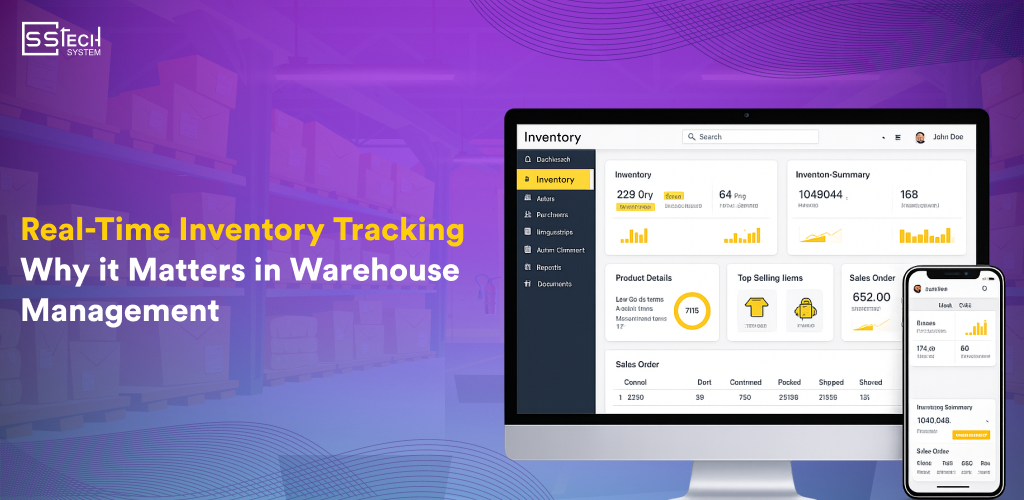
Visibility in terms of stock level is not a back-office operation in this landscape; it is the foundation of the operational performance. A real-time inventory tracking system helps organizations to keep track of the movements of stock right after they transpire.
Whether inventory received, moved, picked, packed, or shipped, the system is updated within seconds, and this establishes a synchronized stream of information between the floors of the warehouse and online digital platforms. Without this level of visibility, warehouses operate by delayed or incomplete data, which creates risk at each step of fulfillment.
In the center of the contemporary warehouse inventory management, efficiency and transparency are concerned with the accuracy of the operations and how efficiently a facility can address demand within control cost. The visibility of inventory influences all of it, including picking paths and stock replenishment, shipping plans and budgeting. In competitive supply chains, precision is performance.
The Growing Need For Real-Time Accuracy Across Supply Chains
Supply chains are no longer linear. Products move between suppliers, manufacturers, distribution centers, micro-fulfillment hubs and last-mile carriers.
This intricacy of this movement renders real-time inventory tracking not just useful, but essential. The global inventory management software market size was valued at USD 3.9 billion in 2024 and is estimated to register a CAGR of 6.4% between 2025 and 2034.
The modern warehouses need synchronized data between a warehouse management system (WMS) and upstream and downstream systems. The inventory decision in one location influences the results of fulfillment in other places. Any hold up in updating stock in one warehouse can spill over to other backorders in another warehouse.
The change in management ideology when organizations implement the WMS software solutions is that the management is no longer expected to respond to changes but to anticipate them. Leaders require live dashboards, predictive alerts and precise system-to-floor alignment. Agile strategies of supply chain are no longer supported by reporting of static inventory.
Besides, distributed storage models and omnichannel retail mean that a company requires a warehouse inventory tracking system that guarantees proper allocation in various locations. Real-time data eliminates uncertainty and enables smarter decisions on replenishment, routing, and customer communication decisions.
Why Traditional Inventory Tracking Falls Short Across Industries
Even though the digital infrastructure has advanced, a large part of the warehouses still utilizes old methods. These old systems are not able to provide the speed and accurateness that is demanded by the new operations.
Manual updates and batch processing delays are common weaknesses. Discrepancies are made when stock adjustments are made at end of shifts or processed during the night. This weakens inventory control in warehouse environments and is likely to create chances of fulfillment errors.
There is also lack of visibility in several facilities, which is another complication. Businesses with regional distribution centers in most cases do not have an integrated dashboard that gives a clear picture of comprehensive inventory visibility in warehouses. Disconnected systems lead to information silos, reducing responsiveness.
Another challenge is inconsistency of data on platforms. Financial records and physical inventory counts go off track without an adequate ERP and inventory integration. The outcome is discrepancies in accounting, procurement mistakes and inaccurate reporting.
Traditional systems also lack effective warehouse software integrations and thus it becomes hard to integrate with transportation platforms, order management tool, and supplier systems. Such disintegration weakens decision-making and slows operational workflows.
Ultimately, delayed and fragmented data compromises inventory tracking in warehouse management, preventing organizations from operating with confidence.

What Real-Time Inventory Tracking Enables For Modern Warehouses
Modern warehouses require live synchronization between digital systems and physical stock. The resilient real-time stock tracking system will ensure that all scan, movements, and transactions are instantly recorded and reflected across platforms.
Live stock visibility at item, location and batch levels enables teams to track inventory in minute detail. This enhances inventory accuracy in warehouses and assists the enhanced replenishment models. The global warehouse management system market is projected to grow from USD 4.57 billion in 2025 to USD 10.04 billion by 2030, registering a CAGR of 17.1%
Constant update of the inbound and outbound processes enhances coordination. From receiving docks to shipping bays, teams rely on real-time inventory data to make informed operational decisions.
Accurate system-to-floor alignment is critical for operational trust. With the matches between the digital records and the physical stock, managers can be sure that they plan picking waves and dispatch schedules. The use of integrated inventory tracking software is a way of making sure that the updates are synchronized without manual intervention.
Precision is further increased with advanced technologies like barcode inventory tracking and RFID inventory tracking. These tools can be used together with a cloud-based inventory management system to allow remote access to synchronized inventory records on a scale.
The automated inventory tracking helps warehouses to minimize the use of entry done manually and minimize errors. This automation improves reliability while freeing teams to focus on higher-value activities.
Operational Impact On Different Industries
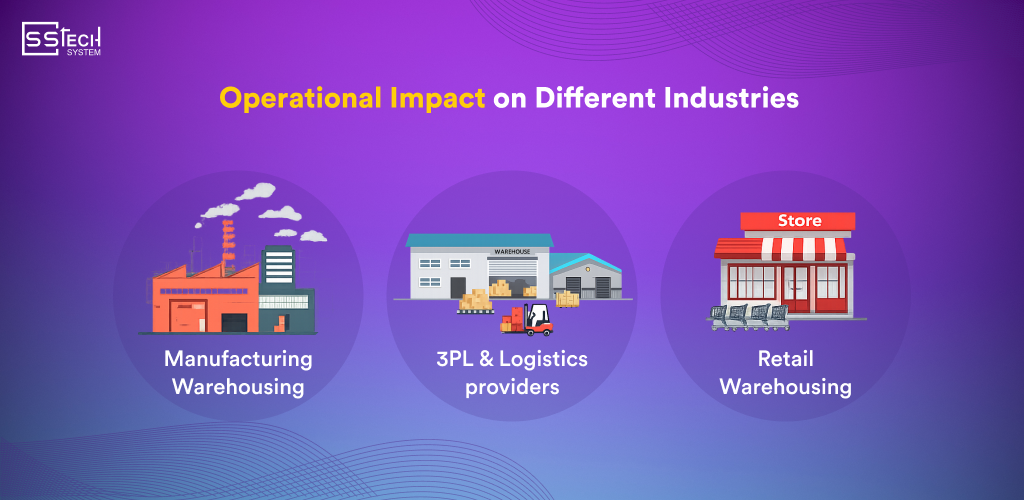
Retail warehousing
Speed and precision are crucial as far as retail operations are concerned. Retailers are faced with the issue of having to maintain correct stock levels in numerous nodes due to the omnichannel models and distributed fulfillment networks. A unified warehouse stock management software platform supports consistent allocation and order processing.
Retailers also benefit from strong warehouse-to-delivery coordination, where the fulfillment centers and the transportation networks will be synchronized. Available updates in real-time aid in the fulfillment and delivery optimization, eliminating delays and enhancing on-time performance.
Manufacturing warehousing
Manufacturers need close coordination between the production schedules and material availability. Through inventory tracking with ERP integration, production planners can align raw material availability with manufacturing timelines.
Effective tracking benefits the warehouse operations management, as it makes sure that the components are staged and replenished effectively. It has a reliable system that facilitates just-in-time operation and minimizes downtime due to discrepancy in stocks.
3PL and logistics providers
The third-party logistics companies serve several clients at a time. Service-level agreements are all about visibility and accuracy. Through the proper WMS and TMS integration, logistics providers coordinate storage and transportation seamlessly.
Better transportation and warehouse integration means that the schedule of dispatch is made in line with stock availability. In real-time tracking, high-volume operations and multi-client reporting environments are supported.
Financial and Cost Control Benefits Across Sectors
One of the major benefits of Real-Time Inventory Tracking System is that it has a direct financial influence. Through keeping proper stock levels, an organization can reduce stockouts and overstocking which would lead to a reduction in the number of lost sales and in the excess carrying costs.
Lower inventory holding costs contribute to warehouse cost optimization. When companies keep the right amount of stock, they eliminate unnecessary storage expansion and reduce capital tied up in idle inventory.
Better visibility helps in inventory optimization such that the levels of inventory match with the demand trends. Less waste through the expired or obsolete products increases profitability.
Better data also improves cash flow management. Companies do not resort to a reactive purchase and emergency delivery when the procurement and replenishment decisions will be made based on the reliable information.
Supporting Scalability And Business Growth
Expansion brings about complexity. Scalability needs a trusted data infrastructure whether it is the need to expand geographically or to increase production capacity.
Retail expansion
It is necessitated by the ability to see the system with consistency on the addition of new stores or fulfillment centers. A scalable warehouse management system development strategy will allow the inclusion of new locations without any problems.
Real-time information will guarantee accuracy in replenishment during the spikes of the seasonal demand and decrease operational burden. Strong inventory and logistics software infrastructure eliminates failure during peak periods.
Manufacturing growth
The process of expanding the production lines requires coordinated material planning. Reliable tracking will make sure that supplier variability and lead times are recorded correctly. Integrated logistics software solutions support coordinated inbound shipments.
3PL client growth
A single platform makes the process of onboarding new clients more efficient. Providers can use custom logistics software development to tailor workflow to the needs of various clients without compromising on accuracy.

Improving Customer Experience And Service Reliability
Fulfillment performance is directly related to customer expectations. The correct stock visibility helps in faster order fulfillment, ensuring orders are processed without delay.
Increased supply chain visibility will enable companies to provide accurate delivery schedules and proactive updates. By enabling better inventory visibility for last-mile delivery, the companies reduce missed deliveries and unplanned delays.
Trust comes with reliable data on inventory. Satisfaction and loyalty are enhanced when customers get proper shipping confirmations and deliveries that are also made on time.
Data-Driven Decisions By Industry
Demand forecasting and SKU optimization of retailers is done by real-time tracking. Organizations that manufacture their products balance production with material availability. 3PL providers compare performance between facilities and customers.
Through the provision of end-to-end supply chain visibility, business organizations will have the benefit of information that is not limited to the walls of the warehouse. The decision-makers are able to compare trends, detect the bottlenecks and streamline the operations using the right data in real time.
When supported by the best real-time inventory tracking software, analytics dashboards provide actionable insights rather than static reports.
Compliance, Traceability, And Risk Management
Compliance with the regulations needs extensive traceability. An effective warehouse management system (WMS) will make sure that the batch numbers, expiration dates, and lot histories are properly recorded.
The live tracking minimizes loss, theft, and misplacement since good audits are kept. The organizations can be able to isolate the affected inventory within a short time in case of recalls or quality problems, which restricts the operational disruption. Increased tracking facilitates risk reduction efforts and audit preparation in regulated fields.
Best Practices For Industry-Specific Implementation
Implementation starts with well-set visibility objectives. Organizations need to know the reason why real-time inventory tracking is important in their operating environment.
It is important to select scalable systems that have high levels of integration. Real-time inventory tracking in warehouse management systems are essential to have smooth data flow among interconnected tools.
Workflows and accountability training enhance inventory accuracy in warehouses. Data integrity is enhanced through regular scanning, verification and performance monitoring.
Finally, the organizations ought to measure the benefits of real-time inventory tracking in warehouses using KPIs that are associated with cost savings, accuracy rates, and services. Understanding how real-time inventory tracking improves warehouse efficiency enables the leadership to align technology investments with measurable outcomes.
The Future Of Warehouse Management Across Retail, Manufacturing, And 3PL
Predictive analytics and artificial intelligence will become the next step of warehouse operations. The AI-driven forecast will allow businesses to predict the changes in demand and respond to replenishment on a dynamic basis.
An integrated warehouse management system with powerful analytics tools will turn into proactive strategies instead of reactive ones. With the development of digital ecosystems, the integration opportunities will be broadened with the help of solid warehouse software integrations and advanced data-sharing frameworks.
Firms will give more attention to platforms that offer real-time inventory tracking, which will be used to synchronize the planning of the procurement, warehousing, transportation and delivery networks.
The rate of convergence in the industry is increasing. The retailers embrace precision in manufacturing. Firms adopt omnichannel distribution. 3PL develop into technology-driven partners. Real-time data turns out to be the common denominator.
Conclusion
The contemporary warehouse functions cannot survive on delayed or fragmented data. Competitive advantage in the current supply chain is characterized by precision, speed and transparency.
A well-implemented Real-Time Inventory Tracking System transforms operational control, financial performance, and customer satisfaction. Real-time visibility is the driving force behind the step forward in warehouse management due to better inventory tracking, as well as better coordination via the combined digital ecosystems.
Warehouses which invest in proper tracking systems get something bigger than data; they get agility. They minimize risk, optimize costs and enhance service reliability. With the increasingly interconnected supply chains, real-time visibility is no longer an operational enhancement but a strategic need.

Frequently Asked Questions
Real-time inventory tracking is a technology-driven process that uses IoT, RFID, and cloud-based software to provide instant updates on stock levels, locations, and movements. Unlike manual tracking, it ensures your data is accurate to the second, allowing for smarter decision-making and faster order fulfillment.
It eliminates manual data entry errors, reduces the time spent on physical stock counts, and optimizes picking and packing routes. By providing live visibility, warehouse managers can prevent stockouts, reduce overstocking, and streamline the entire supply chain workflow.
The most common technologies include RFID (Radio Frequency Identification), Barcode Scanning, IoT sensors, and GPS tracking. These tools integrate with a Warehouse Management System (WMS) to automate data collection and provide a centralized dashboard for all inventory activities.
Yes. By improving accuracy and reducing labor-intensive manual processes, businesses can significantly lower operational overhead. It also minimizes financial losses associated with misplaced stock, expired goods (using FIFO/LIFO), and emergency reorders.
Absolutely. Scalable cloud-based WMS solutions make real-time tracking accessible for businesses of all sizes. Implementing these systems early helps smaller companies compete with larger enterprises by ensuring high order accuracy and superior customer service.
Related Article