


Introduction: The Scaling Challenge in Modern Food Delivery
Hyperlocal commerce coupled with mobile-first ordering behavior has propelled the food delivery market like never before. According to industry reports, the global online food delivery market is expected to surpass USD 500 billion by 2030, growing at a CAGR of over 10% annually. The rapid expansion has increased the competitive pressure and customs expectations to deliver more quickly and reliability.
The software for scaling food delivery business today goes far beyond acquiring restaurants or increasing app downloads. When order volumes surge, delivery operations become the key driver for customer experience and margins. Without consistent online food delivery software, businesses will continue squandering local customers and keeping a list of food delivery delays.
Some of the key factors responsible for adding to the scaling challenge include:
- Growing need for same-hour or under-30-minutes deliveries that creates stress on the delivery teams.
- Increasing costs of operations, which begin to eat into margins with scale of deliveries.
- manage multiple food delivery orders in peak hours.
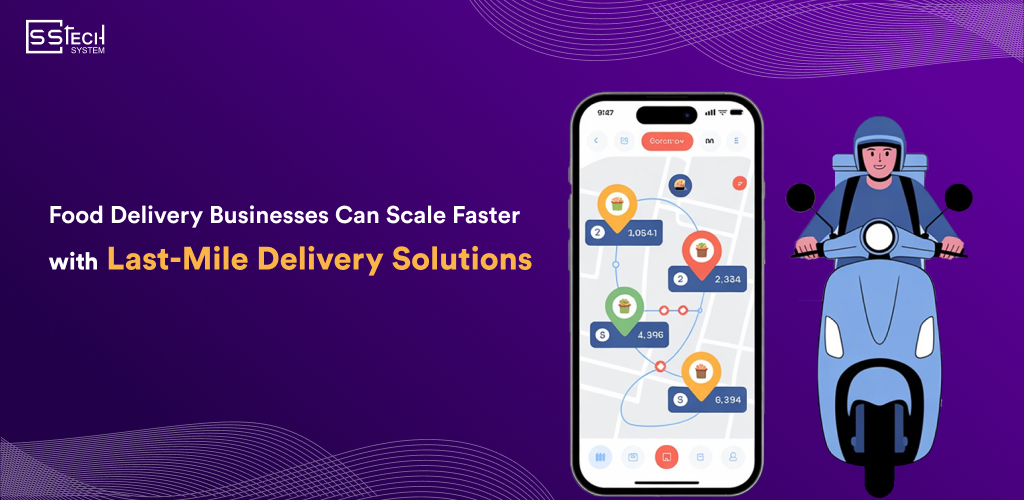
The last mile delivery solution for food delivery directly helps with these challenges, by automating dispatch, synchronizing delivery routes and enhancing operational visibility. Instead of perpetuating chaos, businesses can scale predictably and controllably.
This article is designed for:
- Food delivery companies that want to scale fast
- Aggregators managing high-order density
- Cloud kitchens expanding across locations
- Restaurant chains setting up their own delivery capabilities
It describes the way software development services allow quicker, eco-friendly scaling in an industry that is extremely competitive.
Understanding Last-Mile Delivery Solution for Food Delivery Ecosystem
Last-mile delivery in food logistics refers to the final stage where prepared meals are delivered from restaurants or kitchens to customers. This is the most time-critical and expensive stage of the delivery process.
When you compare food delivery, it is at least an order of magnitude more complicated than traditional eCommerce logistics. When compared to parcels, food orders have the aspect of being perishable, temperature-sensitive and expected to arrive in narrow time windows.
Some of the key challenges in food last-mile delivery are:
- Any minute fluctuation decreases food quality and medium-long levels affect customer satisfaction.
- Hot/cold temperature control requirements
- Lunch and dinner periods see peak-hour demand spikes.
- Delivery windows with very little wiggle room on the timing.
Inefficient last-mile operations are costing businesses:
- Higher order cancellations and refunds.
- Less favourable reviews and ratings from customers.
- High cost of delivery on wasted routes and down time.
A dedicated last-mile delivery solution can help food businesses overcome these problems. This helps with coordination, dispatching and delivery significantly faster and with more reliability. With food & beverage delivery solution landscape in competition, long-term sustainability is achievable only when retailers have learned the art of last-mile execution.

Why Food Delivery Businesses Struggle to Scale Without the Right Technology
When you have the best last-mile delivery solution for food business, your operational inefficiencies are more exposed as the order volume increases and you scale a food delivery business. When demand rises, manual processes and disparate systems start to grind delivery operations to a halt instead of enabling it to grow. Such challenges directly impact on service quality, the cost of delivery, and the ability to penetrate new markets.
Manual dispatching and rider allocation issues
Human judgment has a significant role in manual dispatching, but this breaks down during rush hours. Delays, unequal distribution of the workload, and unroute planning often accompany assigning riders without automation. This has a direct bearing on reduce food delivery delays and catering to customer requirements.
Fragmented systems for orders, drivers, and customers
Starting with the fact that a lot of businesses use different tools to take orders, manage drivers, and communicate with customers. This disconnection creates data islands and misalignment of teams. Hence, handling so many food delivery orders is cumbersome and prone to mistakes.
Limited visibility into delivery operations
In the absence of real-time dashboards, businesses do not have visibility into delivery status, driver performance or bottlenecks. This means that responding to issues like late deliveries and drop offs that were not completed can become really challenging. This not only limits visibility but also impacts long run planning & optimization.
Rising delivery costs and shrinking margins
This is causing much higher operational costs due to inefficient routing and idle driver time. These inefficiencies compound with the growth of order volumes, creating a vicious cycle where the food delivery supply chain becomes costlier and far more difficult to optimize. Even when revenue grows, margins fall.
Inability to manage multi-location or multi-city expansion
In order to scale across geographies you need central control & processes. Still, without an appropriate food delivery logistics software, keeping consistency across different locations and quality of service becomes challenging for businesses.
Limitations of basic food delivery platform
In fact, most basic food delivery platform is built for order placement with minimal shipping large operations. Advanced features that are needed from software at the point where food delivery business operations are scaling, they do not have.
Slow Adoption of AI and Operational Technology Limits Scalability
According to the Deloitte research on AI in restaurants, a strong majority of restaurant executives (82 percent) plan to increase investments in AI technologies to improve operations and customer experience, but actual adoption rates remain uneven and slower than expected. Many food service operators report being underprepared in terms of technology infrastructure, data capabilities, and readiness for broader AI implementation, which creates operational bottlenecks when trying to scale delivery services.
Role of Last-Mile Delivery Solutions in Accelerating Growth
This makes a modern last mile delivery solution for food delivery a key part of the puzzle for businesses who want to scale without adding operational headache. Businesses can gain proactive control over logistics operations and not react to delivery issues. This transformation will lead to less resistance, larger growth, and enhanced customer and profitability experiences across the board.
Automation vs manual coordination
Rather than rely on human beings to manage every aspect of a supply chain, automation replaces human coordination with intelligent workflows. For example, automated dispatching, route optimization for food delivery and driver assignment mitigate the scope for human error and operational delays. Teams can then take on more orders without having to hire more people.
Real-time decision-making using data
Another significant benefit of last-mile solutions is the ability to make decisions in real time. With real-time data, businesses are able to track the progress of delivery processes, spot bottlenecks and respond to unforeseen breakdowns in real-time. The real-time food delivery tracking also brings transparency not only for the customers but also for internal teams.
Managing hundreds or thousands of daily orders efficiently
Scalable order dispatch management software typically handle hundreds or thousands of daily orders. They such as strike workloads, optimize routes on the fly and make sure that deliveries are timely even at the peak hours. This makes it easier to facilitate improvement in food delivery efficiency while providing the desired service quality.
Supporting different delivery models:
The Fleet Management Software Development is the operational backbone of scalable food delivery businesses. It combines all the orders, drivers, routes, and customers in one suite. It also allows teams to work together in a streamlined way whilst ensuring consistency over massive volumes.
- Own fleet: This is where firms use their own drivers, but the vehicles are deployed via fleet management software, giving them more control.
- Hybrid fleet: It combines the in-house drivers as well as third-party partners for agility and versatility in spikes of demand.
- Third Party Courier Integrations: Flexibility to Expand via Courier Delivery App Development or On-Demand Delivery App Development capabilities.
The last mile delivery software for food delivery are crucial to supporting these models, providing the flexibility required for long-term scale within the competitive food delivery platform ecosystem.
Key Capabilities Food Delivery Businesses Need to Scale Faster

At this stage, food delivery players must solidify their last-mile capabilities with the right technology if they are to scale successfully in this competitive market. Unfortunately, the intricacies of order volume, delivery density, and customer expectations that come with being better-known are something that simply cannot be managed with manual processes. This necessitates a food delivery automation software, visibility, and performance controls to support scalable growth while maintaining service standards.
Smart Order Allocation & Dispatching
Auto-allocation of an incoming order-wise ensures that every order is allocated to the right rider basis distance, availability and more. The extended network ability minimizes manual action and helps businesses to streamline more food deliveries without worrying about managing a spike in volume.
Automated dispatching ensures to minimize idling time by evenly distributing the rider workload amongst them, thereby minimizing food delivery delay that occurs during peak lunch and dinner hours. This directly affects customer satisfaction and repeat orders, along with improving delivery reliability.
Route Optimization for Faster Deliveries
In food delivery service, intelligent routing is one of those key area that can help to maintain food freshness and meet shorted delivery windows. The logistics and transportation software development services can help you to take best routes and enable drivers to take the quickest and fastest routes, decreasing transit time and providing better overall delivery performance.
The advanced route optimization software for logistics business helps to avoid traffic congestion, road closures, and delivery overlap that slow down the operations cycle. Even more, with dynamic route adjustments, businesses can reduce fuel consumption, improve rider productivity, and increase the efficiency of food deliveries at a larger scale.
Real-Time Delivery Visibility
Real-time delivery visibility enables customers and internal teams to monitor orders in each phase in the delivery lifecycle. By giving customers up-to-date information about their order status and the estimated date of arrival, live order tracking enhances transparency and trust.
The real-time delivery tracking solution helps in solving issues proactively. In this way, teams can instantly find a solution to any of the delays taking place, dispatch the riders, and update the changes in real-time, which ultimately wipes out the customer complaints and cancellations.
Fleet & Rider Performance Management
Managing fleet and rider performance effectively is also key for businesses to deliver service quality as they scale up. The actionable insights gained through tracking rider efficiency, on-time delivery rates, and the rate of success helps the business optimize their delivery operations.
Fleet management software helps companies address rider availability across zones and shifts. To do so, it guarantees enough coverage when demand spikes and allows you to scale it across multiple locations or cities.
How Food Delivery Management Software Improves Operational Efficiency
Food delivery businesses function in a fast-paced environment where profitability hinges on speed, accuracy and orchestration. When the order volumes go up, managing deliveries through disconnected tools results in chaos, delays, and rising operational costs. An ideal food delivery management software platform simplifies operations by organizing the entire delivery process, providing transparency, and automating the workflows.
Centralized dashboard for end-to-end delivery operations
With a centralized dashboard in restaurant delivery software, businesses can have a single view of orders, drivers, routes, and delivery status all at the same time, in real-time. This allows teams to not have to switch between systems and respond to issues in real time.
Integration with POS, restaurant systems, and food ordering platforms
POS systems and food ordering platforms integrate seamlessly with your delivery workflows, with orders flowing automatically into your delivery systems. Fewer manual data entry errors, faster kitchen to customer order processing.
Managing multiple restaurants, brands, or cloud kitchens
Food delivery management software allows you to have centralized management from the same place for the different outlets/brands or the cloud kitchen. It simplifies standardization of delivery processes to enable rapid business growth.
Data-driven insights for continuous improvement
Using built-in analytics, it provides you detailed information on delivery times, rider performance, order success percentage, etc. This helps businesses identify inefficiencies and improve food delivery efficiency continuously.
Reducing operational chaos at scale
With food delivery management software in place, you need not deal with dispatch and tracking on phones or deal with misplaced orders, as it replaces all chaos with control by automating dispatch, tracking, and communication. With this structured method, teams can scale functions confidently, and continue to deliver a high-quality service.
Optimizing Costs and Margins with Intelligent Delivery Systems
When food delivery companies grow larger, even if the order volume is huge, controlling cost becomes as equally important. Keeping the service levels high while saving costs is where intelligent delivery systems come in. That equilibrium is essential for long-term profitability in competitive markets.
Reducing failed and delayed deliveries
By decreasing the number of failed and delayed deliveries, you greatly decrease customer refund rates and strain on customer support. Real-time tracking of food delivery and automated workflows help ensure that orders reach their destination on time and in clean condition.
Lowering fuel and operational expenses
Optimize routing and delivery methods to reduce fuel and operational costs. Delivery Optimization Software prevents wasting time travelling, waiting or going in the wrong direction which can drive up the cost.
Optimizing rider utilization
Best utilization of riders helps delivery partners to not be overworked or underworked. Adjusted rides help you get the most out of your teams, and you will not have to onboard new riders before the time comes.
Minimizing dependency on expensive third-party delivery partners
Intelligent systems also keep your dependency on costly third-party delivery partners to a minimum. Businesses with both in-house or hybrid fleets benefit from better margin control as growing order sizes become less of a burden to cost by gaining efficiencies.
Using food delivery optimization software to balance speed and cost
In short, with the proper software to create a delivery strategy, quick but cost-effective delivery becomes a reality. It leads to better margins without ruining the customer experience.
Improving Customer Experience to Promote Repeat Orders
Customer experience in food delivery is necessarily linked to last mile performance. Trust is built through fast, reliable deliveries and eroded by delays and poor communication which drive churn. To maximise repeat orders, and ultimately, long-term value, it is, therefore, crucial to optimise your delivery operations.
Faster and more predictable delivery times
More secure and predictable delivery times enhance customer satisfaction and help to prevent cancellations of orders. Smart dispatching and routing guarantee food delivery within the time slots guaranteed to customers.
Real-time tracking and delivery notifications
Customers are updated about their delivery every step of the way with real-time tracking and delivery notifications. It minimizes anxiety and enhances the end-to-end ordering journey.
Accurate ETAs and transparency
A realistic time to arrival, in turn, allows for setting near perfect expectations while avoiding frustration. This also increases trust in the food delivery platform as customers know exactly when their order will arrive.
How delivery experience influences app ratings and brand trust
How you deliver will directly translate to the ratings and reviews you get on your app, and to the trust you build with your brand. Regular successful delivery creates a good perception of brand and better visibility in app stores.
Connecting last-mile performance to customer lifetime value
When businesses link last-mile performance to customer lifetime value, it becomes clear how operational efficiency compounds to drive revenue growth. This leads to repeat usage, loyalty, and long-term profitability driven by reliable delivery experiences.
Custom Food Delivery App Development vs Off-the-Shelf Solutions
The best option between a custom food delivery app development and an off-the-shelf delivery platform, is one of the most crucial decisions to make for food delivery businesses intending to grow. Turnkey tools give you quick GTM advantage but tend to fall flat when operational complexity increases. It is critical to choose a technology that is aligned with long-term growth plans to prevent an expensive pattern of rework, inefficiencies, and unforeseen costs down the road.
Here are the key differences between the custom food delivery app development and off-the-shelf solutions.
| Evaluation Criteria | Custom Food Delivery App Development | Off-the-Shelf Food Delivery Solutions |
|---|---|---|
| Business Fit | Built specifically around your business model, workflows, and growth plans | Designed for generic use cases with limited alignment to unique needs |
| Scalability | Highly scalable; architecture can support multi-city, multi-vendor, and high-order volumes | Scalability is restricted by platform limitations and pricing tiers |
| Customization & Flexibility | Full control over features, UI/UX, integrations, and future enhancements | Minimal customization; changes depend on vendor roadmap |
| Technology Stack | Choice of modern, future-ready technologies including AI, APIs, and microservices | Fixed technology stack defined by the provider |
| AI & Automation Capabilities | Can embed AI for demand forecasting, route optimization, and smart dispatch | AI features are limited or available only as premium add-ons |
| Integration Capabilities | Seamless integration with POS, ERP, CRM, payment gateways, and logistics tools | Limited integrations; may require workarounds or third-party plugins |
| Operational Control | Complete ownership and control over operations, data, and workflows | Vendor-controlled environment with restricted operational visibility |
| Data Ownership & Security | Full ownership of customer, order, and analytics data | Data often stored and managed by the platform provider |
| Branding & Customer Experience | Fully branded experience aligned with your brand identity | Shared or template-based branding with limited differentiation |
| Time to Market | Longer initial development time | Faster deployment and quicker launch |
| Upfront Cost | Higher initial investment | Lower initial cost |
| Long-Term Cost Efficiency | More cost-effective at scale with no per-order or commission fees | Ongoing subscription, transaction fees, and scaling costs |
| Competitive Advantage | Strong differentiation through unique features and optimized workflows | Difficult to stand out using widely available tools |
| Best Suited For | Growing and enterprise-level food delivery businesses focused on long-term scale | Startups or small businesses testing the market quickly |
Drawbacks of Readymade food delivery app solution
Limited customization and rigid workflows
Generic platforms are designed for common use cases with low flexibility. Companies have to change how they operate to the software. They cannot configure the workflows then the delivery model.
Scalability issues when volume of orders increases
High-order density, multi-city operations, or hybrid fleet models are difficult to handle with many off-the-shelf tools. During growth, performance problems and lack of features usually show their ugly heads.
Lack of brand differentiation
If your competition is using the same generic apps, they provide the same user experience. It complicates the process for businesses, hinders them to have a different brand experience or build a uniquely identifiable one.
Benefits of Customized Food Delivery App Development
Tailored workflows
By leveraging delivery driver app for food business, businesses can build delivery workflows that align with their specific operational requirements. It encompasses custom dispatch logic, rider rules, and order prioritization.
Brand differentiation
With a custom app, you have complete control over each of these factors, including UI and UX and customer touchpoints. Doing so helps to reinforce their brand identity and provide a higher quality customer experience.
Scalability and flexibility
Business growth is another aspect that custom solutions solve well. You are not limited by your platform, you can add new features, new locations, new delivery models, and new integrations.
Build vs Buy: Making the Right Choice
When speed to market is paramount but scale and operational complexity are limited, businesses should consider Buy. When delivery operations are at the core and differentiation does matter, building becomes the better path.
By aligning the delivery technology with growth plans, the food delivery app solution can facilitate expansion rather than imposing restrictions. Custom development, therefore, is a strategic investment as opposed to an expense for fast-scaling food delivery businesses. To build scalable and efficient delivery systems, you must carefully choose a Logistics App Development Company with proven industry expertise and a strong technology foundation.
Integrating Last-Mile Delivery with a Complete Food Delivery Platform
Last-mile operations cannot exist apart from food delivery companies that want to scale. A completely integrated food delivery platform integrates ordering, payments, dispatch, delivery, and analytics into a single ecosystem. No operational silos with this integration for quick and effective delivery execution throughout the customer journey.
Unified ecosystem: ordering, payments, dispatch, delivery, analytics
This unified ecosystem allows data to flow seamlessly from order placement to delivery. This minimizes manual handovers, enhances accuracy, and enables teams to operate from a single front-end.
Benefits of seamless integration between:
When the food ordering and delivery app is fully integrated with logistics workflows, orders are dispatched immediately. This reduces waiting time on processing and enhances order fulfillment rate.
Similar to other AI-driven technologies, integrated logistics modules provide intelligent dispatching, routing, and real-time tracking in one platform. It provides better coordination between the operations teams and the delivery partners.
Supporting multi-vendor and multi-location operations
If you are managing several restaurants, brands or locations, integrated platforms help you become centralised. This both guarantees uniformity in delivery quality and enables fast-paced expansion into new geographies.
Role of APIs and modular architecture
They enable businesses to add or replace features without disrupting operations. This level of flexibility enables long-term scalability and changing business models.
Future-Ready Scaling with AI-Driven Last-Mile Delivery Solutions
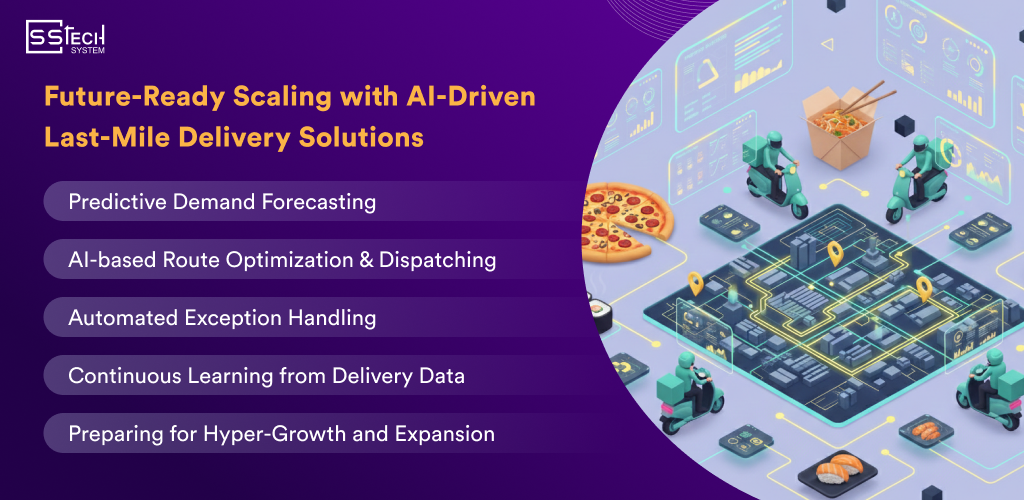
Learn how to scale food delivery business more intelligently and work with data as competition heats up between businesses who are looking for similar growth. With AI-driven last-mile delivery solutions, they can make decisions in a proactive manner rather than in the reactive problem-solving mode. They prepare businesses for hyper-growth and ensure quality in services delivery.
Predictive demand forecasting
It uses AI to analyze historical order patterns and predict demand across locations and time slots. It enables businesses to plan rider availability up front, preventing last minute delivery bottlenecks.
AI-based route optimization and dispatching
Real time order assignment and route optimization via intelligent algorithms This helps minimize delivery time, fuel consumption, and operational expenditure.
Automated exception handling
These AI systems automatically track delays, route deviations, or even deliveries that have failed. This allows automatic rapid corrective action (without manual intervention).
Continuous learning from delivery data
Through machine learning, these models get better in time through delivery performance metrics and outcomes. Imperative to continuously optimize your delivery workflows.
Preparing for hyper-growth and expansion
To ensure scalability advanced solutions are built on Logistics ai app development and Logistics software development. The best Logistics AI Development Company enables you to provide the technological backbone required to ensure rapid scalability into new markets.
Who Should Invest in Last-Mile Delivery Solutions?
Last-mile delivery solutions are no longer restricted to enterprises only. Modern delivery technology can bring benefits for businesses across the food and hyperlocal ecosystem. By investing early, this can ensure that future operations are future-proofed that can help support growth sustainably. Advanced last-mile delivery solutions help organizations Remove Bottlenecks in Logistic Operations by automating workflows, improving real-time visibility, and enabling data-driven decision-making.
Food delivery startups
Scalable infrastructure, supporting endless growth, minus the operational mess, via startups. Investing early helps prevent expensive loss of time needed to rework the system.
Restaurant chains and QSR brands
Chains depend on centralized leadership and standardization across locations. The mobile app for restaurants makes sure that the service levels are maintained at scale.
Cloud kitchens and dark stores
With a high density of orders but short turnaround times, it makes delivery efficiency critical. Scalable cloud kitchen delivery software provide stability during peak traffic.
Grocery and hyperlocal food platforms
The Grocery app development handles the high-frequency, last mile deliveries. On-demand delivery app development and Grocery app development solutions offer unlimited scalability options.
Conclusion:
Despite the introduction of new selections and aggressive acquisition of customers or onboarding of restaurants, scaling a food delivery business in this market is anything but a cakewalk. The delivery at scale is where the sustainability of growth or lack of it all hinges. In the last mile, costs are stacked, customers are gained or lost, and brand reputation is either made or broken, Choosing the right technology partner is critical to long-term success, so businesses should take time to find the best software development agency that understands their domain, scalability needs, and growth goals.
An advantage, especially in specific industries, that companies get when they have the structure in place to drive their delivery operations through technology. A contemporary last mile delivery solution tailored for food delivery provides automation, real-time visibility, intelligent routing, and performance optimisation, all essential to manage escalating order volumes without operational mayhem. Businesses have proactive control over their delivery ecosystem instead of reacting to delays and inefficiencies.
Cloud kitchens, hyperlocal food delivery platforms and multi-city penetration are just few examples in this trajectory and hence, conquering the last mile has become a hygiene factor for growth. Firms which align their delivery well with long-term growth strategies tend to scale more easily, defend margins and achieve resilient quality delivery. Growth never fails at the storefront in delivery; it fails on the street to the consumer. When you choose the right software development partner that understands logistics workflows, you ensure long-term operational efficiency and faster time to market.

Frequently Asked Questions
A food delivery last mile delivery solution is a technology solution that handles the last leg of food order completion, from pickup to delivery. It is all about dispatching, route planning, tracking in real-time, and driver management to ensure quick and accurate deliveries. These solutions are meant for classifying time-sensitive & high-frequency food orders as efficiently as possible.
Food delivery management system is all in one place software that includes orders, drivers, routes, and analytics. This minimizes manual coordination, increases visibility and allows automation of delivery workflows. As order volume increases, the software keeps its efficiency without adding overhead to operation complexity.
Last-mile technology is the solution to the barrier of delayed deliveries, unnecessary routing, inadequate rider capacity utilization, and absence of live visibility. This assists in ameliorating the food delivery problem, peak-hour traffic build-up, and high delivery costs. All of these contribute directly to customer satisfaction and of course profits.
This asset becomes a business investment when delivery volumes begin to rise or companies plan to expand into new markets. Getting ahead of the curve prevents scalability challenges, operational roadblocks, and margin shrink. Cloud kitchens, aggregators and multi-location restaurant brands can particularly benefit from delivery optimization software.
If the priority of your business is on scalability, flexibility and brand differentiation, then custom food delivery app development is the perfect choice. Packaged tools are suitable for initial operations, but as workflows become more intricate and the scale of operations increases, bespoke solutions offer far better support. Depending on the business size, goals of growth, and level of operational complexity, the right choice can vary.
Related Article